Quantum computers are fragile machines. Get a qubit slightly wrong, and the whole calculation collapses. So scientists have spent years trying to build perfect quantum systems—until now.
Researchers at Ohio State and University of Chicago just published a counterintuitive finding: the flaws in crystals might actually be the solution. Not a workaround. Not a compromise. The thing that makes quantum computers finally work at scale.
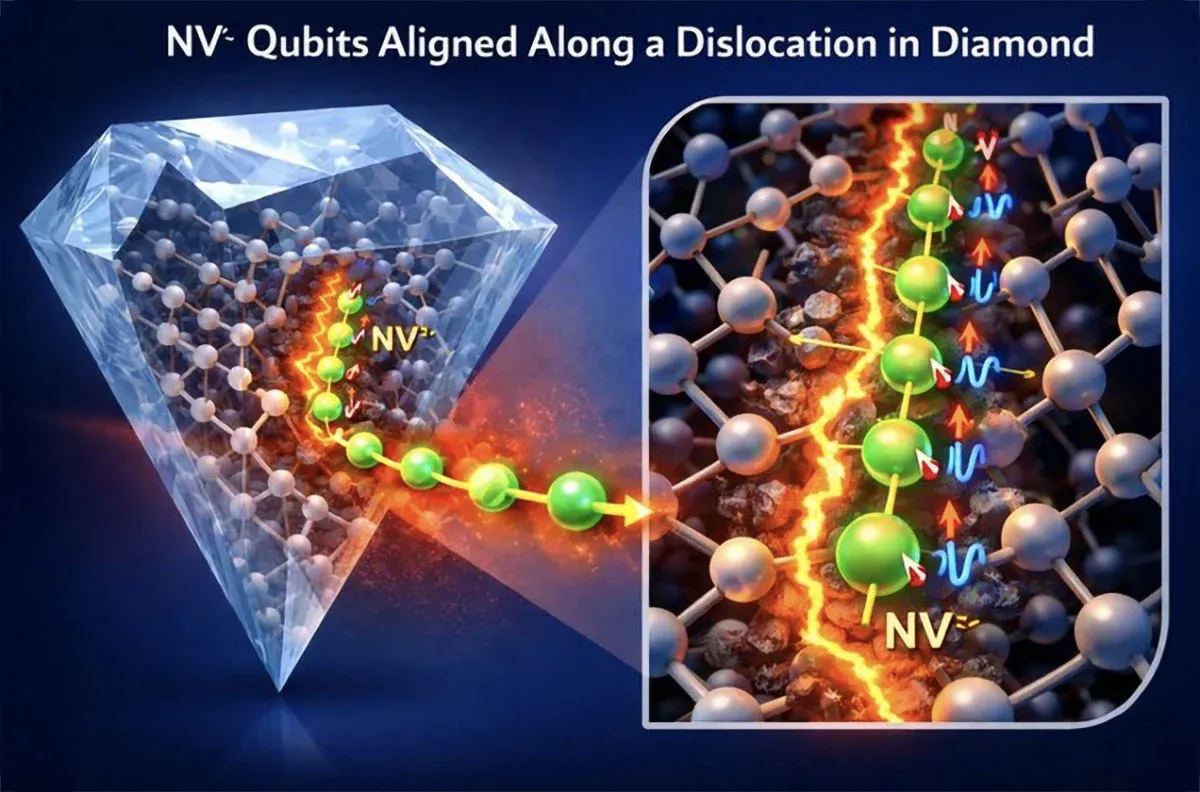
The insight came from studying nitrogen-vacancy centers—tiny atomic defects in diamond that act as qubits. Using supercomputer simulations, the team discovered that these qubits naturally cluster around dislocations, which are line-shaped imperfections that run through the crystal like invisible highways. Instead of degrading performance, these defects create a stable scaffold that keeps qubits organized and their quantum properties intact.
We're a new kind of news feed.
Regular news is designed to drain you. We're a non-profit built to restore you. Every story we publish is scored for impact, progress, and hope.
Start Your News Detox"Because dislocations form quasi-one-dimensional structures extending through a crystal, they provide a natural scaffold for arranging qubits into ordered arrays," explained Cunzhi Zhang, a staff scientist at UChicago who led the computational work.
The Breakthrough
The team ran massive first-principles simulations—the kind that require GPU-accelerated supercomputers—to model how qubits behave near these dislocations. What they found was surprising: not only do the qubits stay stable near the defects, some actually perform better than they do in perfect diamond.
The reason has to do with symmetry breaking. Near a dislocation, the crystal structure creates what physicists call "clock transitions"—special quantum states that shield qubits from environmental magnetic noise, the main thing that scrambles quantum information. It's like finding that the bumpy road actually protects your cargo better than the highway.
The researchers also predicted specific optical and magnetic signatures that experimentalists can now look for, turning theory into something testable. "While not all defect arrangements are suitable for quantum operations, the results show that a substantial fraction meet the requirements for qubit functionality," noted Yu Jin, who worked on the study as a graduate student.
Why This Matters
Quantum computing has been stuck on a scaling problem. You can build a handful of qubits in the lab. Building thousands or millions is another story entirely—each additional qubit introduces new sources of error and instability. If dislocations can genuinely serve as natural organizing structures for qubits, it shifts the entire engineering problem. Instead of fighting the material's imperfections, you'd be leveraging them.
The findings suggest a new design paradigm: quantum devices built not around pristine materials, but around the defects we've always tried to eliminate. The approach could work not just in diamond, but potentially in other materials too.
The next step is experimental. Physicists now have detailed predictions to test—specific configurations to look for, signatures to measure. If the theory holds in the lab, it could accelerate the timeline for practical quantum computers by years.