Physicists at CERN's Large Hadron Collider (LHC) have found new clues that some particle decays might not happen as the Standard Model predicts. This could be a strong hint of "new physics" beyond what we currently understand.
The Standard Model has been the main theory in particle physics for 50 years. These new findings suggest that certain tiny particles might behave in ways that don't match the model's predictions.
Uncovering New Physics at the LHC
Fundamental particles are the smallest known units of matter. They cannot be broken down further. Four basic forces control how they interact: gravity, electromagnetism, the weak force, and the strong force.
We're a new kind of news feed.
Regular news is designed to drain you. We're a non-profit built to restore you. Every story we publish is scored for impact, progress, and hope.
Start Your News DetoxThe LHC is a huge particle accelerator. It sits in a 27-kilometer-long tunnel under the border between France and Switzerland. Its main job is to test the Standard Model and find any areas where the theory might not hold up.
The Standard Model is the best explanation we have for fundamental particles and forces. However, it is known to be incomplete. For example, it doesn't include gravity. It also can't explain dark matter, which is an invisible form of matter thought to make up about 25% of the universe.
Inside the LHC, beams of protons collide. Scientists look for hints of undiscovered physics in these collisions. The new results come from LHCb, an experiment at the LHC that analyzes these collisions.
The findings come from studying how sub-atomic particles called B mesons decay, or transform. Researchers found that the specific way these B mesons decay doesn't match the Standard Model's predictions.
A Theory Under Strain
The Standard Model is based on quantum mechanics and Einstein's special relativity. Physicists test the theory by comparing measurements from places like the LHC with the model's predictions.
Even though scientists know the Standard Model is incomplete, they haven't found any cracks in it during over 50 years of testing. This might be changing now.
The new measurement, published in Physical Review Letters, shows a difference of four standard deviations from what the Standard Model expects.
This means there's only a one in 16,000 chance that such an extreme random fluctuation would occur if the Standard Model were correct. This isn't quite the "gold standard" of five standard deviations (a one in 1.7 million chance), but the evidence is growing.
Another LHC experiment, CMS, published similar results earlier in 2025. While the CMS results are not as precise as LHCb's, they agree, which strengthens the case. These new findings come from studying a process called an electroweak penguin decay.
Rare Decays Offer Clues
The term "penguin" refers to a specific type of decay for short-lived particles. In this study, scientists looked at how a B meson decays into four other particles: a kaon, a pion, and two muons.
This "penguin decay" is very rare in the Standard Model. Only one in a million B mesons decays this way. Researchers carefully analyzed the angles and energies of the particles produced in the decay. They found that their measurements of these quantities don't agree with the Standard Model's predictions.
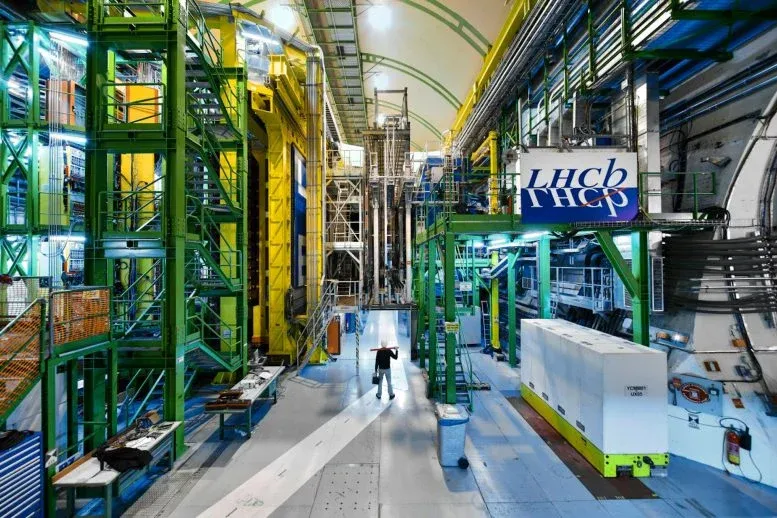
Studying these rare decays is a main goal of the LHCb experiment. Penguin processes are very sensitive to the effects of potentially heavy new particles that the LHC cannot create directly. These particles might still have a measurable influence on these decays. This kind of indirect observation has happened before. For example, radioactivity was discovered 80 years before the particles responsible for it (W bosons) were seen directly.
Future Data Will Confirm
Studying rare processes allows scientists to explore parts of nature that might otherwise only be accessible with particle colliders planned for the 2070s. Many new theories could explain these findings. Some involve new particles called "leptoquarks," which combine two types of matter: "leptons" and "quarks." Other theories suggest heavier versions of particles already in the Standard Model. These new results help narrow down what these models might look like and will guide future searches.
Despite the excitement, some theoretical questions remain. These prevent scientists from definitively claiming that physics beyond the Standard Model has been found. One major question involves "charming penguins," which are processes within the Standard Model that are very hard to predict. Recent estimates suggest their effects are not large enough to explain the new data.
New data already collected will help confirm the situation in the coming years. The current study looked at about 650 billion B meson decays recorded between 2011 and 2018. Since then, the LHCb experiment has recorded three times as many B mesons.
Further upgrades to the LHC are planned for the 2030s. These will collect a dataset 15 times larger. This final step could lead to definitive claims and potentially unlock a new understanding of how the universe works at its most basic level.
Deep Dive & References
A comprehensive analysis of the 𝐵0→𝐾*0𝜇+𝜇−decay - arXiv, 2025