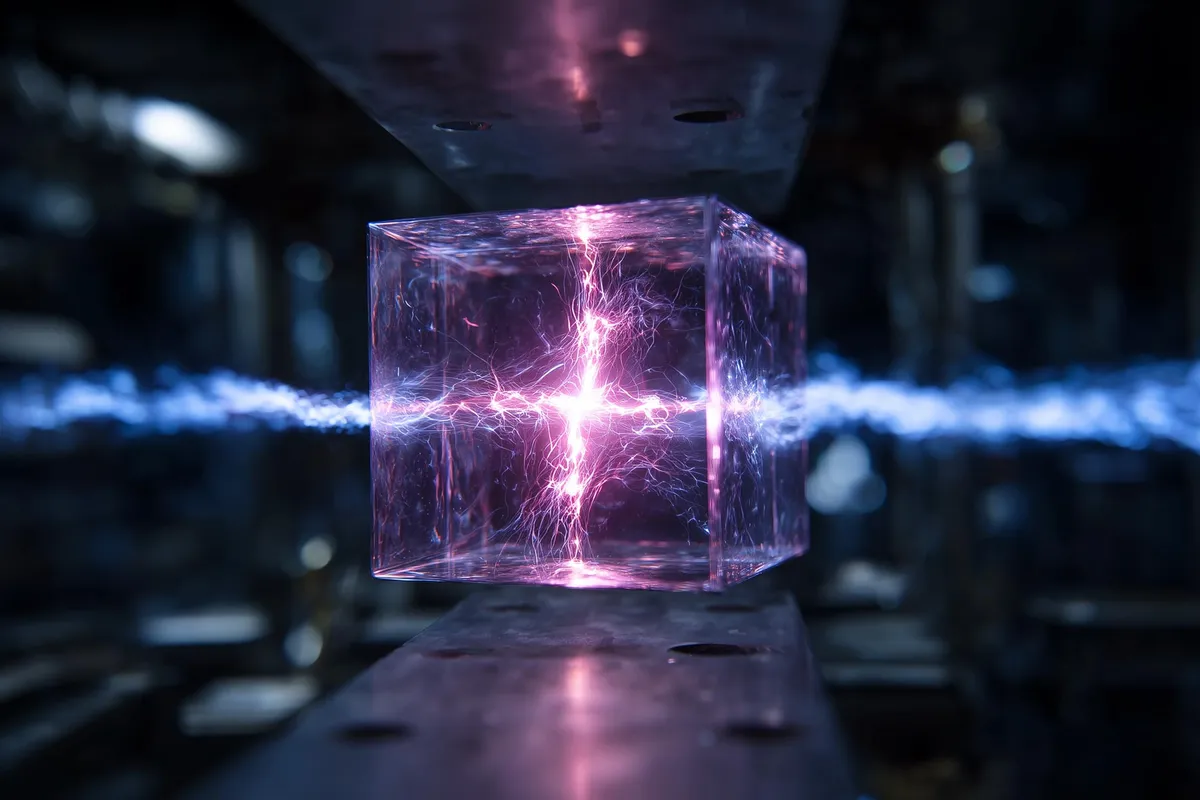
Researchers at Cal Poly have found a way to create unusual quantum states of matter. They do this by changing magnetic fields over time. These new states don't naturally exist in regular materials.
This discovery could lead to more reliable quantum technologies. It might also help build powerful new computing systems in the future.
Creating New Quantum States
The study, led by Cal Poly Physics Lecturer Ian Powell, looked at how matter behaves at very small scales. This includes atoms, electrons, and photons. The team focused on what happens when magnetic fields change over time. These shifting fields can cause strange quantum behavior.
We're a new kind of news feed.
Regular news is designed to drain you. We're a non-profit built to restore you. Every story we publish is scored for impact, progress, and hope.
Start Your News DetoxPowell and student researcher Louis Buchalter published their findings in Physical Review B. Their work shows that carefully changing magnetic fields can create quantum states that don't exist in materials that stay the same over time.
Powell explained that this is a step forward in understanding how controlling things over time can create new forms of quantum matter. He noted that useful quantum properties can depend on how a material is "driven" over time, not just what it is. In their study, changing a magnetic field regularly created quantum phases that have no normal, unchanging equivalent.
Toward More Stable Quantum Technology
The researchers found that timing magnetic fields precisely can create new quantum behaviors. These behaviors might be more stable and less likely to be disrupted. A big problem in quantum technology is "noise," which are tiny flaws that mess with quantum systems and cause errors.
Powell said the detailed physics can be complex. However, the main idea points to new ways to create unusual quantum states in controlled systems. This includes experiments with super-cold atoms.
He added that the study's direct link is to quantum computing and simulation. Any future impact on areas like medicine, finance, or manufacturing would likely be indirect. It would come from helping to develop better quantum technologies in the long run.
The next steps involve testing these ideas in experiments. They also need to connect them to real quantum devices.
Hidden Patterns in Quantum Matter
Besides creating exotic quantum phases, the research found a mathematical pattern. This pattern is similar to those seen in more complex, higher-dimensional quantum systems. This suggests that simpler systems could offer a new way to study advanced quantum physics.
The team also mapped out the system's topological phase diagram. This map shows distinct and stable quantum phases of matter based on their fixed properties.
Quantum mechanics allows advanced computers to process information much faster than traditional ones. It can also run huge simulations and analyze much larger amounts of data.
Magnetic fields are key tools for scientists to control and measure qubits. Qubits are the basic units of information in quantum technology. They are like the 0s and 1s used in today's regular computers.
Student's Research Experience
Buchalter said working on the project gave him direct experience with scientific research. He learned a lot about how to do research and share new findings with other scientists.
He noted that research is rarely straightforward. It often needs persistence and creative problem-solving. Buchalter believes their results show how powerful "Floquet engineering" can be. This method creates quantum systems with properties that can be highly tuned. It opens the door for more research into periodically driven quantum matter and its uses.
Buchalter plans to study materials science and engineering at the University of Washington. He wants to continue experimental research on quantum matter. He is also thinking about a career at a national lab, developing quantum devices.
He became fascinated with quantum materials through this experience. He is very interested in continuing to study them and help develop their uses in electronic and light-based devices.
Deep Dive & References
Flux-switching Floquet engineering - Physical Review B, 2026