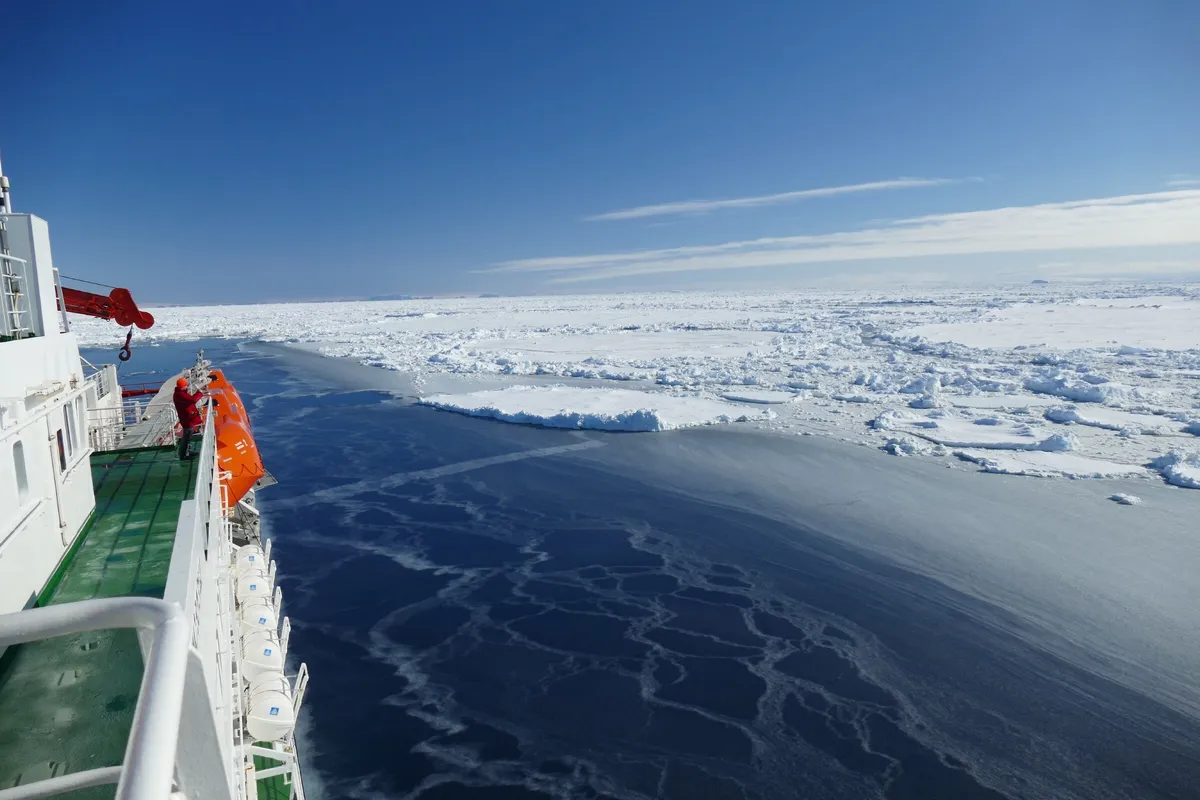
The research vessel Polarstern is heading to one of Earth's least understood regions this weekend—the northwestern Weddell Sea—to answer a question that's been puzzling climate scientists: why is Antarctic sea ice suddenly vanishing.
For decades, Antarctic sea ice was the stable sibling to the Arctic's dramatic melt. While Arctic summer ice has shrunk by around 12% per decade, Antarctica's ice extent barely budged. Then, around 2017, something shifted. Summer sea ice in the northwestern Weddell Sea began declining sharply, likely driven by warmer surface water. No one quite knows why, or what it means for the global climate system.
"The aim of SWOS is to investigate why sea ice in Antarctica has declined so sharply in recent years and how this is impacting the ecosystem," says Prof. Christian Haas from the Alfred Wegener Institute, who's leading the Summer Weddell Sea Outflow Study (SWOS) expedition.
We're a new kind of news feed.
Regular news is designed to drain you. We're a non-profit built to restore you. Every story we publish is scored for impact, progress, and hope.
Start Your News DetoxWhat makes this expedition urgent is that the Weddell Sea remains one of the planet's least explored regions. Satellites can track ice from space, but they can't tell you what's happening in the water below, in the ice itself, or on the seabed. Haas, who first explored this region over 30 years ago, is returning to see how profoundly it has changed in just seven years.
A Rare Window into a Changing World
The team will spend weeks collecting observations that satellites simply can't provide: sea ice thickness and snow properties, water temperature and chemistry, nutrient flows, and the biological communities living in and beneath the ice. They'll measure how carbon moves through this ecosystem—crucial data for understanding whether Antarctic changes might trigger feedback loops that accelerate warming elsewhere.
There's a wrinkle. This year, the western Weddell Sea has accumulated an unusually large amount of ice, possibly a normal fluctuation. The expedition team may need to adjust their route and research questions on the fly. "It is currently unclear whether we will be able to reach the vicinity of the Larsen C Ice Shelf as planned," says Dr. Ilka Peeken, a marine biologist and co-leader. But she frames this not as a setback—it's a chance to study conditions that have rarely, if ever, been directly observed.
The data collected will feed into satellite models and Earth system models that predict how our planet will respond to warming. Without in-situ observations—actual measurements from the ice, water, and seabed—those models remain incomplete guesses.
When Polarstern returns across the Atlantic, the voyage will double as a training mission for students. By then, the team will have a clearer picture of what's happening in one of Antarctica's most consequential regions—and why the ice that was once thought immovable is beginning to shift.