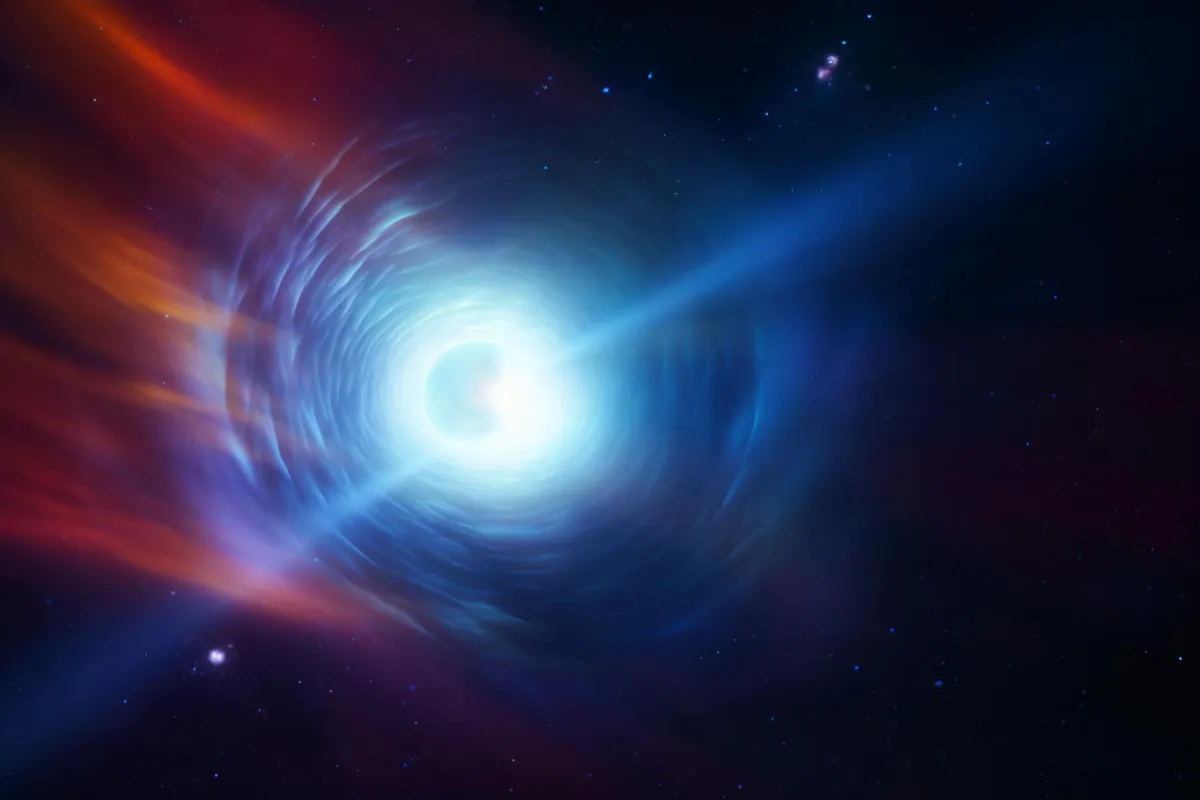
A pulsar's gentle flicker is revealing how space bends and delays the signals we receive from distant stars—and that knowledge is quietly reshaping how we search for life beyond Earth.
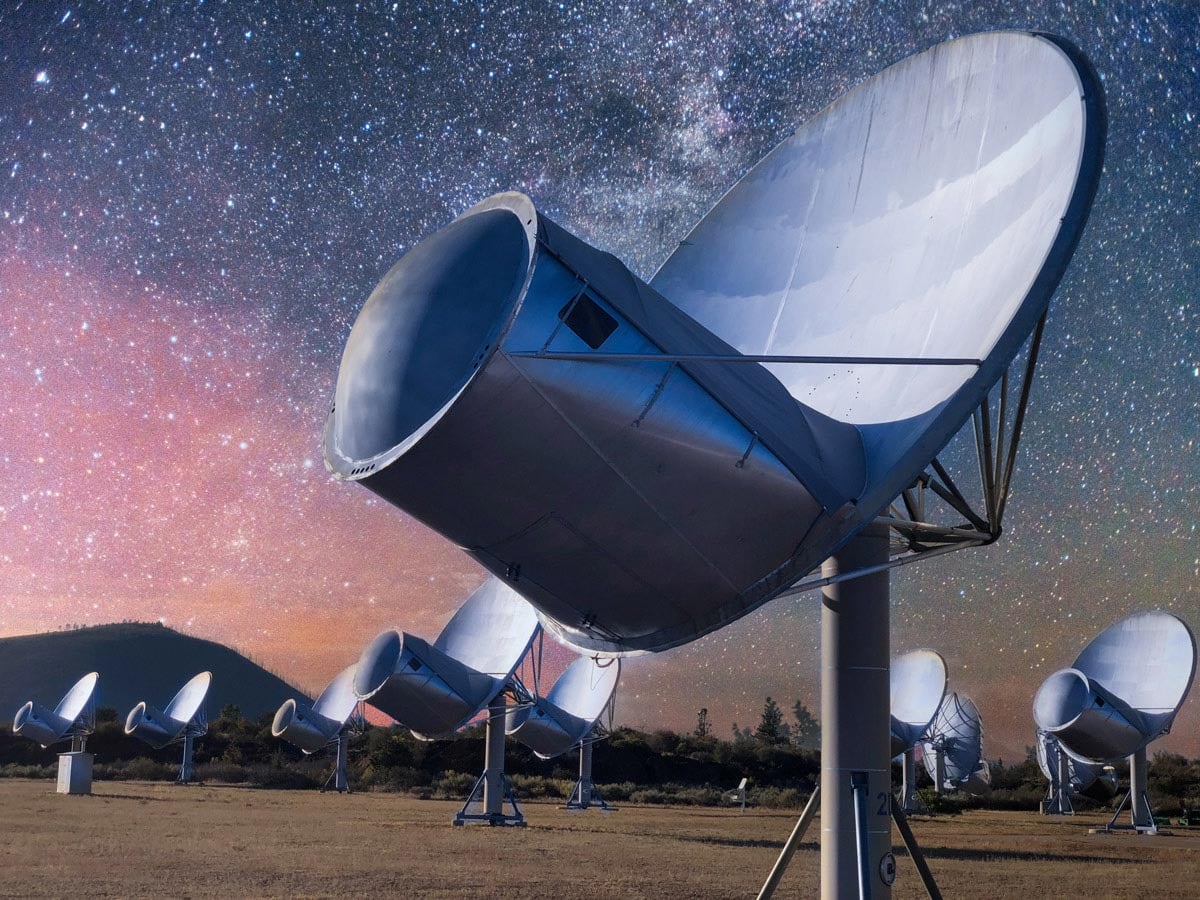
For about ten months, scientists at the SETI Institute trained the Allen Telescope Array on a pulsar called PSR J0332+5434, watching how its radio signal appears to "twinkle" as it travels through the gas between the pulsar and Earth. What they found was a pattern: the twinkling wasn't random. It shifted in predictable ways—sometimes over days, sometimes over months, with an overall rhythm that repeated roughly every 200 days.
This matters because pulsars are among the most reliable clocks in the universe. They're the dense, rapidly spinning remains of massive stars that ended in explosions. As they rotate, they send out radio pulses with extraordinary regularity—so reliable that astronomers can measure the exact arrival time of each pulse to within nanoseconds (billionths of a second). That precision is what makes pulsars useful for detecting gravitational waves and for other cutting-edge astronomy.
We're a new kind of news feed.
Regular news is designed to drain you. We're a non-profit built to restore you. Every story we publish is scored for impact, progress, and hope.
Start Your News DetoxBut space gets in the way. Clouds of electrons between the pulsar and Earth scatter the radio waves, spreading them out and slightly delaying when each pulse arrives. Those delays can be tiny—sometimes only tens of nanoseconds—but they add up. Learning to measure and correct these shifting delays is essential if you want to keep pulsar timing as accurate as it needs to be.
The hidden cycles in cosmic noise
The SETI Institute team observed the pulsar nearly every day for about 300 days, measuring how the scintillation pattern—the size of the bright and dim patches across different radio frequencies—changed over time. They discovered that the strength of this twinkling followed cycles ranging from days to months, layered over a longer rhythm of about 200 days. By tracking these patterns, they could figure out exactly how much delay the interstellar gas was introducing, then apply that correction to future observations.
They also developed a new technique for measuring how scintillation increases with radio frequency, taking advantage of the Allen Telescope Array's unusually wide frequency coverage (900 to 1956 MHz). This approach is more reliable than previous methods and could be used to study other pulsars.
The implications reach beyond pulsar science. Every radio signal passing through space experiences some scintillation. For SETI researchers specifically, noticeable twinkling can actually be useful—it helps separate signals created by human technology from those that might originate beyond our solar system. "Pulsars are wonderful tools that can teach us much about the universe and our own stellar neighborhood," said Grayce Brown, the SETI Institute intern who led the project. "Results like these help not just pulsar science, but other fields of astronomy as well, including SETI."
The Allen Telescope Array proved essential for this work. As co-author Dr. Sofia Sheikh noted, the array's wide bandwidths and ability to commit to long-term observation projects made it uniquely suited to tracking how a pulsar's signal evolves as it crosses the interstellar medium. That kind of patient, sustained observation is exactly what reveals the hidden cycles buried in cosmic noise.