Austrian physicists just proved something that shouldn't be possible: they made a quantum system stop absorbing energy, even while continuously pushing it.
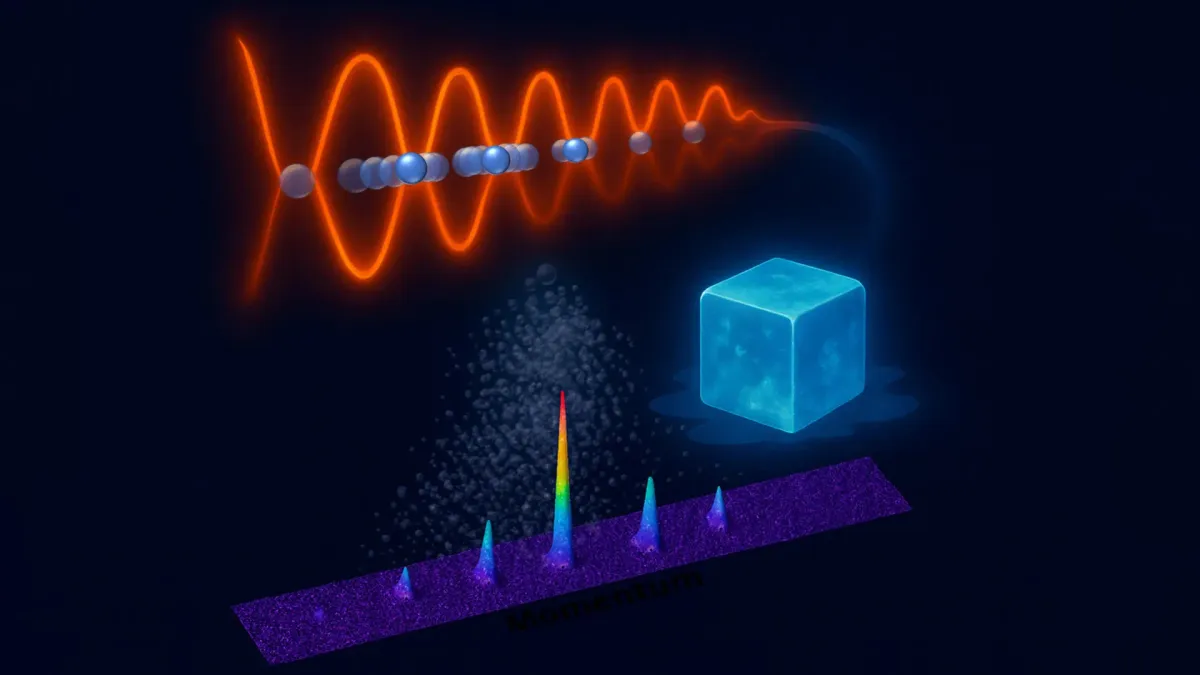
The team at the University of Innsbruck, led by Hanns Christoph Nägerl, created a one-dimensional quantum fluid from atoms cooled to a few nanokelvin above absolute zero. Then they used laser light to repeatedly "kick" the atoms with a rapidly switching lattice potential—the quantum equivalent of someone jumping on a trampoline over and over.
Normally, this would be obvious: more kicks, more energy, hotter system. That's just physics. But after an initial burst, something strange happened. The atoms' momentum stopped spreading. Their kinetic energy flatlined. The system had entered what researchers call "many-body dynamical localization"—a state where quantum coherence and entanglement essentially lock the atoms in place, preventing them from absorbing any more energy.
We're a new kind of news feed.
Regular news is designed to drain you. We're a non-profit built to restore you. Every story we publish is scored for impact, progress, and hope.
Start Your News Detox"We had initially expected that the atoms would start flying all around," said lead author Yanliang Guo. "Instead, they behaved in an amazingly orderly manner."
Their collaborator Lei Ying from Zhejiang University put it more plainly: this violates our intuition about how strongly driven systems should behave. In classical physics, you keep pushing something, it keeps taking on energy. But quantum mechanics has other rules.
The Coherence Trick
To test whether this was real or fragile, the researchers introduced randomness into the driving sequence. Even a small amount of disorder broke the spell. The atoms reverted to normal behavior, spreading out and heating up as expected. This proved that quantum coherence—the delicate alignment of quantum states—was doing all the heavy lifting. Remove the coherence, and the protection vanishes.
Why does this matter beyond the lab? Unwanted heating is one of the biggest obstacles facing quantum computers and quantum simulators. These machines rely on maintaining fragile quantum states, and heat is their enemy. If you can't keep them cold, you lose your quantum advantage.
This discovery shows there's a way to resist that pull toward chaos—at least under carefully controlled conditions. It won't directly solve the heating problem tomorrow, but it reveals a new principle for how quantum systems can protect themselves. Understanding that principle opens new paths for designing quantum technologies that stay coherent longer, work at higher temperatures, or require less aggressive cooling.
The research, published in Science, suggests that the next generation of quantum machines might be able to borrow tricks from nature itself.