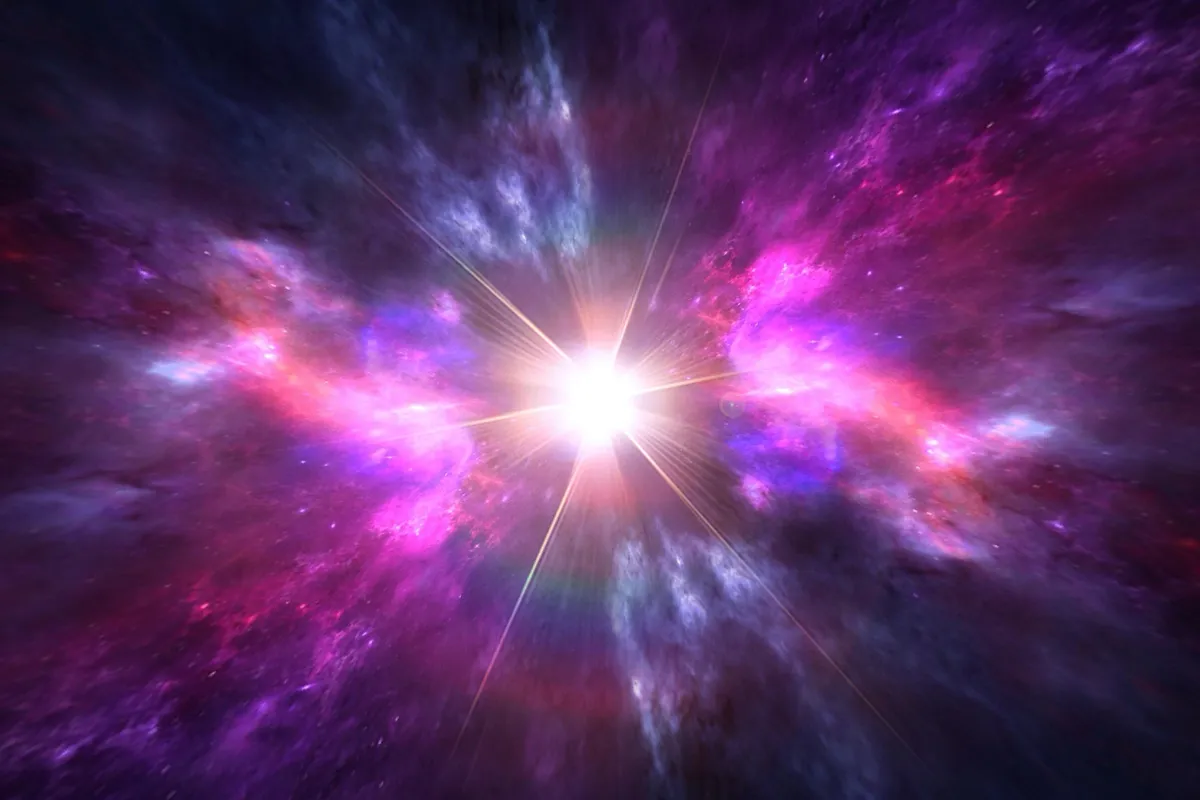
For the first time, astronomers have caught radio waves from an exploding star in its death throes — and what they found is reshaping how we understand stellar collapse.
Using the National Science Foundation's Very Large Array radio telescope in New Mexico, researchers tracked faint radio emissions from the explosion over 18 months. Those signals revealed something optical telescopes alone could never show: gas the star had shed only years before it was destroyed.
Raphael Baer-Way, a Ph.D. student at the University of Virginia and lead author of the study, describes it as a kind of time machine. "We were able to use radio observations to 'view' the final decade of the star's life before the explosion," he explains. "Especially the final five years, when the star was losing mass intensely."
We're a new kind of news feed.
Regular news is designed to drain you. We're a non-profit built to restore you. Every story we publish is scored for impact, progress, and hope.
Start Your News DetoxHere's what makes this possible: distant stars are usually too faint to study directly before they explode. But when a star sheds enormous amounts of material in its final years, that surrounding gas acts like a cosmic mirror. When the supernova's shockwave collides with this material, it produces strong radio waves — a signal that reveals what the star was doing at the end.
A Binary Star in Crisis
The data pointed to something unexpected: the star was likely part of a binary system, orbiting a companion. That matters because the interactions between two stars gravitationally bound together could explain the extreme mass loss in those final years. "To lose that kind of mass in just the last few years," Baer-Way notes, "it almost certainly requires two stars orbiting each other."
Until now, scientists relied mainly on visible light to infer how stars behave before they explode. Radio observations open a completely new window. Maryam Modjaz, a professor of astronomy at UVA and expert in stellar death, sees the significance clearly: "This paper has opened a new window to the Universe for studying these rare, but crucial supernovae, by revealing that we must point our radio telescopes much earlier than previously assumed."
The next step is scaling up. Researchers plan to examine more supernovae to understand how common these dramatic mass loss episodes actually are — and what they tell us about how the most massive stars live and die across the universe.