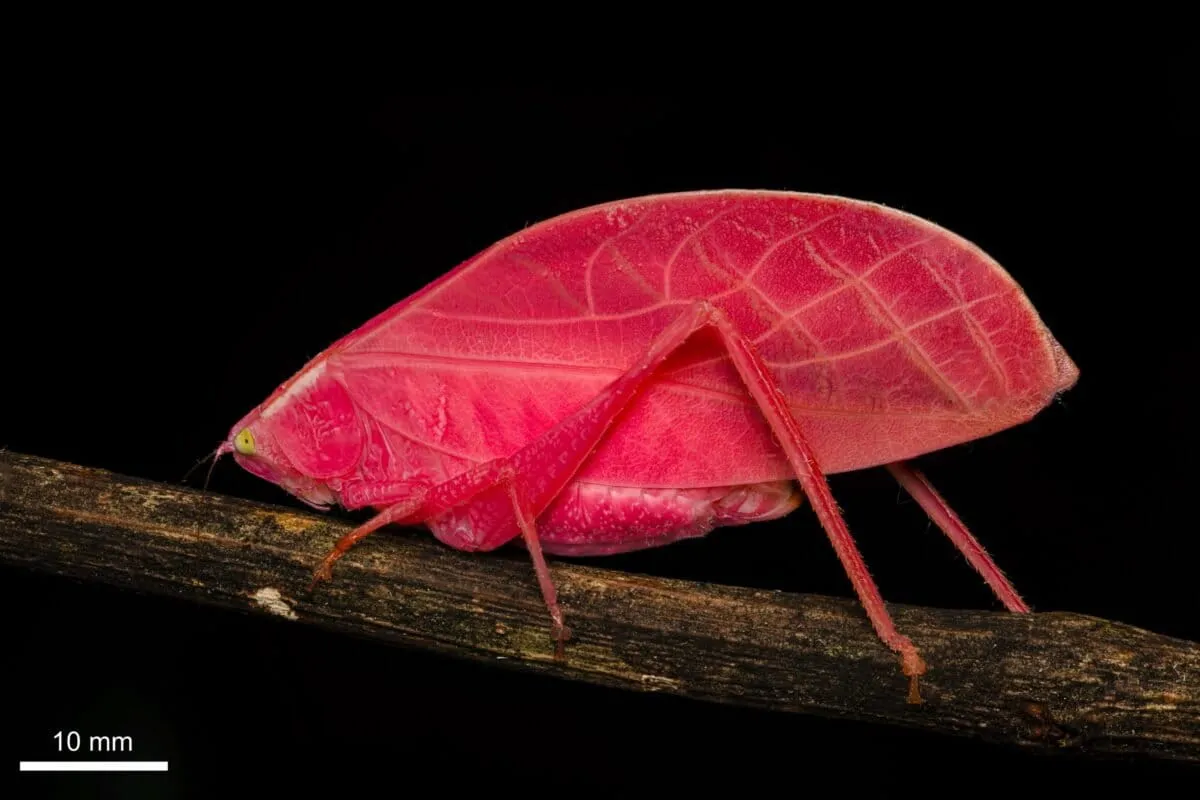
Imagine you're deep in the Panamanian rainforest, on the hunt for leaf-mimicking insects. You're expecting shades of green, maybe some brown. What you don't expect is a neon, hot-pink creature that looks like it just walked off a Barbie movie set. Yet, that's exactly what biologist Benito Wainwright and his team stumbled upon in March 2025: a vividly pink katydid, specifically an Arota festae.
This wasn't just any pink bug; it was a shapeshifter. The team, clearly intrigued by this unexpected pop of color, decided to bring it back to the lab. For 14 days, they played paparazzi, snapping daily photos as the katydid underwent a truly remarkable transformation. It started hot pink, faded to a soft pastel, and then, as if deciding it had had enough of its flamboyant phase, settled into a perfectly camouflaged green.

Now, most A. festae katydids are light green, blending seamlessly with young plant life. A hot pink one? Wainwright, who has spent eight months combing tropical regions, has only ever seen this single specimen. His colleagues, with a combined two years on Barro Colorado Island, have seen precisely zero. Finding one is, apparently, the entomological equivalent of finding a unicorn that changes color.
We're a new kind of news feed.
Regular news is designed to drain you. We're a non-profit built to restore you. Every story we publish is scored for impact, progress, and hope.
Start Your News DetoxWainwright, hailing from the University of St Andrews, suspects these young, vibrant pink katydids might just be incredibly good at hiding in places scientists aren't typically looking. Because once they go green, they're everywhere. Jeffrey Cole, a katydid evolution expert not involved in the study, called the color change "remarkable," noting it's the first time such an ability has been documented in this particular katydid family. Which, if you think about it, is both impressive and slightly terrifying for anyone trying to spot them.