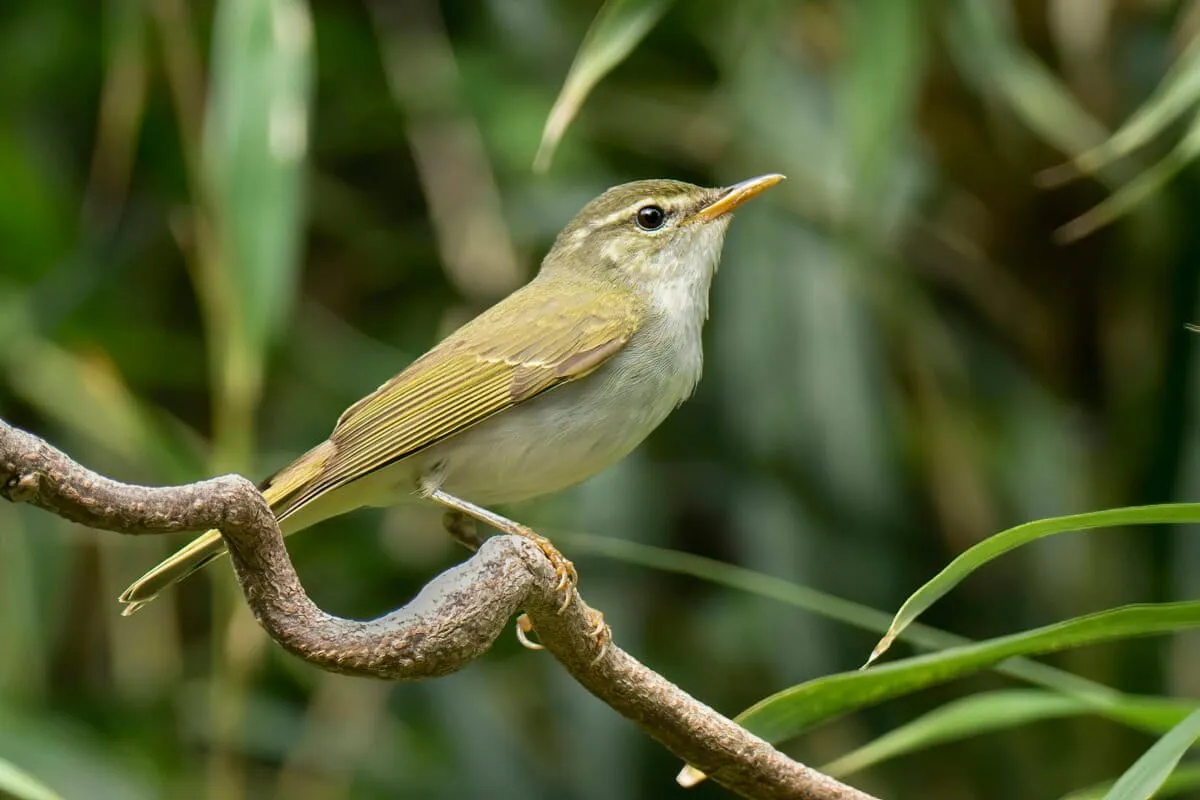
For decades, birdwatchers and scientists alike were convinced that the small, olive-green songbirds flitting across two distinct Japanese island chains were all part of the same feathery club. Turns out, they were wrong. Very, very wrong.
A new study has revealed that what everyone thought was a single species is actually two separate ones, both of which have been quietly evolving on their own for millions of years. Which, if you think about it, is both impressive and slightly terrifying for their long-term survival.

Back in 1988, researchers first spotted what they called the Tokara leaf warbler (Phylloscopus tokaraensis) on the Tokara archipelago. They figured it was just a localized population of the Ijima’s leaf warbler (Phylloscopus ijimae), a known species living a good 1,000 kilometers (620 miles) away in the Izu Islands. An understandable assumption, given they look almost identical. But sometimes, looks can be deceiving.
We're a new kind of news feed.
Regular news is designed to drain you. We're a non-profit built to restore you. Every story we publish is scored for impact, progress, and hope.
Start Your News DetoxAn international team, spearheaded by Per Alström from Uppsala University and Takema Saitoh from the Yamashina Institute of Ornithology, decided to dig a little deeper. They didn't just look at the birds; they listened to them and peered into their DNA.
The Million-Year Mixtape
Genetic tests delivered the first shocker: these two groups of birds hadn't just separated recently. They'd been doing their own thing for about 3.2 million years. That's a lot of separate evolution for birds that still look like avian twins.

But the real giveaway? Their songs. While visually indistinguishable, their vocalizations are as different as a lullaby and a speed metal track. Saitoh observed that the Tokara species warbles at a lower pitch and a much faster pace than its Izu relatives. The difference is so pronounced that researchers could correctly identify 100% of the Tokara recordings just by listening to the tune. It's like having a secret handshake, but for birds, and it's an entire symphony.
This discovery means these birds are far rarer than previously thought. The Tokara leaf warbler, with its unique song and ancient lineage, is now known to breed only on the Tokara archipelago. Which makes its continued existence a much more delicate proposition than we ever realized.