Ever wonder what family gatherings were like 1,500 years ago in ancient Korea? Turns out, they were really close-knit. As in, marrying your first cousin wasn't just common; it was practically a family tradition, even for powerful leaders and, rather grimly, those chosen for human sacrifice.
Researchers just dropped a genetic bombshell, revealing that the people of the Silla Kingdom had family trees that resembled a very tangled vine. They mapped the full genetic blueprints of 78 skeletons unearthed from the Imdang-Joyeong burial site in Gyeongsan, South Korea. We’re talking teeth, inner ear bones, the works. This deep dive, published in Science Advances, is basically a genealogical exposé from the grave.
Unlocking Ancient Genomes
The team went full detective, hunting for tiny DNA variations called SNPs (single nucleotide polymorphisms) and something even more telling: “runs of homozygosity” (ROH). Think of ROH as genetic neon signs screaming, "Hey, these parents were related!" If you've got long, identical stretches of DNA from both mom and dad, odds are your folks were cousins. Or closer. Which, if you think about it, is both impressive and slightly terrifying.
We're a new kind of news feed.
Regular news is designed to drain you. We're a non-profit built to restore you. Every story we publish is scored for impact, progress, and hope.
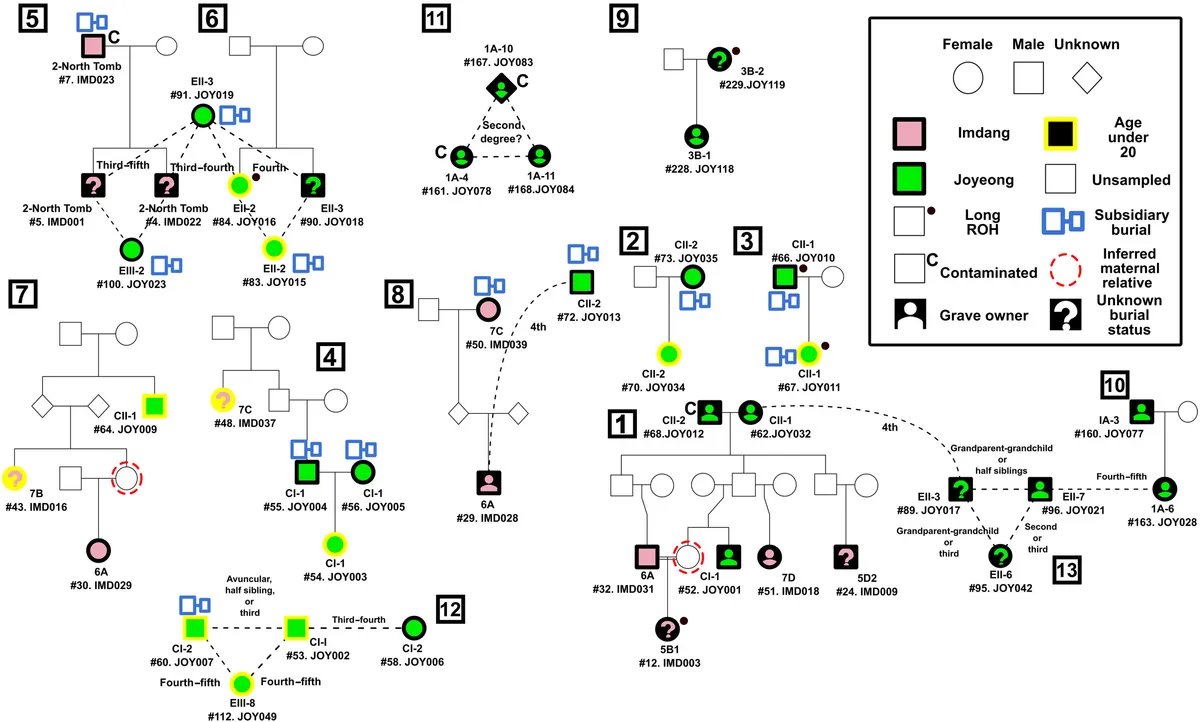
Start Your News DetoxWhat they found was a kinship network so dense it could probably stop a charging rhino. Eleven pairs of first-degree relatives (parents and children), 23 pairs of second-degree relatives (like grandparents or aunts/uncles), and 20 more distant connections. It seems everyone at this burial site was, well, family.
And here’s where it gets particularly spicy: five individuals had parents who were closely related. This wasn't some isolated incident; it was happening among the elite grave owners and the sacrificial victims. Because apparently, even when you're being sacrificed, you're keeping it in the family.
Interestingly, while there were no major genetic differences between the grave owners and the sacrificial victims, they were never closer than third-degree relatives. So, while you might marry your cousin, you probably weren't sacrificing them. There are some boundaries, after all.
Unlike many ancient European societies where women moved to their husband's turf, the women of Imdang-Joyeong often stayed put, buried near their birth families. This suggests a society that really valued those close family ties — which, when you're marrying your relatives, makes a certain kind of sense. It's a reminder that human relationships, even the really, really close ones, have always been complicated.