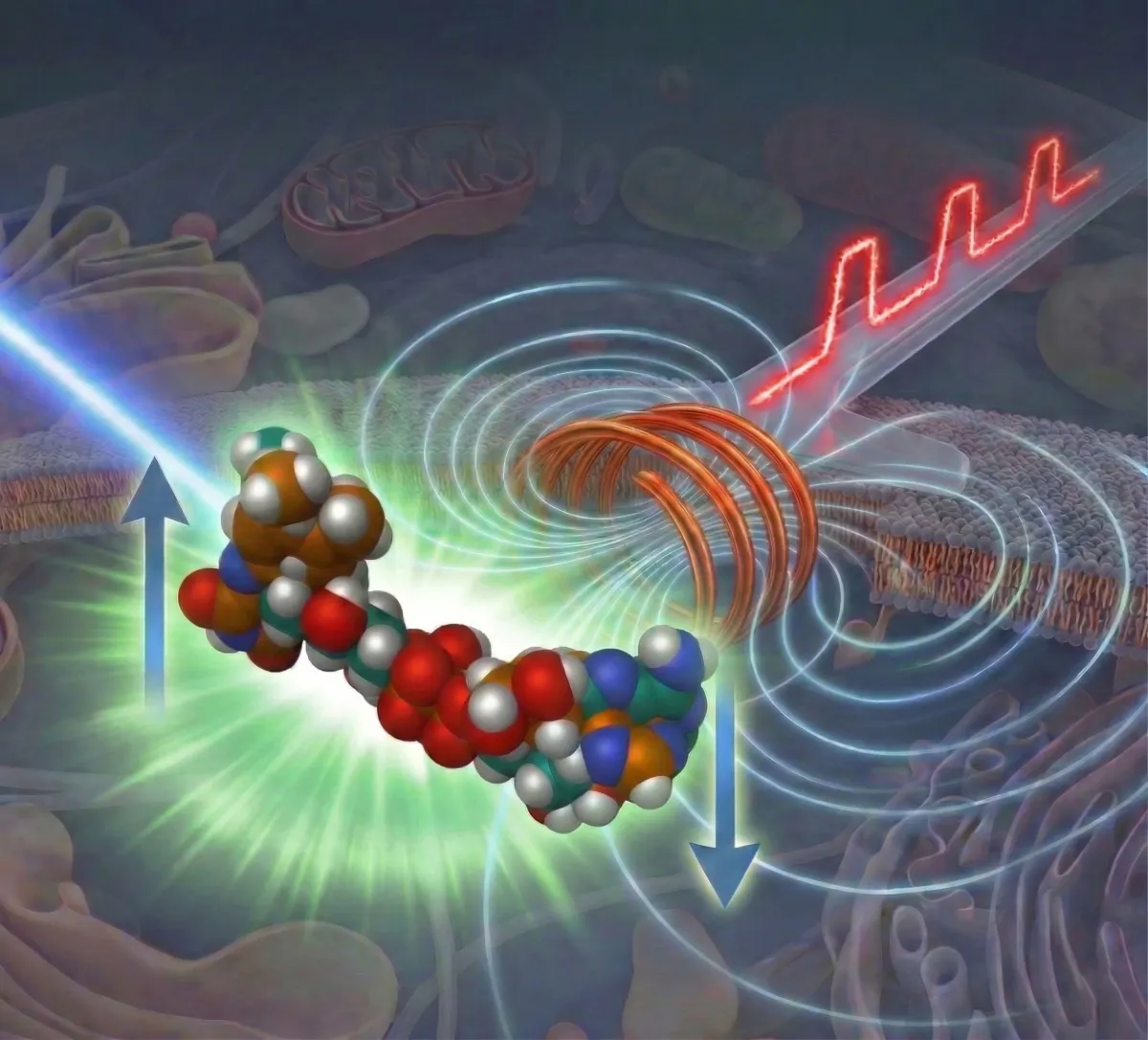
Imagine a whole secret world of molecular drama playing out inside your cells, completely invisible to science. For decades, researchers knew something was happening with certain molecules that don't emit light, especially in reactions influenced by weak magnetic fields. But they couldn't actually see it. It was like trying to watch a movie in a pitch-black room.
Enter a team from the University of Tokyo, led by Project Researcher Noboru Ikeya and Professor Jonathan R. Woodward. They've just unveiled a new microscopy technique that acts like flipping on the lights in that dark room, revealing a previously unseen layer of biomolecular chemistry.
The Trick to Seeing the Unseen
The problem? Many crucial molecules in these magnetic-field-dependent reactions are "dark." They don't glow, which makes them impossible to image with standard tools. So, the Tokyo team got clever. They combined two light pulses with a precisely synchronized magnetic pulse, all lasting mere nanoseconds. They call it "pump-field-probe fluorescence microscopy," which sounds like something out of a sci-fi novel, but it’s actually just very smart physics.
We're a new kind of news feed.
Regular news is designed to drain you. We're a non-profit built to restore you. Every story we publish is scored for impact, progress, and hope.
Start Your News DetoxThis method tracks how signals shift when the magnetic field blinks on and off at different times. By comparing these subtle changes, the system can isolate the magnetically sensitive part of the reaction. Suddenly, those "dark" molecules — the ones that form and disappear based on magnetic fields — become visible.
They tested this wizardry on flavin-based systems, which are the go-to for studying light-driven chemical reactions in biology. The results? The platform could measure how long these reactions lasted and how they responded to magnetic fields, even at the low concentrations you'd find inside actual cells. It's sensitive enough to detect tiny signal changes with minimal sample damage, all in a single experiment per frame. Which, if you think about it, is both impressive and slightly terrifying.
This breakthrough doesn't just connect fluorescence microscopy with spin chemistry in a new way; it lets scientists directly study molecular processes that were previously only theoretical. It offers clearer insight into how those weak magnetic fields we're all surrounded by might actually be affecting living things, from the smallest bacteria to, well, us.
The researchers are betting this approach could be huge for quantum biology and might even lead to new ways to diagnose illnesses based on how molecules react to magnetic fields. Because apparently, even your cells have secrets, and now we might finally be able to read them.