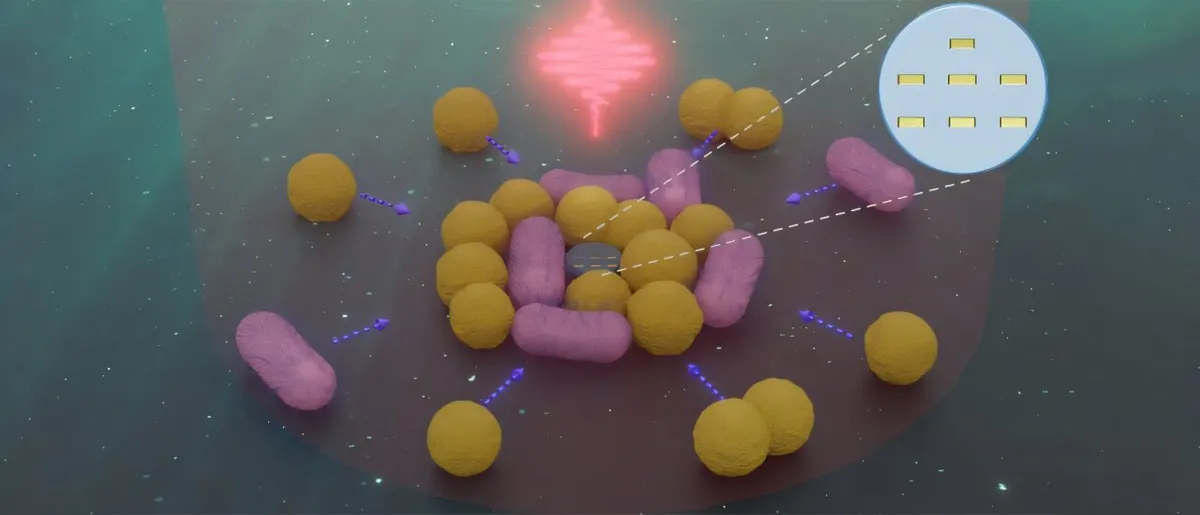
For decades, physicists have chased a cosmic unicorn: stable antimatter. The problem? The universe's most elusive particles — like antiprotons and positrons — are such picky neighbors, they refuse to share a trap. Until now.
A team of researchers just built a radiofrequency trap that can handle particles with wildly different demands. Think of it as a particle day-care center that can simultaneously soothe a screaming toddler and a grumpy teenager. In early tests, it successfully snagged either electrons or calcium ions, which are excellent understudies for the real antimatter stars.

This might seem like a small step, but it's the kind of thing that makes antimatter researchers do a little jig. If scientists can trap both particle types together, they could finally assemble antihydrogen outside colossal facilities like CERN. Which means antimatter experiments could soon pop up in labs worldwide. Because apparently, that's where we are now.
We're a new kind of news feed.
Regular news is designed to drain you. We're a non-profit built to restore you. Every story we publish is scored for impact, progress, and hope.
Start Your News Detox"Antihydrogen is a kind of Holy Grail in antimatter research," explained Hendrik Bekker, a senior scientist at the Helmholtz Institute Mainz. "Its simple makeup—just one antiproton and a positron—means we can generate it relatively easily compared to other antimatter." Relatively, of course, being the operative word when you're talking about particles that vanish on contact.
The Ultimate Particle Playset
The secret sauce is a reimagined Paul trap, a device that uses oscillating electric fields to wrangle charged particles. Paul traps are usually reliable, but they’re also usually one-trick ponies, operating at a single frequency. That’s great if all your particles are the same weight class. Not so great if you're trying to trap a feather and a bowling ball at the same time.
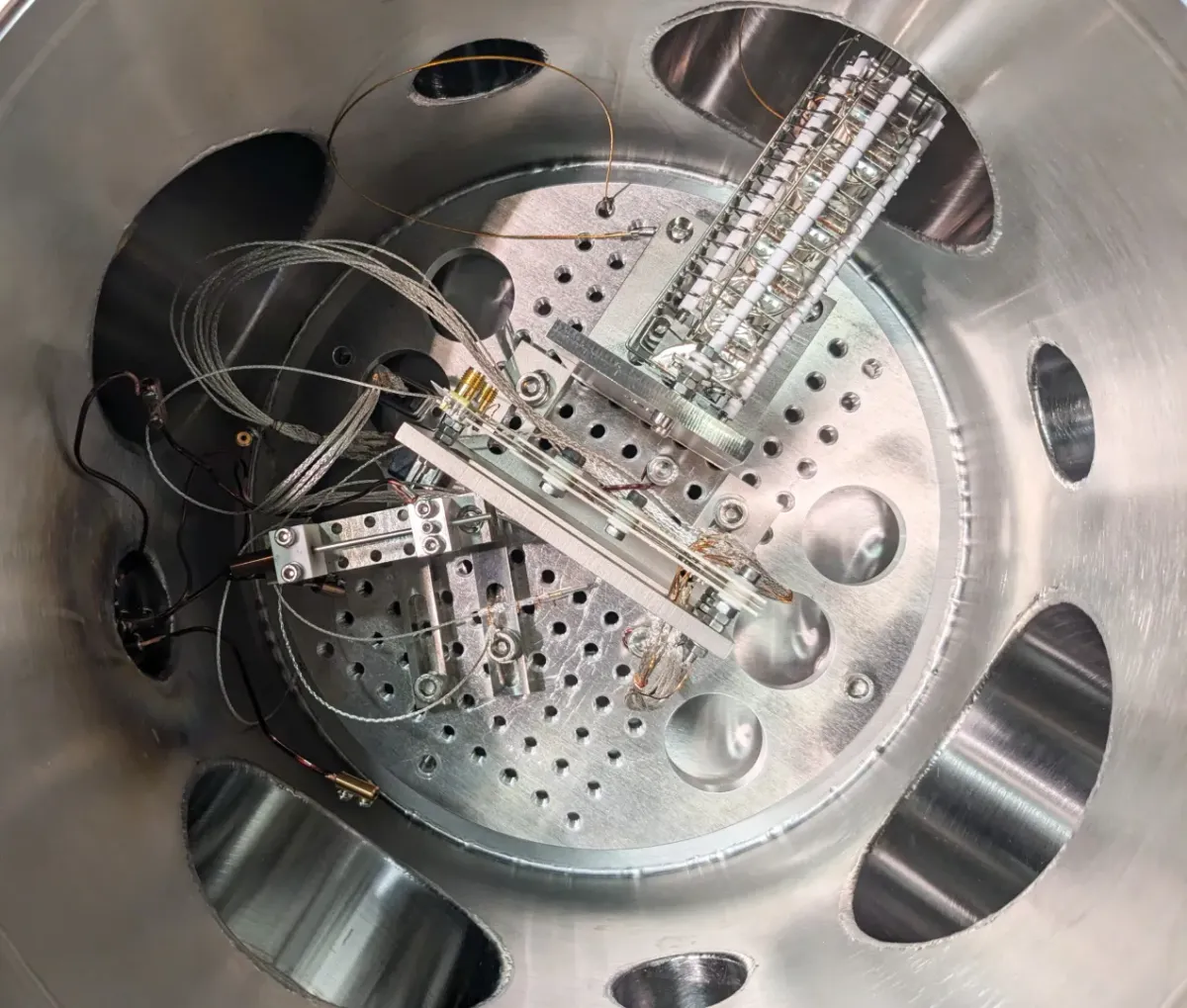
Light particles, like positrons (or electrons), need incredibly fast oscillations — in the gigahertz range — to stay put. Heavier particles, like antiprotons (or calcium ions), prefer a much more leisurely megahertz rhythm. It's like trying to make two different musical instruments play in tune on opposite ends of the frequency spectrum.
Traditionally, scientists had to pick a favorite. But this team built both into the same device. Their design stacks three printed circuit boards with ceramic spacers. The middle layer handles the high-frequency gigahertz field for the electrons. The top and bottom layers provide the slower megahertz field for the ions. It's a particle party with separate sound stages.
The Dance of Opposites
To test this tiny marvel, the researchers zapped neutral calcium atoms with lasers to create charged particles, then herded them into the trap. They managed to hold tens of electrons or ions for milliseconds, with a few stubborn holdouts lasting hundreds of milliseconds. Not bad for a first date.

The system worked for each particle type separately. The real challenge, however, is getting them to coexist. Electrons, for instance, are surprisingly sensitive to the low-frequency field meant for the ions. Turn that field up too high, and the electrons stage a dramatic exit. The ions, on the other hand, couldn't care less about the high-frequency field. It's an imbalance that makes co-habitation tricky, like a roommate who blasts music while the other tries to meditate.
There are also engineering quirks. Tiny imperfections like rough surfaces, slight misalignments, and stray electrical charges can make the trap a bit unstable. The team is already working on smoother, laser-etched versions with better thermal stability. Because when you're trapping antimatter, precision is key.
Currently, antiprotons are only churned out at CERN's Antimatter Factory, making them a rather exclusive commodity. But this could change. Dmitry Budker, another study author, pointed out that recent success in trucking antiprotons (yes, you read that right) means delivering them to researchers far from CERN is now feasible. Imagine the insurance policy on that delivery.
Combine that with traps like this one, and scientists could soon be assembling antihydrogen in their own labs. This would be a major leap, allowing them to finally test fundamental physics questions, like why our universe is so rudely overflowing with matter and not its equally fascinating twin. The trap isn't perfect yet, but it’s already opening doors to experiments that, until now, were pure science fiction.