Tiny robots, about 50 times smaller than a human hair, are opening up new possibilities. They allow us to control objects too small for human hands. This brings us closer to directly interacting with the microscopic world.
Handling biological objects like single cells or bacteria in water has been a big challenge. Now, a team of researchers has shown how these microscopic cleaners can be used and precisely controlled.
The study was published in Nature Communications. It shows that these nanorobots can already manipulate, collect, and move bacteria in a controlled way.
We're a new kind of news feed.
Regular news is designed to drain you. We're a non-profit built to restore you. Every story we publish is scored for impact, progress, and hope.
Start Your News DetoxHow Light Powers and Controls Nanorobots
A major hurdle for tiny machines is how to power and steer them. At Julius-Maximilians-Universität Würzburg (JMU), Professor Bert Hecht's team has been working on this. They use the recoil from individual photons to move devices called microdrones.
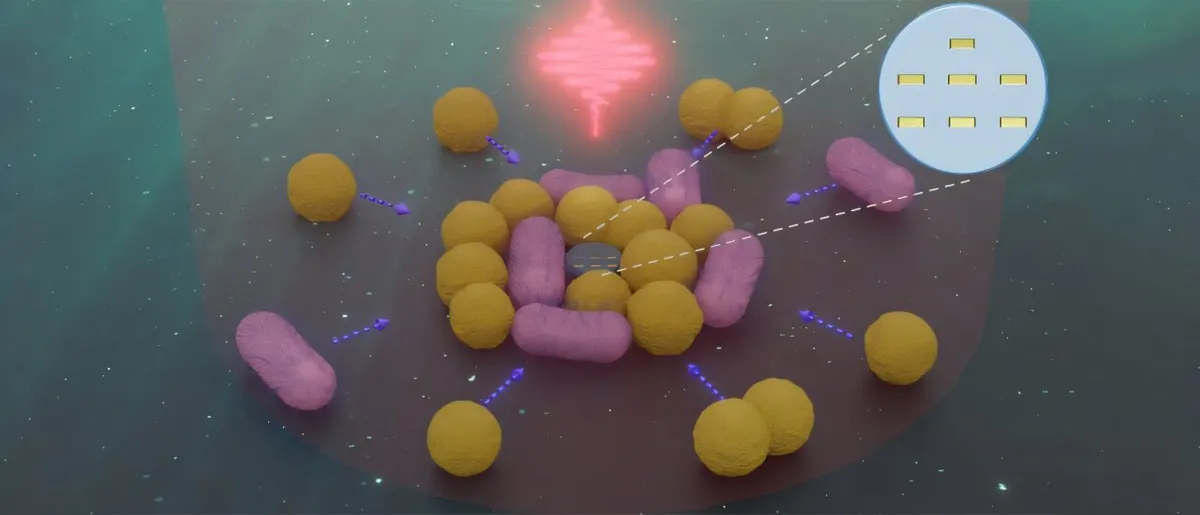
These devices have up to four tiny antennas that absorb light of a specific color and then re-emit it in a certain direction. Each re-emitted photon creates a recoil force, much like a gun firing a bullet. Because microdrones are so light, this creates significant speed and acceleration.
In their latest work, the team made these light-driven robots even smaller, less than one micrometer in size. They simplified the steering without losing the photon-based propulsion.
The researchers use the way tiny antenna wires in the robot tend to line up with the light's polarization. By changing the light's polarization, they can steer the nanorobot's direction. The photon recoil still drives the robot forward. This is similar to how larger vehicles are steered.
"Microscopic Cleaners" in Action
"We built a light-driven nanorobot that can find and collect bacteria," said Jin Qin, the study's lead experimental scientist. "By making the design simpler, we reached a size where these robots can work directly in the world of microbes, almost like tiny cleaning devices."
The nanorobots are very agile. They can make quick 90-degree turns, which helps them scan large areas efficiently. They can also selectively capture, move, and release many bacteria.
This means they can "clean" microscopic areas in the lab. They collect bacteria and place them in specific spots.
"This shows how light can not only help us see the microscopic world but also actively change it," Hecht added. "The idea of tiny robotic cleaners might sound futuristic, but we are already proving the science behind it."
Even when carrying larger groups of bacteria, the nanorobots stay fully maneuverable, though a bit slower. This strength highlights their potential for future uses in microbiology, medical research, and precise control at the micro-level.
Deep Dive & References
A nanoscale robotic cleaner - Nature Communications, 2026