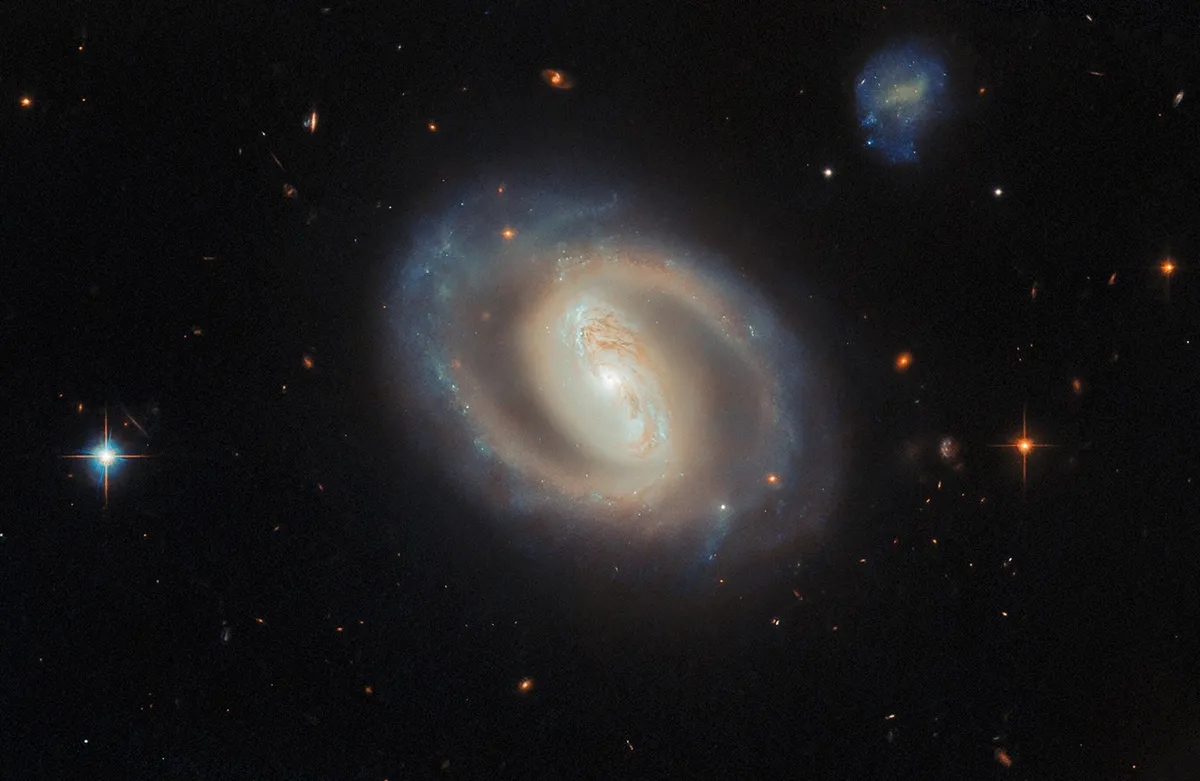
Imagine a galaxy, 380 million light-years away, just chilling at the edge of the Gemini constellation. That's IC 486, a barred spiral galaxy that looks like a cosmic pinwheel, all soft light and swirling arms. Hubble recently snapped a picture, and it's quite the looker, glowing with an ethereal light against the inky blackness. But don't let its gentle appearance fool you. This galaxy has a secret. And it's hungry.
At its heart, IC 486 harbors an active galactic nucleus (AGN), powered by a supermassive black hole that's more than 100 million times the mass of our Sun. That's not just a big black hole; that's a diet-shattering black hole. While every large galaxy has one of these gravitational behemoths at its core, most are just... hanging out. Not this one.
IC 486's black hole is actively feasting, pulling in vast amounts of gas and dust. This cosmic meal forms a swirling accretion disk, heating up so intensely that it blasts out radiation, including X-rays. This radiation is so bright, it can outshine every single star in the galaxy combined. Which, if you think about it, is both impressive and slightly terrifying. It's like the galaxy's entire electricity bill is being paid by its central vacuum cleaner.
We're a new kind of news feed.
Regular news is designed to drain you. We're a non-profit built to restore you. Every story we publish is scored for impact, progress, and hope.
Start Your News DetoxThe Great Galactic Growth Spurt
Hubble's detailed images, combined with data from two observing programs, are helping scientists understand how galaxies like IC 486 grow. They're trying to connect those grand spiral arms and central bars to the dramatic activity happening at the nucleus. Basically, they want to know if the black hole's ravenous appetite influences the galaxy's overall shape and development. It's the ultimate chicken-or-egg question, but with significantly more gravity and less clucking.
They're even using citizen scientists through Galaxy Zoo to help classify galaxies, and get this: they're testing how well large language models and machine learning can do the job. Because apparently, even galaxies need AI to sort themselves out now. This could scale up galaxy studies for future telescopes like Euclid and the Roman Space Telescope, meaning we'll soon have even more dramatic pictures of black holes having lunch.

Beyond IC 486 itself, Hubble's image is a cosmic tapestry, dotted with distant background galaxies and the occasional foreground star showing off its diffraction spikes. Those reddish smudges? Even more galaxies, scattered across the vastness. It’s a dynamic system, constantly evolving, with stars being born and dying, all contributing to the ongoing, dramatic saga of galactic life. And somewhere in the middle, a black hole just keeps on eating.