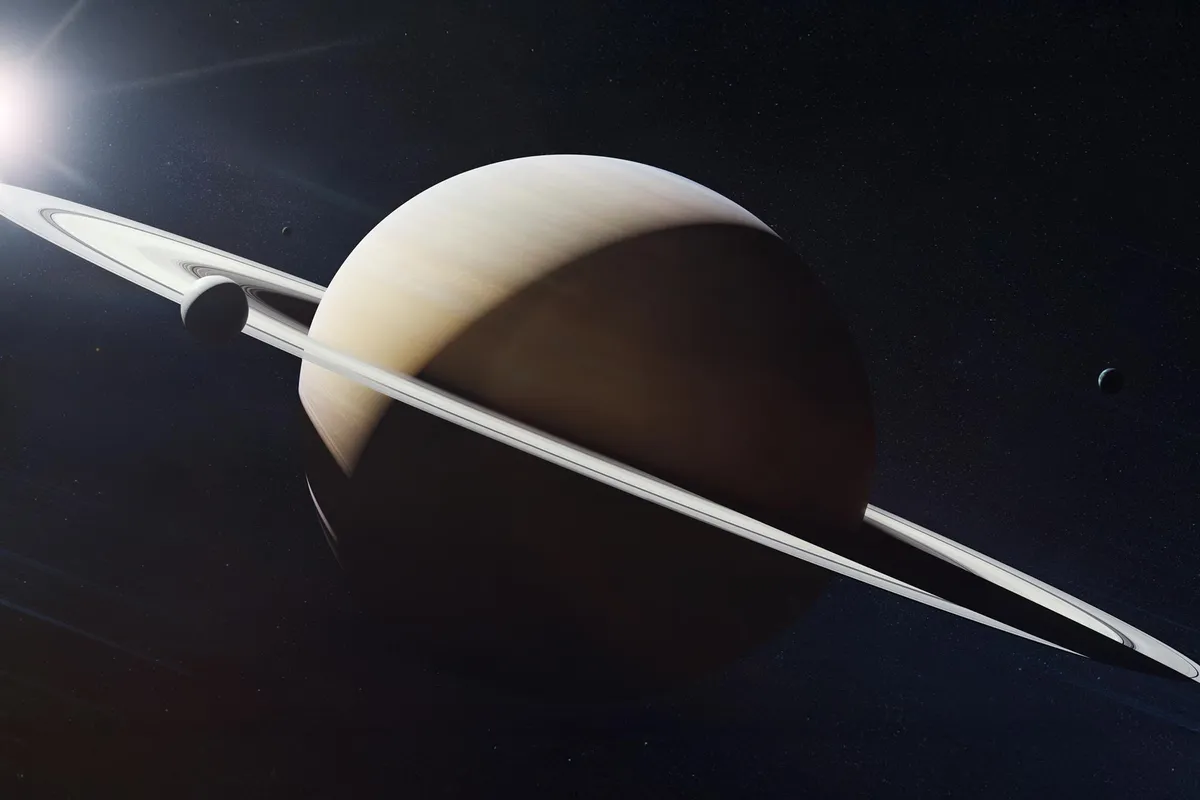
Scientists have found something unexpected about Saturn's magnetic shield. It behaves differently than Earth's. This suggests that giant planets follow different rules for their magnetic fields.
This discovery comes from data collected by the Cassini-Huygens mission. The study was published in Nature Communications. Dr. Licia Ray and Dr. Sarah Badman from Lancaster University were part of the team. Dr. Chris Arridge, also formerly of Lancaster, contributed.
The Cassini spacecraft explored Saturn from 2004 to 2017. It was a joint mission by NASA, the European Space Agency (ESA), and the Italian space agency (ASI).
We're a new kind of news feed.
Regular news is designed to drain you. We're a non-profit built to restore you. Every story we publish is scored for impact, progress, and hope.
Start Your News DetoxThe new findings support an old idea. It suggests that the fast spin of large planets like Saturn can be more powerful than the solar wind. The solar wind is a stream of charged particles from the Sun. This spin helps shape their "magnetospheres."
A magnetosphere is the area around a planet where its magnetic field protects it from the solar wind. But near the poles, there are funnel-shaped openings called "magnetospheric cusps." These allow charged particles from the Sun to enter the atmosphere.
Saturn's Magnetic Structure Is Different
Researchers looked at Cassini data from 2004 to 2010. They wanted to find the exact spot of Saturn's magnetospheric cusp. They found it was very different from Earth's.
Saturn's strong rotation seems to "drag" the cusp away from noon. It shifts it towards the afternoon side. On average, it sits between 1 p.m. and 3 p.m. local time. It can even go as far as 8 p.m. This shift towards dusk shows that a planet's spin can greatly change its space environment.
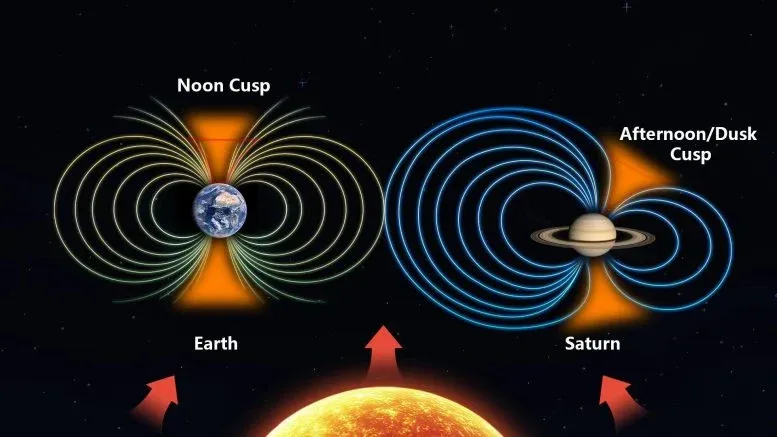
This change affects how scientists understand important processes. These include magnetic reconnection, how high-energy particles speed up, and how Saturn's auroras are made.
Dr. Licia Ray said this result helps scientists create better theories. These theories will explain how planetary magnetospheres interact with the solar wind.
Why Saturn and Earth Differ
Earth spins much slower than gas giants like Saturn. Earth's day is 24 hours long. Its magnetosphere is mostly controlled by the balance between solar wind pressure and the planet's magnetic field. This balance keeps the cusp near local noon.
Saturn, however, spins much faster. It completes a rotation in about 10.7 hours. Its magnetosphere also has a lot of ionized material from its moon Enceladus. Because of these factors, Saturn's magnetic field and fast-spinning plasma must fight against the solar wind.
Dr. Ray noted that the afternoon cusp locations have implications. They change how we understand Saturn's bright aurora. They also affect where we expect magnetic reconnection to happen. This is an explosive process that speeds up particles to very high energies. She added that this highlights the rich science still possible with Cassini data, even years after the mission ended.
Deep Dive & References
Dawn-dusk Asymmetrical Distribution of Saturn’s Cusp - Nature Communications, 2026