Physicists have achieved a new milestone in quantum control. They cooled the spinning motion of a tiny nanoparticle to its lowest possible energy state. This means they reached the quantum limit for its rotation.
This work was done by researchers from the University of Vienna, TU Wien, and Ulm University. Their findings were published in Nature Physics.
Reaching the Quantum Limit for Rotation
Quantum mechanics states that no particle can ever be completely still. Even at absolute zero temperature, particles still have a minimum amount of energy. This is called quantum zero-point fluctuations.
We're a new kind of news feed.
Regular news is designed to drain you. We're a non-profit built to restore you. Every story we publish is scored for impact, progress, and hope.
Start Your News DetoxThe team cooled a levitated silica nanorotor. They controlled its rotational motion in two directions. This confined the particle's orientation within the limits set by quantum mechanics.
This level of control is a big step. It could lead to new ways to measure tiny forces and explore quantum phenomena.
Two-Dimensional Quantum Alignment
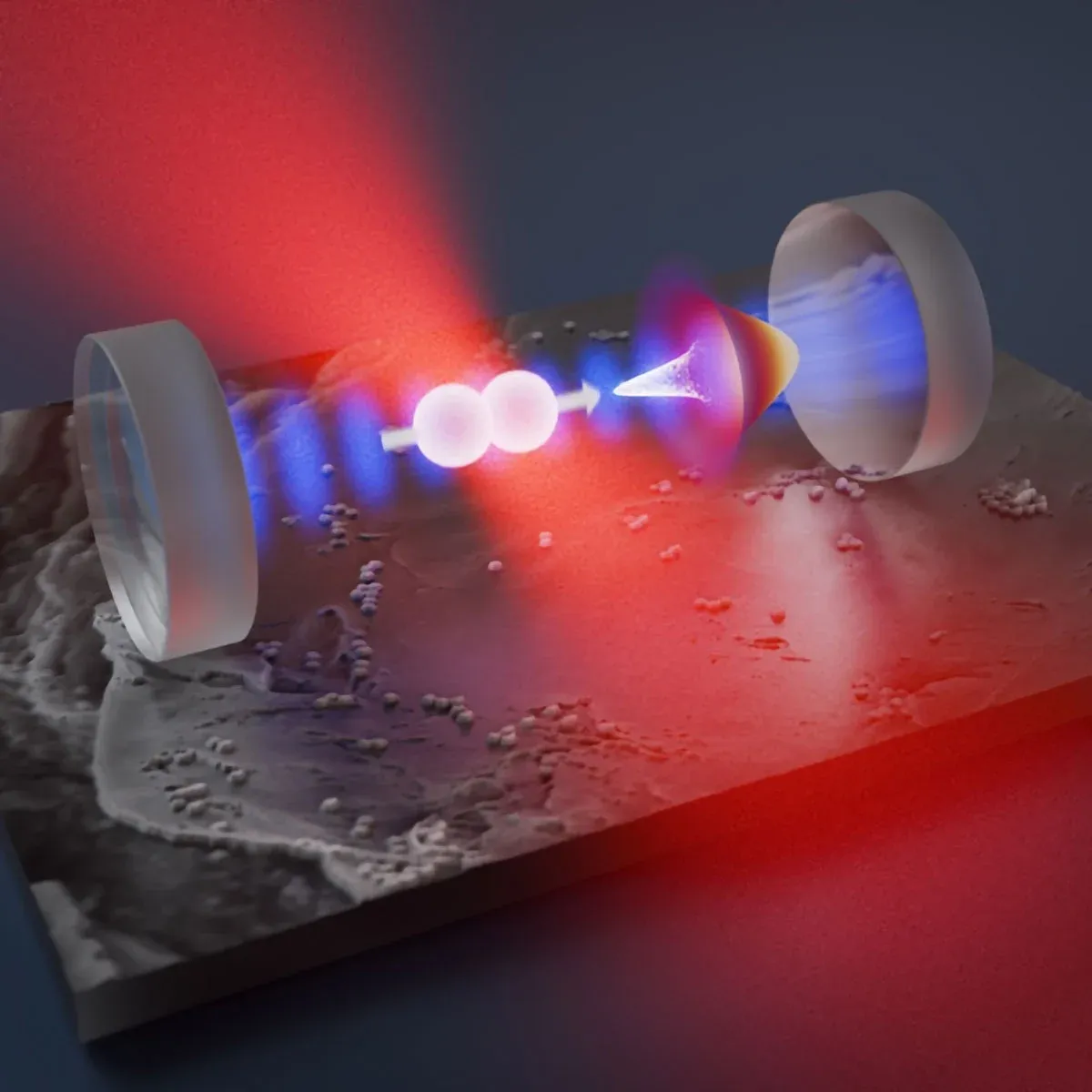
The researchers used a tiny dumbbell-shaped rotor. It was made of two silica spheres, each 150 nanometers wide. A laser's electric field held and aligned the particle.
Initially, the rotor showed thermal motion. But as optical cooling was applied, its temperature dropped to just a few tens of microkelvin above absolute zero. At this point, quantum effects took over. The system reached its lowest energy state.
This is the first time rotational cooling has been achieved along two axes. Even at this quantum limit, the rotor's direction isn't perfectly fixed. Its orientation remains uncertain by about 20 microradians.
Stephan Troyer, the lead author, explained how precise this is. "The tip of the rotor then moves less than one hundredth of the diameter of a single atom," he said. "This is like a compass needle oriented to better than the width of a bacterium."
A New Way to Explore the Quantum World
This achievement opens doors for new quantum experiments. Most quantum systems involve single atoms or molecules. These silica nanorotors, however, contain about 100 million atoms. Yet, they still show quantum behavior.
Rotational motion adds new effects not seen in linear systems. For example, if the trapping light is turned off, the rotor can enter a quantum superposition. This means it effectively rotates in all possible directions at once.
This process, called quantum revival, is key for rotational matter-wave interferometry. Observing it might require even smaller particles.
"The beauty of our 2D cooling method is that it works across scales," Troyer noted. "Cooling is easier for larger bodies but applying our techniques to smaller structures we hope to be able to observe this rotational quantum interference."
This method could also improve quantum sensing. A cooled nanorotor could act as a very sensitive detector for tiny torques.
How the Cooling Works
To reach such low temperatures, the scientists used coherent scattering cooling. They trapped the nanoparticle in a very intense light field. The particle then scatters light into an optical resonator.
Each scattered photon removes a unit of rotational energy from the particle. This energy transfers into the optical field. Repeating this process steadily reduces the rotor's energy, cooling it to its quantum ground state.
Deep Dive & References: Quantum ground-state cooling of two librational modes of a nanorotor - Nature Physics, 2026