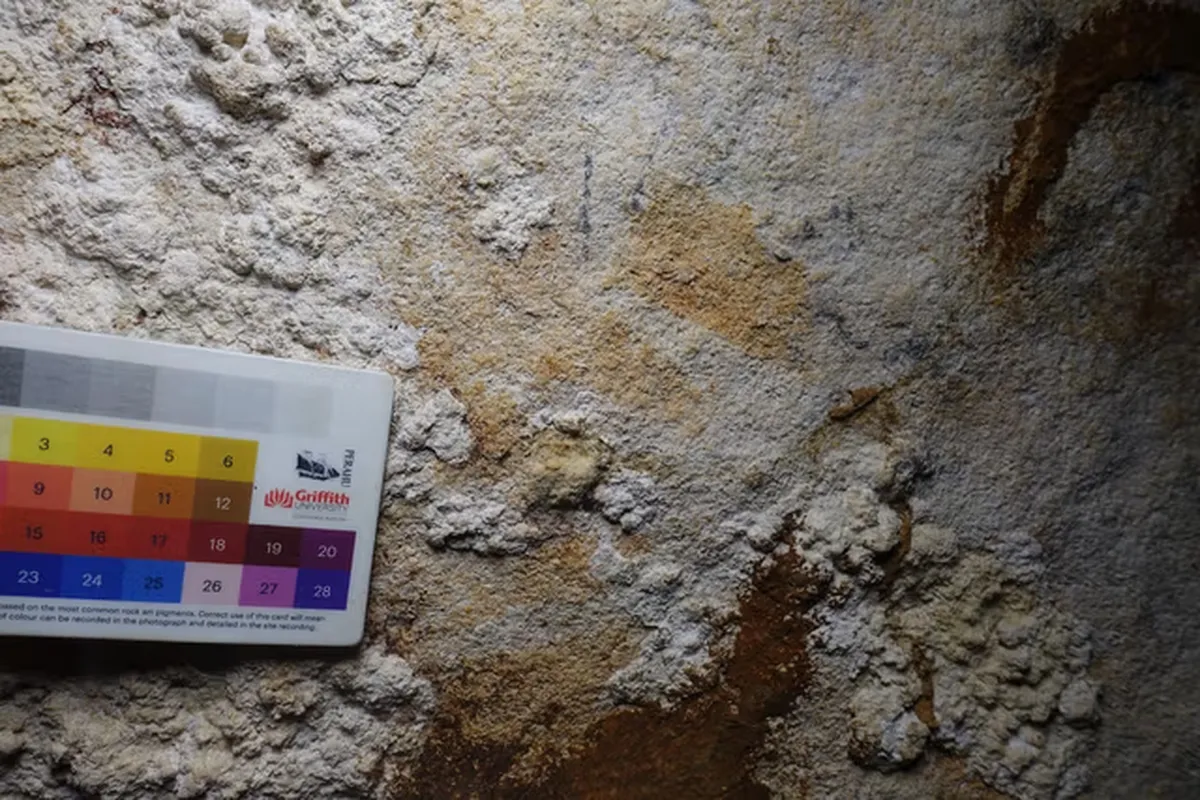
A faded patch of pigment on an Indonesian cave wall has just rewritten the timeline of human art. Researchers have dated a hand stencil in southeast Sulawesi to 67,800 years ago — making it the oldest known rock art ever discovered. What remains is barely visible: just 14 by 10 centimeters showing fingers and part of a palm. But what it tells us about our ancestors is profound.
This isn't the first breakthrough from this team. Less than two years ago, archaeologists from Griffith University in Australia, working with Indonesian research organizations, found a 51,200-year-old painting of a pig on the same island. Now they've gone deeper still, pushing back the frontier of symbolic human expression by another 16,000 years.
The dating method itself is elegant. Maxime Aubert, the archaeologist leading the work, explains that mineral crusts naturally form on top of rock paintings over time. By analyzing these crusts, researchers can determine the youngest possible age of the art beneath — a kind of geological timestamp. The team spent years documenting 44 cave sites across southeast Sulawesi, carefully dating 11 individual artworks.
We're a new kind of news feed.
Regular news is designed to drain you. We're a non-profit built to restore you. Every story we publish is scored for impact, progress, and hope.
Start Your News DetoxWhat makes these hand stencils particularly striking is that the ancient artists deliberately reshaped their fingertips to be pointed. This wasn't accidental — it was intentional, possibly symbolic, perhaps linked to animals or spiritual meaning. Someone stood at that cave wall, pressed their hand against the stone, and blew pigment around it, leaving a mark that would outlast 67,800 years of history.
The discovery reshapes our understanding of human migration. These hand stencils suggest that the ancestors of Indigenous Australians were moving through Southeast Asia far earlier than previously thought, creating art as they traveled. The evidence now points to maritime journeys between Borneo and Papua, with people arriving in Australia and the surrounding region as early as 60,000 to 65,000 years ago. This supports what archaeologists call the "long chronology" — and genetic evidence increasingly backs it up.
What emerges is a picture of our ancestors as deliberate travelers and symbolic thinkers. They weren't simply surviving; they were creating. They were leaving their mark. That faded handprint on a Sulawesi cave wall is, in a very real sense, a 67,800-year-old conversation across time — proof that the human impulse to make art, to say "I was here," runs deeper than we ever knew.