Twenty years ago, physicists had almost no way to deliberately shape light at the quantum level. Today, they're doing it routinely—and it's opening doors to quantum communication systems that could be far more secure and efficient than anything we have now.
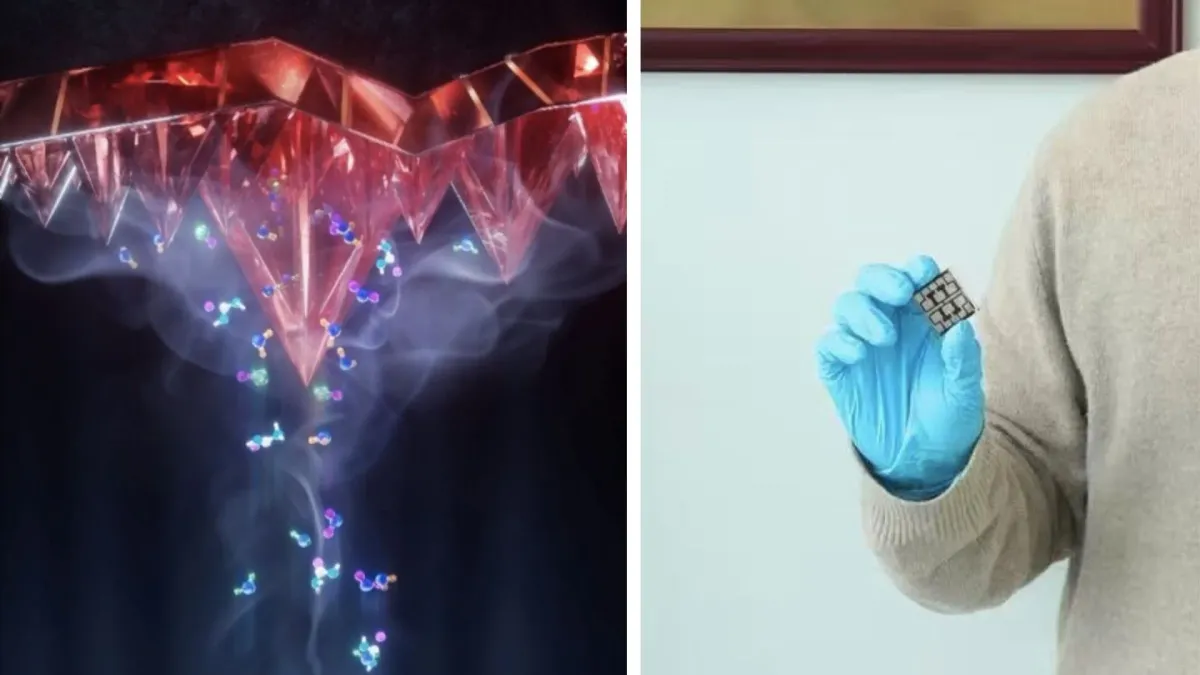
Researchers at the University of the Witwatersrand in South Africa, working with colleagues in Barcelona, have shown how to engineer individual photons (particles of light) so they carry more information and resist interference better. By carefully controlling a photon's spatial pattern, timing, and spectrum, they can create what's called "structured quantum light"—custom-designed particles that behave exactly as needed for specific tasks.
The practical payoff is significant. A normal photon carries information in limited ways—think of it like a single letter. A structured photon can carry multiple pieces of information simultaneously, like an entire word. This means quantum communication systems built on these principles could transmit more data through the same channel, and with better protection against eavesdropping.
We're a new kind of news feed.
Regular news is designed to drain you. We're a non-profit built to restore you. Every story we publish is scored for impact, progress, and hope.
Start Your News DetoxThe toolkit that didn't exist
Professor Andrew Forbes, who led the research, describes the transformation bluntly: "Twenty years ago the toolkit for this was virtually empty. Today we have on-chip sources of quantum structured light that are compact and efficient."
The breakthrough hinges on three converging technologies. On-chip integrated photonics lets researchers build quantum light sources small enough to fit on a computer chip. Nonlinear optics allows them to manipulate light in ways that create new quantum states. Multiplane light conversion lets them reshape the light's structure with precision. Together, these tools have moved structured quantum light from theoretical curiosity to something engineers can actually build and use.
But real-world conditions still create friction. Structured photons don't travel as far through certain communication channels as traditional light properties like polarization do. It's a genuine limitation—the distance reach remains "very low," Forbes acknowledges.
His team is working on a solution: giving quantum states topological properties, which are geometric features that make information more stable even when the quantum system gets jostled by noise or interference. Early results suggest this approach could preserve quantum information even in fragile conditions.
The field is moving fast. Researchers are now exploring multidimensional entanglement (linking multiple quantum properties at once), ultrafast temporal structuring (shaping light in trillionths of a second), and detection techniques that can measure higher-dimensional quantum light than before. Compact devices that generate or process this light are becoming reality.
The practical applications are starting to emerge: high-resolution quantum imaging, measurement tools precise enough to detect tiny changes, and quantum networks that could transmit more data by using multiple interconnected channels. None of this replaces existing technology overnight, but the momentum is clear. The field appears to be reaching the moment where structured quantum light moves from "interesting research" to "infrastructure we actually build."