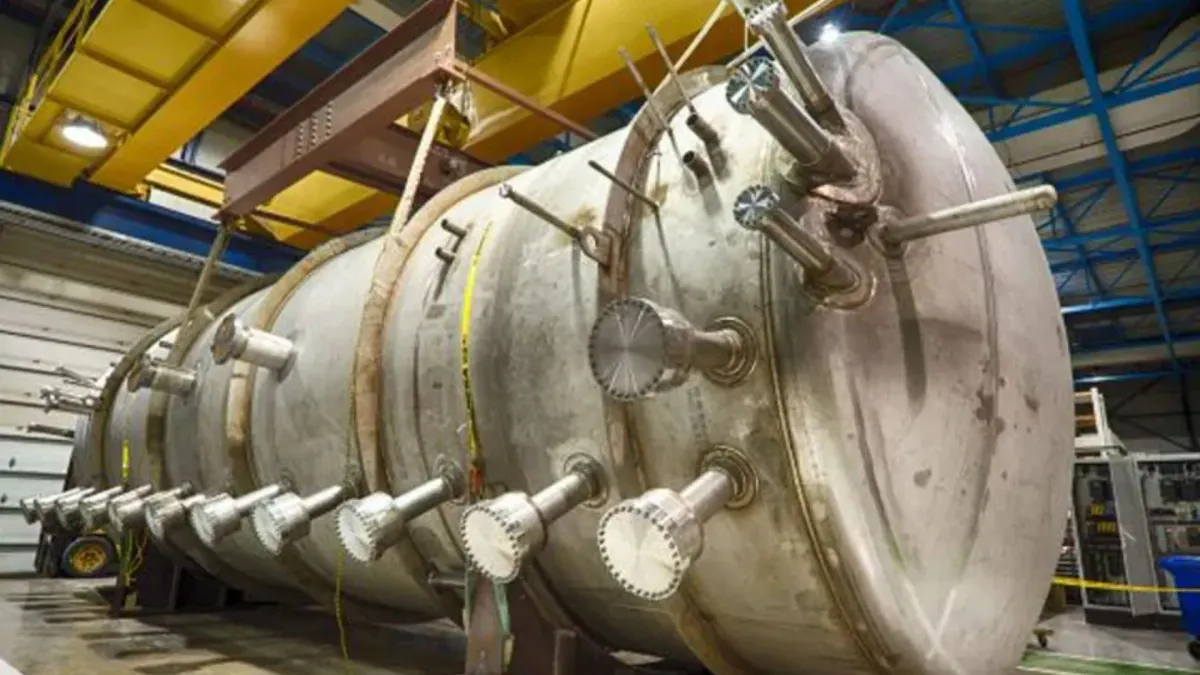
For decades, physicists have chased a ghost particle. Sterile neutrinos—hypothetical particles that interact only with gravity, invisible to the forces that govern ordinary matter—kept appearing in experimental anomalies. They could explain dark matter. They could solve mysteries about neutrino mass. They kept not being found. Now, a bus-sized detector at Fermi National Accelerator Laboratory has essentially closed that particular door.
The MicroBooNE project has ruled out sterile neutrinos with 95% certainty, based on data that contradicts what these particles would actually do if they existed. It's the kind of negative result that feels anticlimactic until you realize what it actually means: physicists can stop looking in one direction and start looking harder in others.
The anomalies that started it all
Back in 1995, the Liquid Scintillator Neutrino Detector at Los Alamos found something odd: more electron anti-neutrinos than the physics models predicted. Then MiniBooNE saw the same pattern with electron neutrinos. More recently, Russia's BEST experiment detected a deficit in germanium that hinted at something invisible happening in the particle interactions. These weren't huge discrepancies, but they were consistent enough to suggest the Standard Model of particle physics was missing something.
We're a new kind of news feed.
Regular news is designed to drain you. We're a non-profit built to restore you. Every story we publish is scored for impact, progress, and hope.
Start Your News DetoxSterile neutrinos fit the bill perfectly. Unlike the three known types of neutrinos—electron, muon, and tau—sterile neutrinos would barely interact with anything except gravity. They'd be the ultimate wallflowers at the particle physics dance. If they existed, they could explain why the experiments kept seeing unexpected numbers.
How two beams solved the puzzle
MicroBooNE took a different approach than its predecessor. Instead of one neutrino beam, it used two running at different energies into the same detector: the Booster Neutrino Beam traveling 470 meters and the Neutrinos at the Main Injector beam traveling 680 meters. The idea was elegant: if sterile neutrinos were real, they'd produce a specific pattern of behavior across these different energy scales.
What the researchers actually found was messier and more interesting. The BNB beamline showed a deficit of electron neutrinos—consistent with earlier experiments. But the NuMI beamline showed no deficit at all. This pattern doesn't match what sterile neutrino models predict. "This first-of-its-kind two-beam measurement is a trailblazing result that significantly constrains the parameter space where a sterile neutrino could exist," said Sowjanya Gollapinni, leader of the MicroBooNE team.
In other words: sterile neutrinos, at least in the form physicists were looking for, probably aren't the answer.
What actually is happening, then
This is where it gets genuinely interesting. Rather than solving the puzzle, MicroBooNE has reframed it. The anomalies are still real. Something is still off in the measurements. But it's not sterile neutrinos. Physicists now suspect neutrinos might oscillate—transform from one type into another—in ways more complex than currently understood. Or there's physics beyond the Standard Model that nobody has figured out yet.
The next generation of experiments is already being built. The Short Baseline Neutrino Program and the Deep Underground Neutrino Experiment are deploying even more sensitive detectors with longer baselines, promising to push the search deeper. "As a result of MicroBooNE, neutrino physics now has a novel tool that other experiments can deploy," said Erin Yandel, co-convener of the oscillation physics group. "This remains a vital and exciting scientific challenge."
Sometimes the most important scientific result is learning that your best guess was wrong. It means you're closer to the real answer.