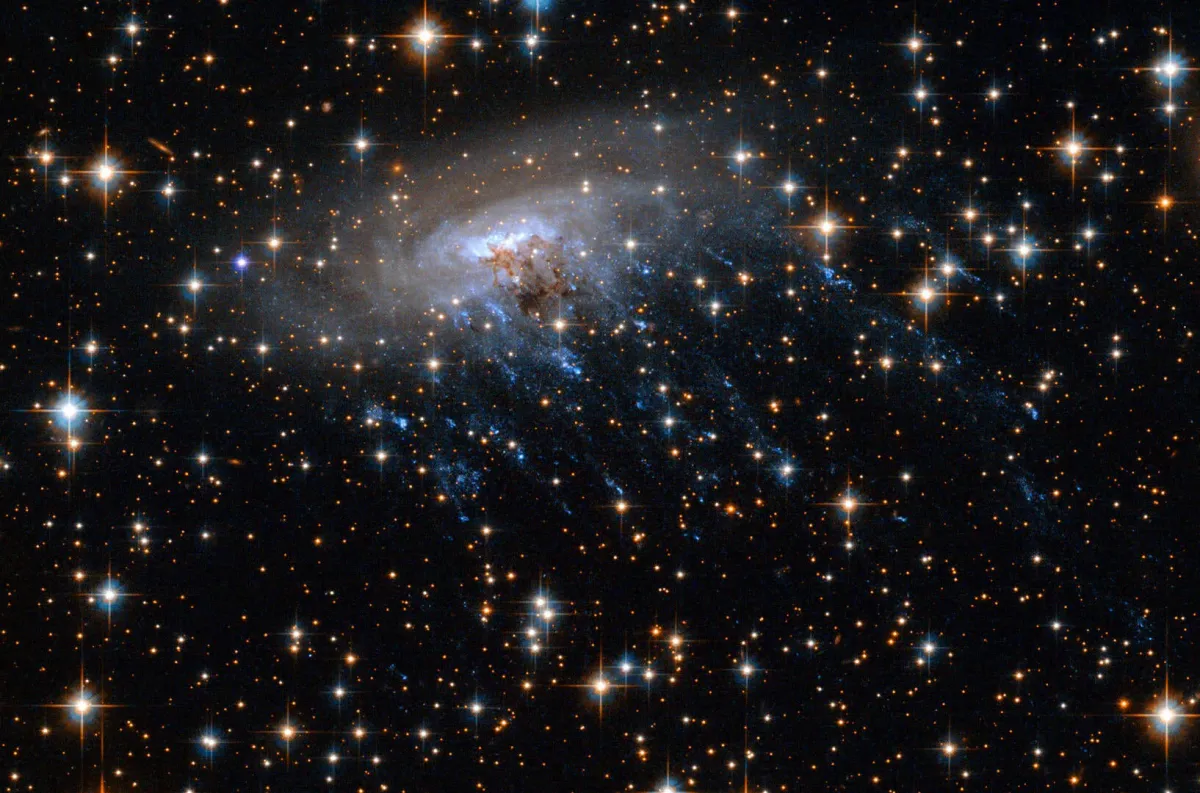
Astronomers have spotted something unexpected in the deep universe: a galaxy with long, tentacle-like streams of gas trailing behind it, seen as it existed 8.5 billion years ago. The discovery is forcing a rethink about how hostile galaxy clusters were in the early universe — and how quickly they began reshaping galaxies around them.
The galaxy gets its jellyfish nickname from those distinctive tails. They form when a galaxy hurtles through the hot, crowded environment of a galaxy cluster. The surrounding gas acts like a powerful headwind, stripping material out of the galaxy and stretching it into long streams. Astronomers call this ram-pressure stripping, and it's a process that fundamentally transforms galaxies over time.
Dr. Ian Roberts and his team at the University of Waterloo spotted this specimen while scanning data from the James Webb Space Telescope. The light from this galaxy has traveled for 8.5 billion years to reach Earth, offering a rare snapshot of what was happening in the early universe. "Early on in our search of the JWST data, we spotted a distant, undocumented jellyfish galaxy that sparked immediate interest," Roberts said.
We're a new kind of news feed.
Regular news is designed to drain you. We're a non-profit built to restore you. Every story we publish is scored for impact, progress, and hope.
Start Your News Detox
What makes this discovery particularly striking is what's happening inside the trailing streams. The galaxy shows bright blue clumps embedded in its tails — and these aren't old stars. They're extremely young stars, born not in the galaxy's main body, but within the gas that had already been stripped away. This tells astronomers something important: the stripping process was active and vigorous enough to trigger star formation even as it was tearing the galaxy apart.
The implications shift our understanding of the early universe's timeline. Researchers previously thought galaxy clusters were still forming at this point in cosmic history, and that ram-pressure stripping was relatively uncommon. This discovery suggests otherwise. The clusters were already harsh enough to strip galaxies. They were already altering galaxy properties far earlier than expected. And this early transformation may have set the stage for the population of "dead" galaxies — those no longer forming new stars — that astronomers observe in galaxy clusters today.
"This data provides us with rare insight into how galaxies were transformed in the early universe," Roberts noted. The team has requested additional observation time on JWST to study this jellyfish galaxy in greater detail, probing deeper into the mechanics of its transformation and what it reveals about the universe's middle age.