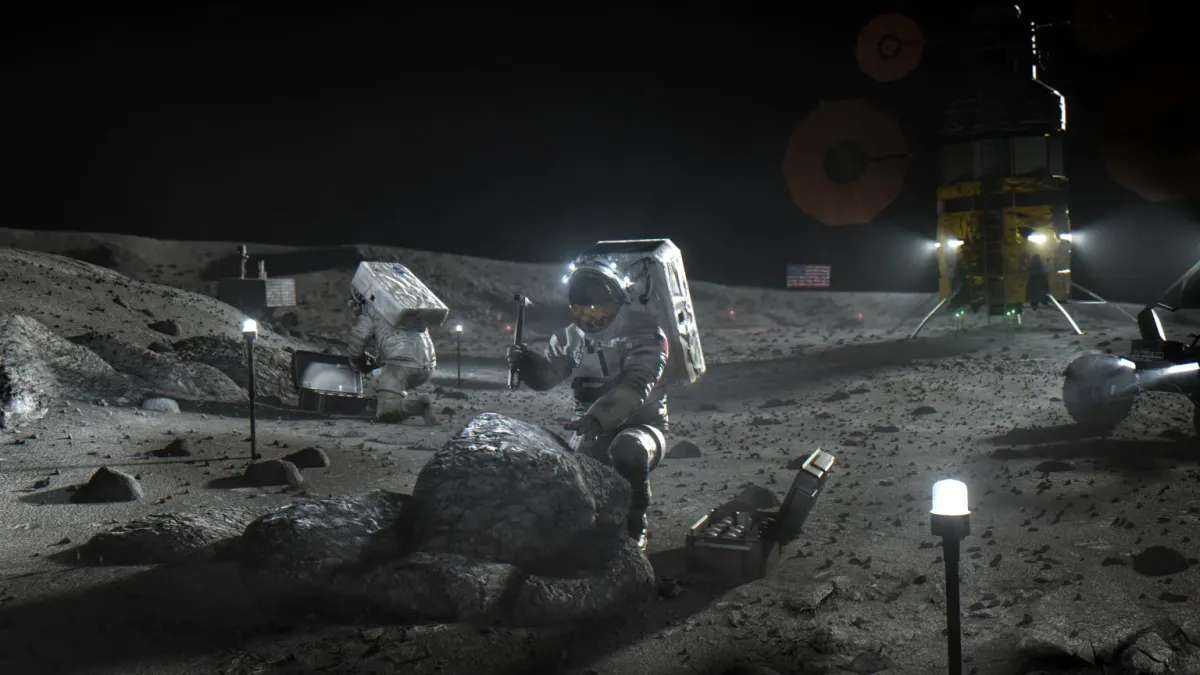
Moon bases might one day hide inside the Moon itself. Beneath the surface of both the Moon and Mars lie vast lava tubes—natural tunnels carved by ancient volcanic flows—that could shelter human explorers from radiation and space debris. A European research team has now proven that robots can navigate these extreme underground environments autonomously, mapping them in detail and preparing the way for future human missions.
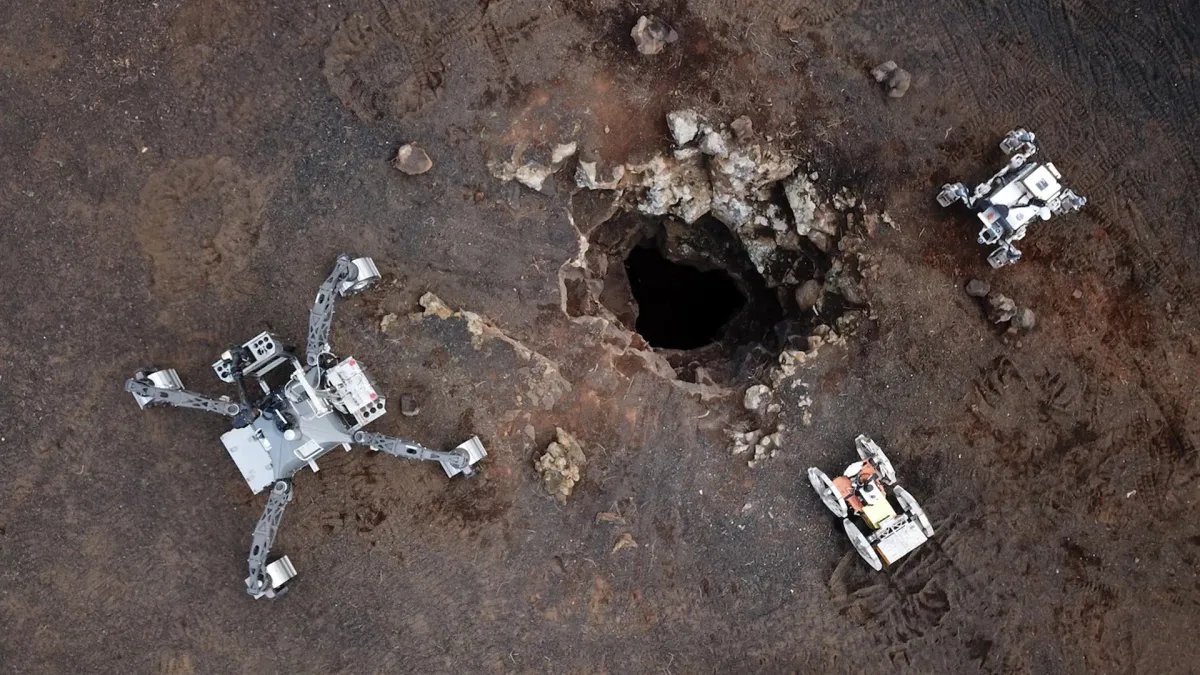
The concept sounds like science fiction, but the engineering is grounded in real-world testing. In February 2023, a consortium led by Germany's DFKI (German Research Center for Artificial Intelligence), along with researchers from the University of Malaga and the Spanish company GMV, sent three coordinated robots into a lava cave on the volcanic island of Lanzarote. The mission unfolded in four stages: first, the robots cooperatively mapped the area around the cave entrance. Then a sensor-equipped cube was dropped inside to gather initial measurements of the environment. A scout rover rappelled down through the opening to reach the interior, followed by a deeper exploration phase where the robotic team produced detailed 3D maps of the tunnel system.
The trial worked as planned. This matters because it demonstrates that autonomous robots can handle the kind of collaborative, complex exploration that future lunar and Martian bases will require. No human pilot controlling each movement in real-time. No waiting for radio signals to bounce back and forth across space. Just robots working together, making decisions, adapting to obstacles, and building maps of terrain that humans have never seen.
We're a new kind of news feed.
Regular news is designed to drain you. We're a non-profit built to restore you. Every story we publish is scored for impact, progress, and hope.
Start Your News DetoxWhy caves matter for space exploration
Lava tubes are essentially ready-made shelters. On the Moon, where surface temperatures swing wildly and radiation from solar wind is constant, a lava tube offers insulation and protection. They're also structurally stable—the rock overhead is thick enough to shield inhabitants from micrometeorites and cosmic rays. For a future lunar base, that's invaluable. You're not building from scratch in a vacuum; you're moving into geology that's already there.
The research also reflects a broader shift in space robotics: moving from single, remotely-operated machines to teams of autonomous agents that can coordinate, communicate, and divide tasks. The Space Robotics Laboratory at the University of Malaga has been central to this work, developing algorithms that let rovers plan routes and operate independently—crucial for missions where radio delays make real-time control impossible.
This isn't just a proof of concept buried in a research paper. The lab is training the next generation of space robotics engineers through internships and thesis projects, often in partnership with the European Space Agency. The knowledge being built now is the foundation for the robots that will actually descend into lunar caves in the next decade.
The question of whether humans will live in caves on the Moon is still open. But the robots that will explore them, map them, and prepare them for habitation are already working.