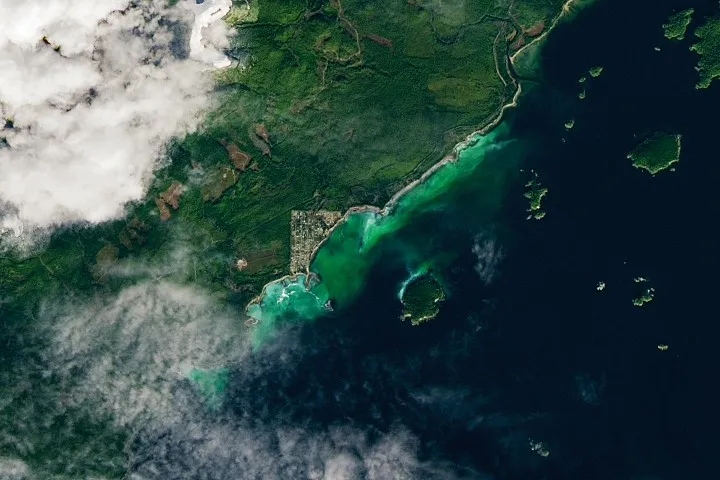
Imagine something so big, so vibrant, it's visible from space. That's exactly what a NASA satellite just caught off the coast of British Columbia, Canada: thousands of Pacific herring kicking off their annual spawning party.
Every year, from mid-February to early May, these fish gather in shallow waters, especially around Vancouver Island. It's a huge event, and this year, the Landsat 9 satellite got an early peek.
The Great Green Cloud
On February 19, 2026, Landsat 9 spotted the first major spawn in Barkley Sound, a favorite spot on Vancouver Island's southwest side. Here’s how it works: female herring lay their sticky eggs on kelp, seagrass, and rocks. Then, the males release a milky fluid called milt. This milt turns the ocean water a cloudy, almost glowing green or turquoise. Seriously cool to see.
We're a new kind of news feed.
Regular news is designed to drain you. We're a non-profit built to restore you. Every story we publish is scored for impact, progress, and hope.
Start Your News DetoxJessica Moffatt, a biologist with the Island Marine Aquatic Working Group (IMAWG), says herring love sheltered spots with rocky bottoms and slightly less salty water. Barkley Sound checks all those boxes. IMAWG is a clever group that mixes traditional knowledge from First Nations with modern science to help manage local fisheries.
These spawning events can last anywhere from a few hours to several days. Near Forbes Island, observers saw fish gathering by February 13, with the big show happening from February 19 to 21.
Why This Matters (Beyond the Cool Colors)
This isn't just a pretty sight. The sudden change in water color draws a crowd. Whales and sea lions show up for a feast, and you might spot eagles, wolves, and even bears on the shore. It's a whole ecosystem buzzing with life.
After they've done their thing, the herring head back to deeper, food-rich waters. They often stick together in massive schools for years. That's a serious commitment.
For a long time, we relied on surveys to track these spawns. But now, satellites like Landsat can watch huge areas over longer periods. Researchers at the University of Victoria have used decades of this satellite data to fill in historical gaps and even predict future spawns. That's pretty nuts.
Herring and their eggs are super important. They're a key food source for First Nations communities and a big deal for commercial fishing in British Columbia. Plus, as "forage fish," they're basically the backbone of the food chain for salmon and tons of other marine animals. Knowing exactly where and when they spawn helps us understand the health of our oceans. It's like getting an insider look at the ocean's annual party, and it tells us a lot about what's really going on down there.