Jordan Steele, a meteorologist in Atlanta, photographed something scientists had theorized about for decades but never actually seen: delicate purple sparks dancing across tree branches during a thunderstorm. These weak electrical discharges, called coronae, happen in the moments before lightning strikes—and until now, they'd eluded every camera.
The breakthrough came through ultraviolet imaging. Researchers at Penn State University used UV technology to finally make visible what had always been there, hidden from ordinary sight. It's a small but significant moment: a theory moves from classroom diagrams into documented reality.
Why this matters
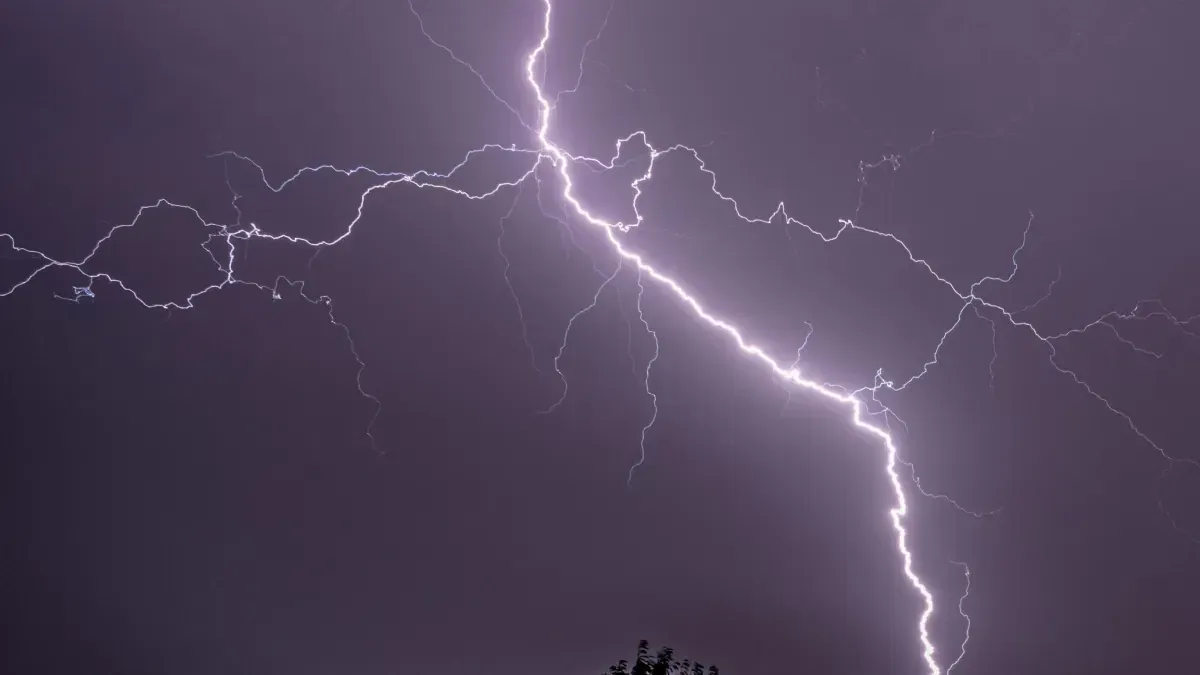
Coronae are part of how lightning actually forms. When a thunderstorm builds, electricity seeks the path of least resistance through air. These coronae are the opening act—the initial weak discharges that eventually lead to a full lightning strike. You've experienced the same principle: that eerie moment when your hair stands on end during a storm, your body's warning that a strike might be close. St. Elmo's Fire, the ghostly glow sometimes seen on ship masts or aircraft, works through the same electrical mechanism.
We're a new kind of news feed.
Regular news is designed to drain you. We're a non-profit built to restore you. Every story we publish is scored for impact, progress, and hope.
Start Your News DetoxBut here's what makes this capture interesting beyond the atmospheric science: it shows how modern tools can reveal layers of the world we've always inhabited but couldn't quite see. For generations, these coronae were happening in every thunderstorm—purple sparks flickering across branches, completely invisible to human eyes and standard cameras. The storm didn't change. The physics didn't change. Only our ability to witness it did.
The photograph has already sparked something unexpected online. Storm photographers and enthusiasts are now hunting for their own UV cameras, realizing they might already own most of the equipment needed—just missing the specialized lenses. There's a genuine shift happening: from "this is theoretically possible" to "I could actually document this myself." One observer noted the natural display made Christmas lights seem redundant, which captures something real about how we respond when nature reveals its hidden details.
This is how scientific understanding often advances—not through entirely new discoveries, but through finally being able to see what's been happening all along. The coronae were there in every storm your grandparents witnessed. Now, with the right camera, they're visible. That gap between what exists and what we can observe is where tools like ultraviolet imaging make their mark, turning atmospheric theory into something you can actually photograph and share.