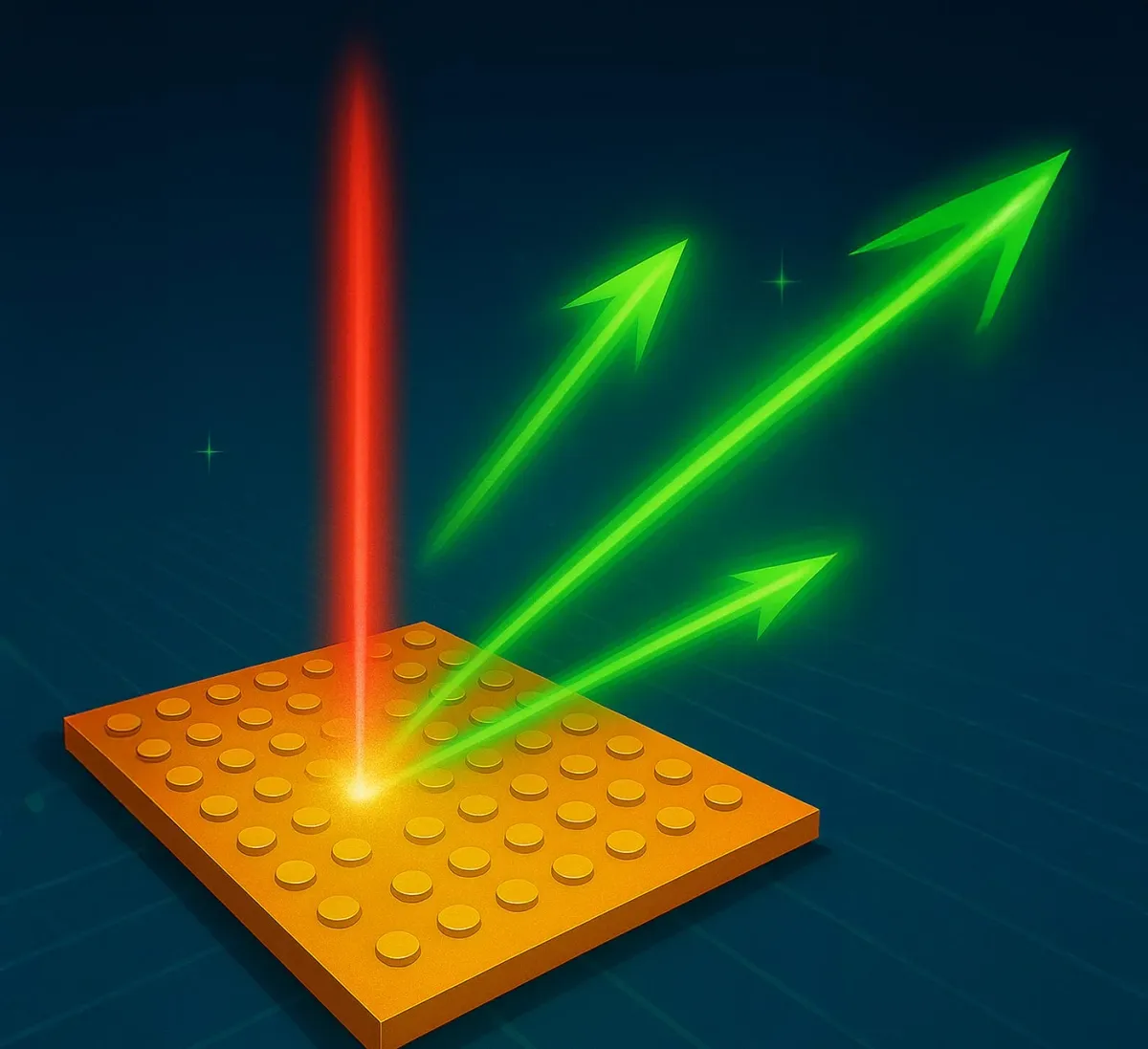
Scientists at CUNY's Advanced Science Research Center have built something that sounds like science fiction but works on a lab bench: a chip thinner than a human hair that acts like a microscopic spotlight. It takes invisible infrared light, converts it to visible green, and aims the beam wherever you want—all by simply flipping the polarization of the incoming light.
The device is a metasurface, which is essentially a flat piece of material engineered at the nanoscale with patterns smaller than light's wavelength. In their experiments, the team converted infrared light at 1,530 nanometers (the kind used in fiber optic cables) into green light at 510 nanometers, then steered that beam to precise angles. "Think of it as a flat, microscopic spotlight that not only changes the color of light but also points the beam wherever you want, all on a single chip," said Andrea Alù, founding director of the CUNY ASRC Photonics Initiative.
The engineering puzzle that took years to solve
This breakthrough solves a problem physicists have wrestled with for years. Metasurfaces have been around for a while—researchers have used them to bend, focus, and reshape light. But they faced a painful tradeoff: you could either control light precisely at each point on the surface (good for steering, bad for efficiency) or let light waves interact across the whole surface (good for efficiency, bad for control). You couldn't have both.
We're a new kind of news feed.
Regular news is designed to drain you. We're a non-profit built to restore you. Every story we publish is scored for impact, progress, and hope.
Start Your News DetoxThe CUNY device is the first to crack this. The trick involves something called a quasi-bound state in the continuum—essentially a way to trap and amplify the incoming infrared light across the entire chip. At the same time, each tiny element on the metasurface is rotated in a precise pattern, giving the outgoing light a built-in lens effect. The result: the chip converts light three times as efficiently as previous devices that could steer beams, and it does it about 100 times more efficiently than similar systems.
What makes this particularly elegant is the control mechanism. Reverse the polarization of the incoming light, and the outgoing beam reverses direction. No moving parts, no complex electronics—just a property of light itself.
Why this matters beyond the lab
The applications are starting to come into focus. Michele Cotrufo, the lead author and now an assistant professor at the University of Rochester, points to LiDAR (the light-based radar that guides autonomous vehicles), quantum light generation, and optical signal processing. All of these currently rely on bulky, power-hungry components. A flat chip that does the work could shrink these systems dramatically and cut energy use.
There's also a broader implication: because the concept relies on geometry rather than one specific material, it should work with different materials and across different wavelengths—from visible light all the way to ultraviolet. The researchers are already thinking about stacking multiple metasurfaces, each tuned to different wavelengths, which could expand the range of light colors the chip can handle efficiently.
This is the kind of progress that doesn't make headlines but quietly reshapes what's possible. A decade from now, the light-steering chip in your phone's camera or your car's navigation system might trace its lineage back to this thin piece of engineered material on a lab bench in New York.