Scientists have found a new way that cells die and how the immune system cleans them up. This discovery could change how we fight diseases.
Researchers at La Trobe University found a previously unknown way viruses might spread. This new information could help create better treatments.
The study, published in Nature Communications, gives new insights into how cells die and are replaced. PhD candidate Stephanie Rutter led the work in Professor Ivan Poon’s lab.
We're a new kind of news feed.
Regular news is designed to drain you. We're a non-profit built to restore you. Every story we publish is scored for impact, progress, and hope.
Start Your News DetoxThe research shows that cell death is a very organized process. Each step helps break down the dying cell so the immune system can remove it.
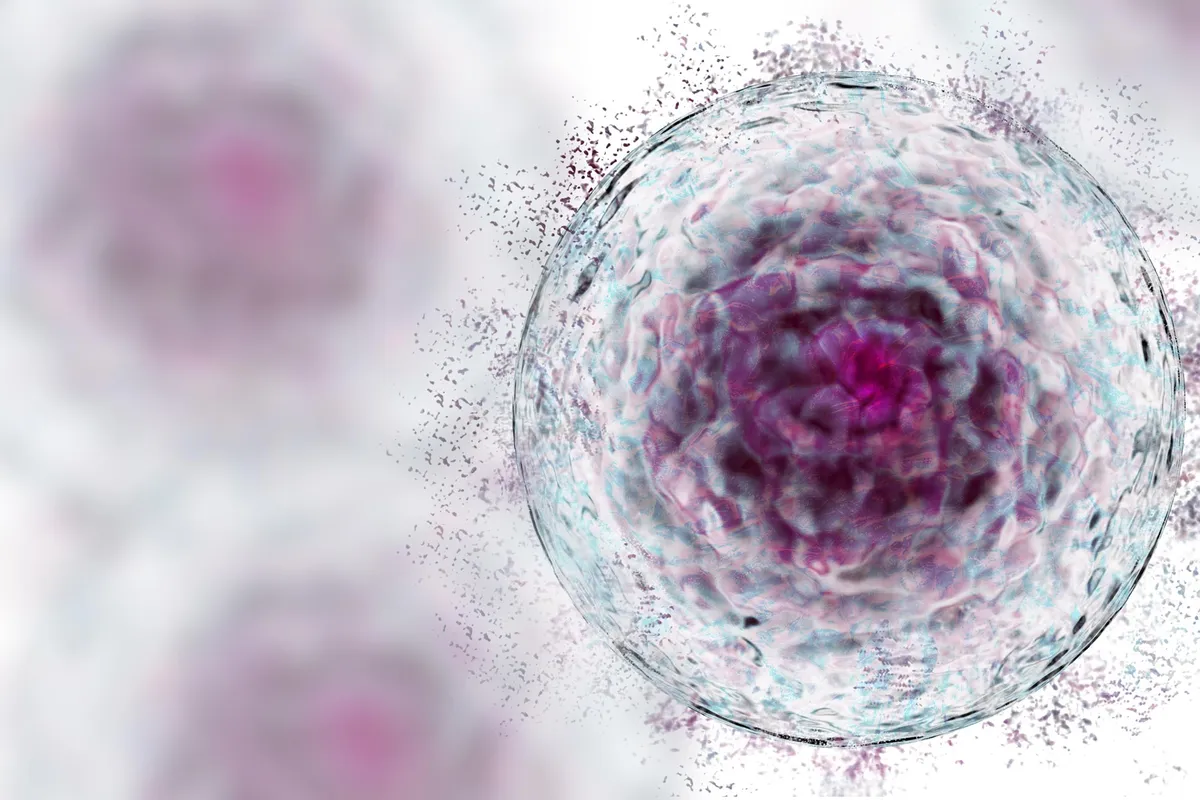
As cells self-destruct, they change shape and detach from nearby tissue. They leave behind a residue called the "footprint of death." This residue contains a new type of tiny particle called an extracellular vesicle (EV).
EVs are small particles released by cells. They carry proteins, fats, DNA, and RNA to other cells. They are important for how cells communicate.
The Footprint of Death
These new vesicles are called F-ApoEVs. They mark where a cell has died. They act like signals, guiding the immune system to find and clear away cell debris. This helps prevent inflammation.
However, early lab tests showed something surprising. When dying cells are infected with the flu virus, the virus can use this cleanup system. It hides inside the F-ApoEVs. This might help the virus spread to other cells.
Professor Poon, who directs the Research Centre for Extracellular Vesicles (RCEV), said this discovery could affect future drug development.
He explained that understanding this basic process could lead to new research. This research might help develop treatments that use these steps to boost the immune system and fight disease better.
Billions of cells die each day as part of normal body function and disease. Until now, scientists thought cell fragmentation during death was random and simple. These new findings show the process is complex. Each step is critical for the dying cell to break down efficiently and be cleared by the immune system.
How Viruses Exploit Cells
Rutter noted that these findings show how important cell-to-cell communication is for health. They also reveal how viruses can take advantage of these systems.
She said the body clears dead cell fragments to prevent inflammation and autoimmune diseases like Systemic Lupus Erythematosus (SLE). The team saw that F-ApoEVs are quickly cleared from where a cell dies.
What they did not expect was how viruses could use this process to cause infection by hiding in F-ApoEVs.
The team believes this discovery could help us better understand infectious and autoimmune diseases. This could eventually lead to improved treatments.
Rutter added that the more we understand about cell death and what happens afterward, the better we can understand diseases and find new treatments.
Dr. Georgia Atkin-Smith from WEHI, a co-leader, highlighted the broader importance of the findings. She said the study showed that dying cells can still communicate and might affect immune function.
Deep Dive & References
The formation of the ‘footprint of death’ as a mechanism for generating large substrate-bound extracellular vesicles that mark the site of cell death - Nature Communications, 2025
This research was done by scientists at La Trobe University’s RCEV, LIMS, and the School of Agriculture, Biomedicine and Environment (SABE). They worked with researchers at WEHI and Toronto Metropolitan University in Canada.