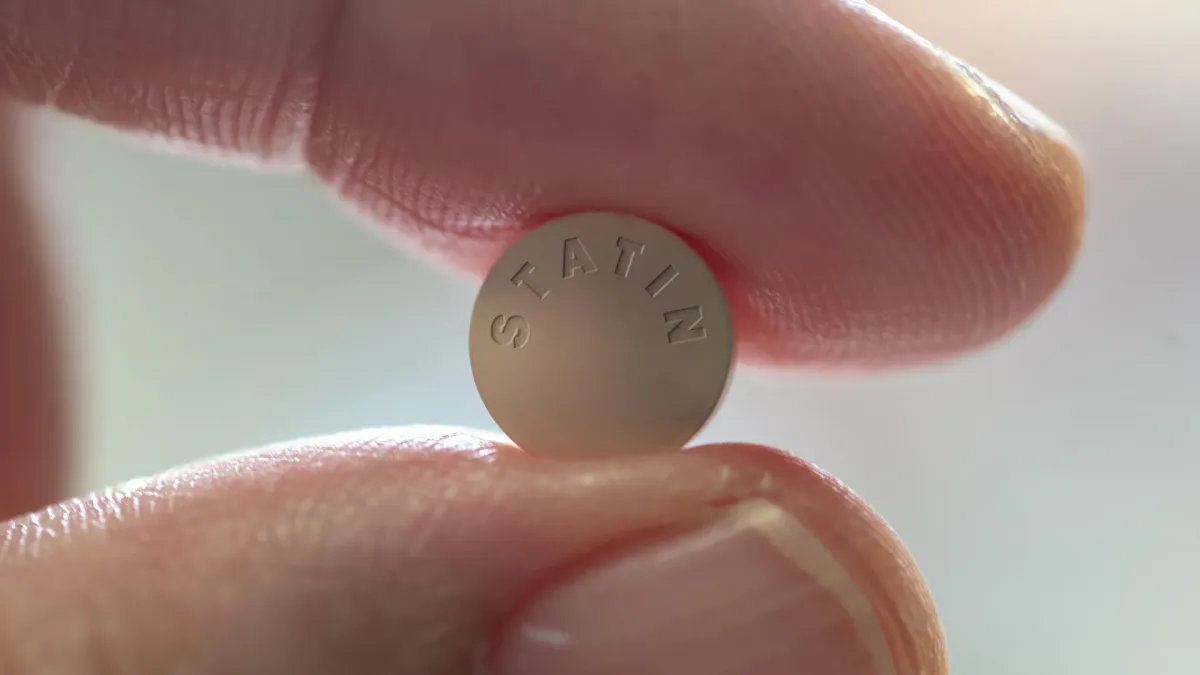
Statins save lives. They lower cholesterol, prevent heart attacks, and have kept millions of people alive. But roughly one in five people who take them experience muscle pain bad enough to stop treatment entirely. For decades, doctors knew this happened—they just didn't know why.
Now they do. Researchers at the University of British Columbia and University of Wisconsin-Madison have identified the precise molecular culprit: statins force open a critical muscle protein, flooding cells with calcium. The finding is a breakthrough not because it solves the problem immediately, but because it gives scientists a map for designing safer statins that keep the heart benefits without the muscle damage.
The Calcium Leak
The team used cryo-electron microscopy—a technique that lets scientists see proteins in near-atomic detail—to watch how statins interact with a muscle protein called the ryanodine receptor. Think of this protein as a calcium gate. It's supposed to open only when your muscles need to contract. But when statins bind to it, they jam it open, creating a continuous leak of calcium into the cell. That leak is toxic. It causes the muscle soreness and weakness that send patients back to their doctors asking if they can stop taking the drug.
We're a new kind of news feed.
Regular news is designed to drain you. We're a non-profit built to restore you. Every story we publish is scored for impact, progress, and hope.
Start Your News Detox"We were able to see, almost atom by atom, how statins latch onto this channel," said Dr. Steven Molinarolo, the postdoctoral researcher who led the work. "That leak of calcium explains why some patients experience muscle pain or, in extreme cases, life-threatening complications."
The researchers focused on atorvastatin, one of the world's most commonly prescribed statins. But they believe the same mechanism applies across the statin family.
A Roadmap Forward
Here's where it gets practical. The team discovered that statins bind to the ryanodine receptor in an unusual pattern: three statin molecules cluster together inside a pocket of the protein. The first one binds while the channel is closed, then two more lodge in and force it fully open. This is the first time anyone has seen this mechanism clearly.
"It's a big step forward because it gives us a roadmap for designing statins that don't interact with muscle tissue," said Dr. Filip Van Petegem, the senior author. By modifying only the parts of the statin molecule responsible for these harmful interactions—while leaving the cholesterol-lowering machinery intact—researchers may be able to design a new generation of statins that work without the muscle side effects.
Severe muscle injury from statins is rare, affecting only a small fraction of the more than 200 million people taking them worldwide. But milder symptoms—soreness, fatigue, general weakness—are common enough that they drive real people to stop treatment. That matters. Those people then lose the heart protection statins provide. If safer versions can keep patients on their medication, the health gains compound.
The breakthrough also highlights something quieter but equally important: how advanced imaging tools are transforming medical research. This question has hung over statin safety for decades. Better microscopes finally gave scientists the clarity to answer it.
For millions of people balancing heart health against muscle pain, this research suggests the choice may not stay binary for much longer.