For decades, cell membranes refused to behave the way physics said they should. Scientists would add cholesterol to these fatty cellular skins, expecting predictable changes in how flexible or stiff they'd become. Sometimes they did. Sometimes they didn't. The results were a mess—and it bothered physicists.
Rana Ashkar, a physicist at the University of Delaware, had a hunch that everyone was asking the right question at the wrong scale. When she and her team zoomed in to the nanoscale—billionths of a meter—the chaos suddenly looked like order. What they found, published in Nature Communications, wasn't just academically satisfying. It opens doors to better drug delivery, artificial cells, and understanding why some diseases unravel the membrane's control in the first place.
The Cholesterol Problem
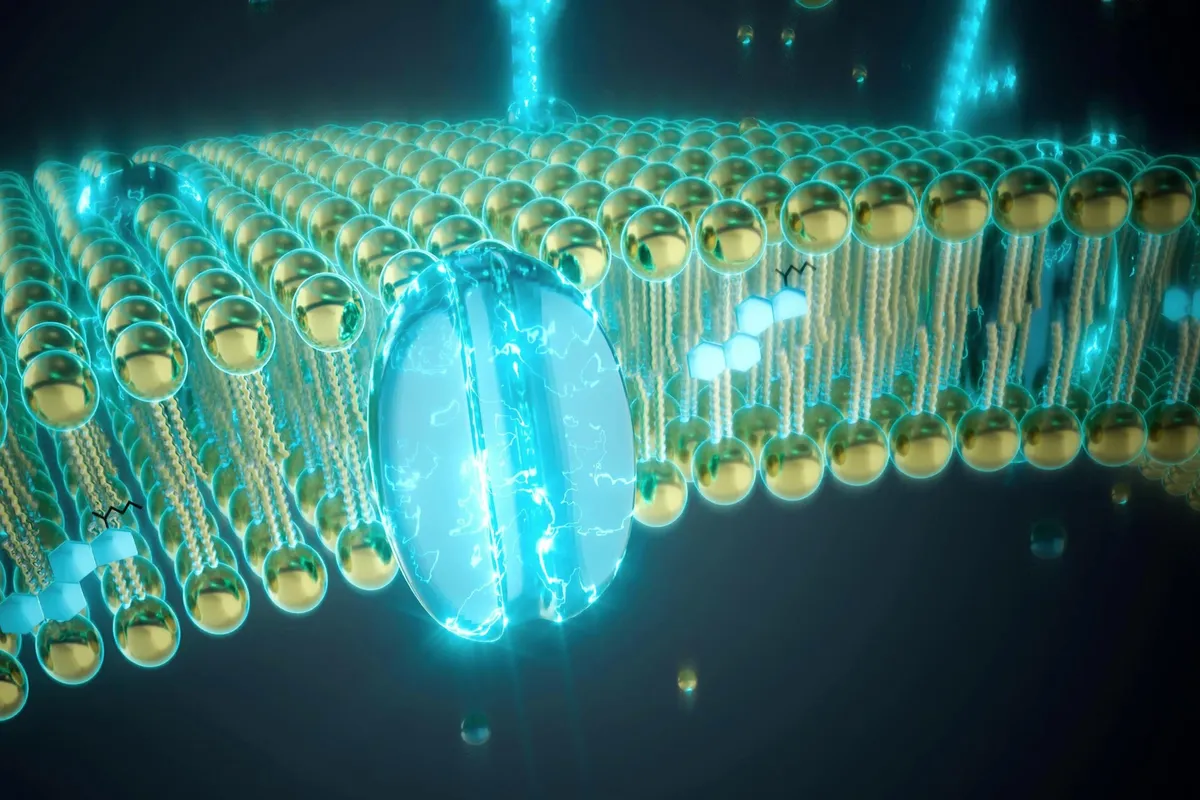
Cell membranes are mostly made of lipids—fatty molecules that form a flexible barrier around everything alive. They're not rigid. When temperature shifts or diet changes, cells can swap out their lipid composition within hours, a survival trick called homeostasis. The membrane adjusts itself to stay stable even when the world outside gets chaotic.
We're a new kind of news feed.
Regular news is designed to drain you. We're a non-profit built to restore you. Every story we publish is scored for impact, progress, and hope.
Start Your News DetoxBut here's where it got weird. Physics has a straightforward rule: change a material's ingredients, and its physical properties should change too. Wood gets heavier when you add water. Steel gets softer when you heat it. The ingredients determine the behavior.
Cell membranes didn't follow the script. Researchers would add cholesterol to model membranes and measure how flexible or elastic they became. Some membranes stiffened. Others barely changed. "It caused a dilemma in the field," Ashkar said. "Somehow cholesterol changed the structure of some membranes but not their elastic properties."
Most scientists assumed different types of lipids must respond to cholesterol differently. Ashkar wondered if everyone was just measuring at the wrong resolution.
What Really Matters
Using neutron scattering and X-ray techniques, Ashkar's team discovered something simpler and more powerful: elasticity depends far less on which lipids you have and far more on how tightly they're packed together. Some lipids naturally resist compression. Others squeeze in close. The density of that packing—how snugly the molecules sit—turned out to be the master control for flexibility.
This matters because membrane flexibility is essential to cell survival. A membrane that can't bend properly can't let nutrients in or waste out. It can't respond to stress. It can't do its job.
The team worked with collaborators at the University of Arizona and Stockholm University to confirm the pattern held across different experiments and computational models. The principle was consistent: cells follow a simple, elegant design rule. Pack the lipids tightly, and the membrane stiffens. Loosen them, and it becomes more flexible. Composition is less important than arrangement.
"Membranes can have remarkable compositional complexity," Ashkar said, "but what really matters in determining or predicting their elasticity is how packed they are. And that is a very, very powerful design principle that cells seem to follow and that we can now apply in engineering lifelike artificial cells."
This isn't just about solving a physics puzzle. Understanding how membranes actually work—at the level where they actually work—opens possibilities for designing drugs that slip through membranes more effectively, building artificial cells that behave like real ones, and eventually understanding what goes wrong when diseases like Alzheimer's or certain cancers start breaking down the membrane's protective control.
The next step is applying this principle. Now that we know what cells are doing, we can start doing it on purpose.