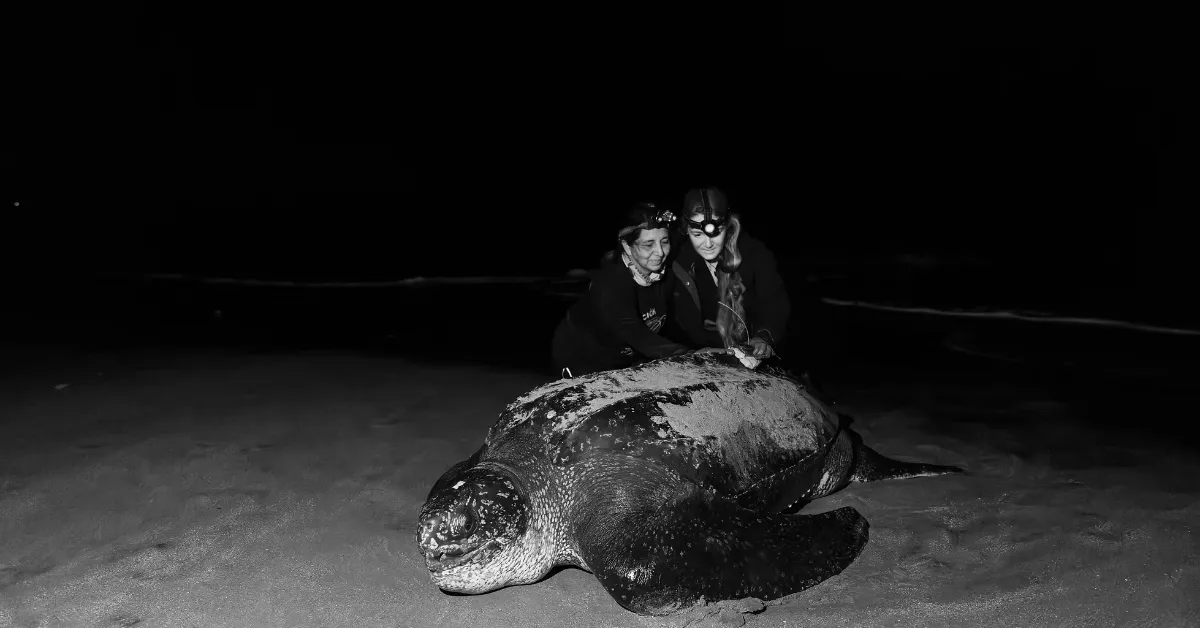
Only about a thousand leatherback sea turtles are left in the Eastern Pacific. These magnificent, enormous creatures, who can weigh as much as a small car, nest along a stretch of coast from Mexico to Ecuador. So when researchers in Ecuador recently spotted one heading for a remote beach to lay her eggs, they knew they had a rare opportunity.
They named her Lucero, which means "morning star" in Spanish. Because apparently, even critically endangered, 2,000-pound reptiles get a poetic moniker. Scientists estimate she's between 25 and 40 years old, and now, thanks to a satellite tag, they're tracking her every move.
The Great Turtle Stakeout
Attaching a tracker to a massive, ancient sea turtle isn't exactly a walk in the park. The team, including marine conservation biologist Callie Veelenturf, spent multiple nights on the beach, radios in hand, waiting for Lucero to make her grand appearance. Veelenturf described it as an adventure, which is a polite way of saying it was probably a very long, sandy, and mosquito-filled stakeout.
We're a new kind of news feed.
Regular news is designed to drain you. We're a non-profit built to restore you. Every story we publish is scored for impact, progress, and hope.
Start Your News DetoxLuckily, sea turtles enter a kind of trance when laying eggs, becoming blissfully unaware of the humans attaching high-tech gear to their shells. Once Lucero was done, the team affixed a satellite tag that now pings her location every time she surfaces for air. It's like a very slow, very important GPS signal.
Why Lucero Matters
So, why all the fuss over one turtle? The Eastern Pacific leatherback population has plummeted by 98% in recent decades. A major culprit is bycatch — getting tangled in fishing nets, which is bad for both turtles and the nets.
By tracking Lucero's migration routes, timing, and diving depths, scientists hope to map out where these turtles hang out. This data can then inform fishers, helping them avoid areas where sea turtles are common. Because nobody wants to accidentally catch a two-ton, critically endangered animal.
And here's the kicker: leatherbacks eat their weight in jellyfish daily. Jellyfish, it turns out, are big fans of eating young fish and fish larvae. So, a healthy leatherback population doesn't just save turtles; it helps keep fish stocks healthy, which in turn supports fishing communities. It's a surprisingly elegant ecosystem balance, all thanks to a jellyfish-guzzling giant.
Lucero, since laying her eggs, has already traveled south to coastal Peru. Her tag is expected to stay on for one to two years, hopefully long enough to map out her entire migration and feeding grounds. Veelenturf checks the signal daily, probably with the kind of anticipation usually reserved for lottery results. Because when it comes to saving a species, every ping counts.