Perovskite solar cells have long promised a cheaper, more flexible alternative to traditional silicon panels. They're easier to manufacture at scale, which matters enormously for a technology that needs to power millions of homes. But they've had a stubborn problem: the buried interface where two critical layers meet has been nearly impossible to control precisely, and that microscopic flaw tanks both efficiency and durability.
Researchers at China's Qingdao Institute of Bioenergy and Bioprocess Technology just published a solution in Nature Synthesis that sounds deceptively simple: use tiny crystal seeds to guide how the perovskite layer forms.
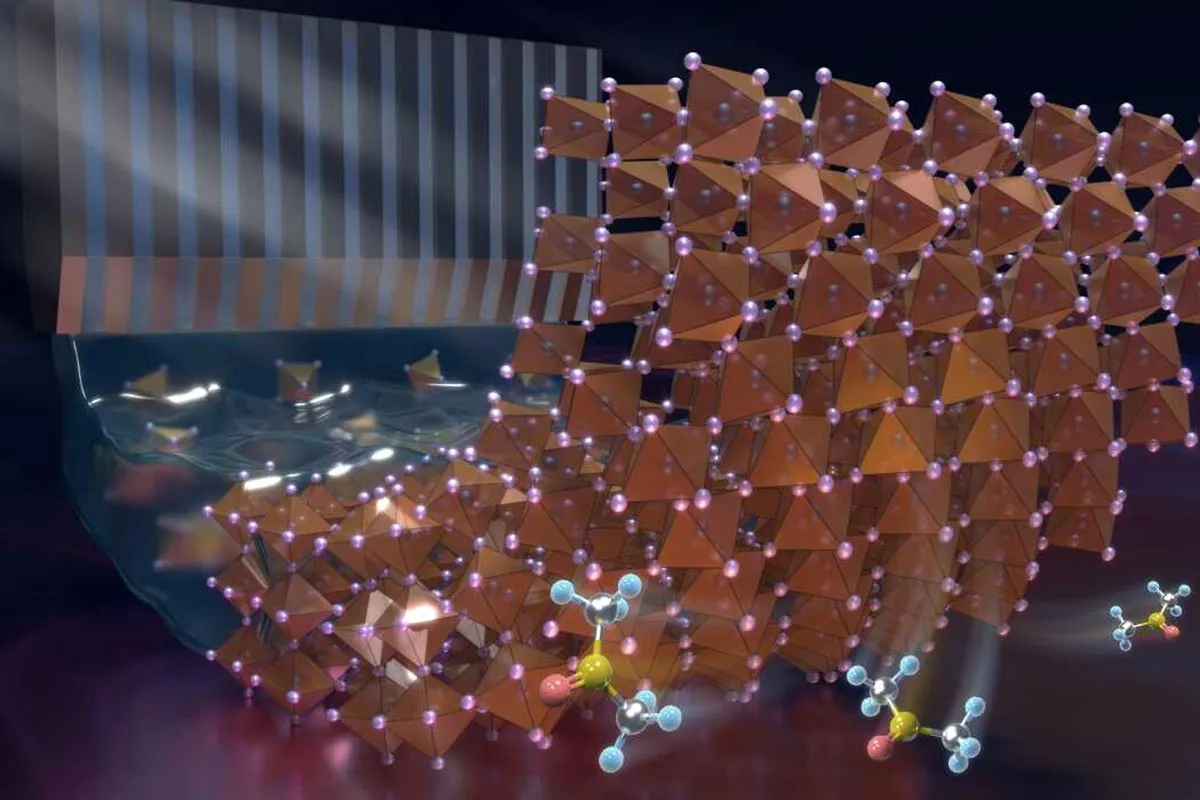
Here's what they did. They deposited specially engineered nanocrystals—rod-shaped structures containing dimethyl sulfoxide (DMSO)—onto the substrate before the perovskite layer was added. These seeds act like a scaffold. They help the perovskite precursor solution spread evenly across a surface that normally repels it, and they provide abundant nucleation sites where perovskite crystals can start growing in an organized way.
We're a new kind of news feed.
Regular news is designed to drain you. We're a non-profit built to restore you. Every story we publish is scored for impact, progress, and hope.
Start Your News DetoxThe real innovation is what happens next. When the device is heated during manufacturing, the DMSO molecules trapped inside the crystal structure gradually release. This creates a localized solvent atmosphere right at that critical buried interface—what the team calls "lattice-confined solvent annealing." It's gentle enough to let crystal grains reorganize and align without damaging anything, producing a denser, more uniform perovskite layer with fewer structural defects.
From lab to factory floor
What makes this genuinely significant is that it works at scale. The team combined their seeding method with slot-die coating—an industrial manufacturing technique—to produce a perovskite solar module 49.91 square centimeters in size. The efficiency was 23.15%. More importantly, the efficiency drop from tiny lab cells to this larger module was less than 3%. That's the number that matters for commercialization. Many earlier approaches lost far more performance when scaled up, which is why perovskites haven't yet reached your rooftop.
The researchers also note that their approach opens a broader platform. By adjusting the organic compounds and solvent molecules in the crystal seeds, they can tune the system for different applications—not just solar cells, but other semiconductor devices too.
This is the kind of incremental-but-crucial progress that rarely makes headlines. No breakthrough, no revolution. Just a team identifying a specific bottleneck and engineering a practical solution that actually works when you try to manufacture it at meaningful scale. That's how technologies move from "promising" to "deployable."