Scientists have created tiny, atom-sized pores that act like the channels found in living cells. This breakthrough could lead to new types of nanotechnology.
Ion channels are vital pathways in living systems. They are incredibly narrow, sometimes just a few atoms wide. Building artificial pores this small has been very difficult with current technology.
Mimicking Nature's Channels
Researchers at the University of Osaka found a new way to create these tiny pores. They used a miniature electrochemical reactor to form pores that are almost subnanometer in size. Their findings were published in Nature Communications.
We're a new kind of news feed.
Regular news is designed to drain you. We're a non-profit built to restore you. Every story we publish is scored for impact, progress, and hope.
Start Your News DetoxIn living cells, ions move through protein channels in cell membranes. This movement creates electrical signals, like those that control muscle movement. These natural channels have very narrow parts and can open or close based on external signals.
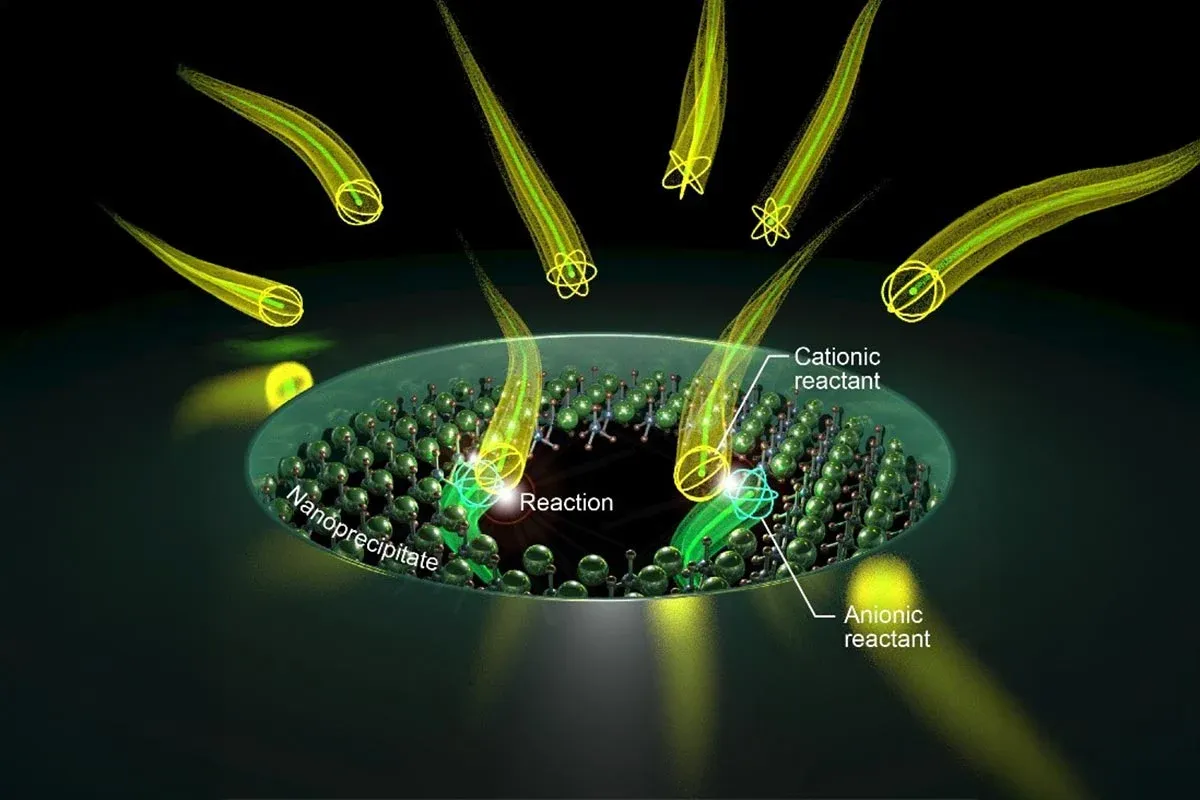
The research team was inspired by these natural processes. They built a solid-state system that can form pores similar to biological ion channels. They started with a nanopore in a silicon nitride membrane. This nanopore then became a tiny reaction chamber.
When a negative voltage was applied, a chemical reaction happened inside the nanopore. This reaction created a solid material that gradually filled and blocked the pore. When the voltage was reversed, the material dissolved, allowing ions to pass through again.
Makusu Tsutsui, the lead author, explained that this opening and closing process could be repeated hundreds of times over several hours. This shows the reaction is strong and can be controlled.
Electrical Spikes and New Possibilities
The scientists watched ions flow through the membrane. They saw sudden spikes in electrical current, much like those in natural ion channels. This suggests that many subnanometer pores were forming within the original nanopore.
The system's behavior could also be changed. By altering the chemicals and pH of the solutions, the researchers could control the size and properties of these ultrasmall pores.
Tomoji Kawai, a senior author, noted that they could adjust the pores' behavior and effective size. This allowed them to selectively transport ions of different sizes through the membrane.
This new method lets multiple ultrasmall pores form inside a single nanopore. It offers a powerful way to study how ions and fluids move in very tight spaces, similar to biological environments.
This chemically driven membrane system could help develop new technologies. These include single-molecule sensing, like using nanopores to sequence DNA. It could also advance neuromorphic computing, which mimics brain neurons, and nanoreactors, which create unique reaction conditions.
Deep Dive & References
Chemistry-driven autonomous nanopore membranes - Nature Communications, 2026