Astronomers have just created the sharpest map yet of dark matter—the invisible stuff that makes up most of the Universe's mass and holds everything together through gravity alone.
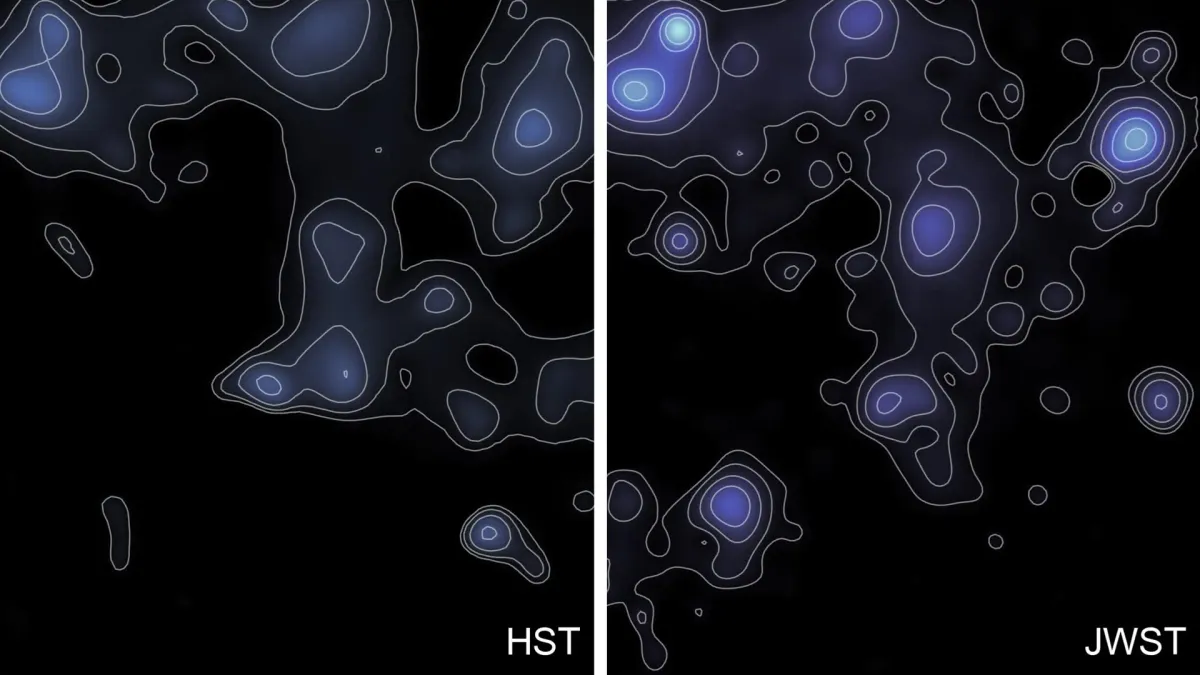
Using NASA's James Webb Space Telescope, researchers mapped a patch of sky about 2.5 times the size of the full Moon and found nearly 800,000 galaxies, many never seen before. More importantly, they revealed how dark matter's gravitational scaffolding shaped the cosmos itself.
Here's what makes this significant: In the Universe's first moments, dark matter and ordinary matter were spread thinly everywhere. Dark matter clumped first. Its gravity then pulled in the normal matter—the stuff that makes stars, planets, and you—into dense regions where galaxies could form. Without this early gravitational architecture, stars and planets might never have existed at all.
We're a new kind of news feed.
Regular news is designed to drain you. We're a non-profit built to restore you. Every story we publish is scored for impact, progress, and hope.
Start Your News Detox"By revealing dark matter with unprecedented precision, our map shows how an invisible component of the Universe has structured visible matter to the point of enabling the emergence of galaxies, stars, and ultimately life itself," said Dr. Gavin Leroy from Durham University, one of the study's lead researchers.
The challenge has always been that dark matter is genuinely invisible. It doesn't emit light, absorb it, or interact with ordinary matter in any way we can directly detect. Billions of dark matter particles pass through your body every second without a trace. But detect it we can—through gravity's effects.
When light from distant galaxies travels toward Earth, dark matter's mass warps space itself, bending that light like it's passing through a warped windowpane. By measuring these subtle bends, astronomers can map where dark matter actually is. The new Webb observations are twice as sharp as any dark matter map made before, revealing finer details about how dark matter and normal matter align throughout the cosmos.
"Wherever you find normal matter in the Universe today, you also find dark matter," said Professor Richard Massey, also from Durham. "The whole swirling cloud of dark matter around the Milky Way has enough gravity to hold our entire galaxy together. Without it, we'd spin ourselves apart."
This is just the beginning. Researchers plan to expand these observations using the European Space Agency's Euclid telescope and NASA's upcoming Nancy Grace Roman Space Telescope to map dark matter across much larger regions of space. That work will help answer deeper questions: What exactly is dark matter made of? How has it changed over billions of years? Understanding these answers could reshape our understanding of physics itself.