For a quarter-century, quantum physicists have been staring at a wall. A very specific, very tiny, very entangled wall. It turns out, you can't build a quantum future without being able to properly measure something called a W state. And measuring W states? Well, that's been the equivalent of trying to weigh a ghost with a broken scale.
Until now. A team of Japanese researchers just cracked the code, finding a one-shot way to identify these notoriously tricky quantum states. Which, if you think about it, is both impressive and slightly terrifying.
The Ghost in the Machine
So, what's a W state, and why should you care? Imagine a quantum entanglement, but extra tough. Unlike other fragile quantum states, W states are like the cockroaches of the quantum world — even if one particle gets lost, the others stay entangled. This makes them absolute gold for quantum communication, where particles vanishing into the void is just another Tuesday.
We're a new kind of news feed.
Regular news is designed to drain you. We're a non-profit built to restore you. Every story we publish is scored for impact, progress, and hope.
Start Your News DetoxThe problem? Measuring them was a nightmare. Traditional methods involved quantum tomography, which basically means taking so many pictures that by the time you're done, the moment's long gone. The more photons you added, the exponentially longer it took, making it about as practical as using a sundial to time a drag race.
Scientists knew there had to be a better way — an "entangled measurement" that could reveal the whole state in one go. They'd done it for simpler systems, but W states remained stubbornly enigmatic. For 25 years. Cue the dramatic music.
Then, a combined force from Kyoto University and Hiroshima University decided enough was enough.
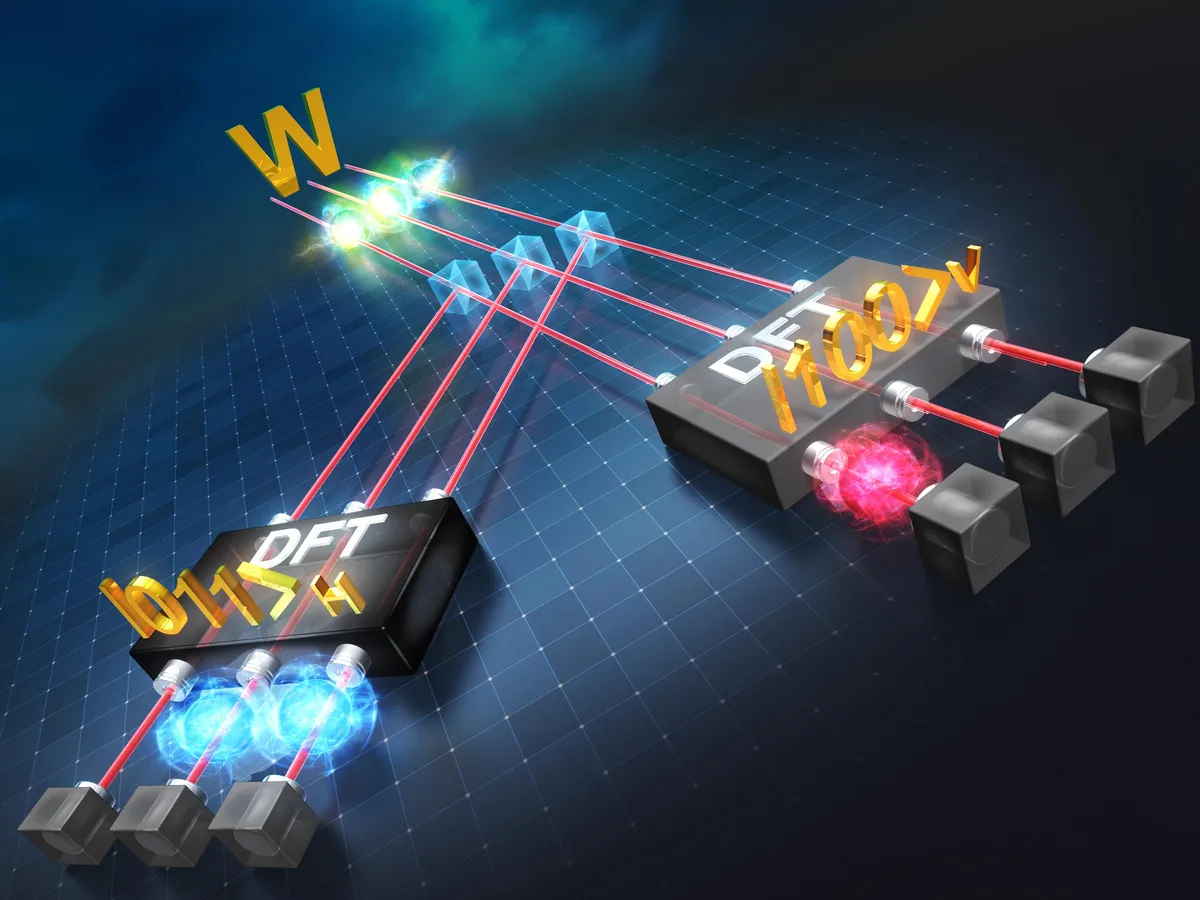
Instead of brute-forcing the problem, they got clever. They looked for a hidden pattern: cyclic shift symmetry. Think of it like a quantum kaleidoscope — if you rotate the photons' positions, the state looks the same. By building an optical system specifically designed to detect this symmetry, they found a direct path to identifying the W state.
Their device, a stable setup for three photons, essentially performs a quantum Fourier transform. The way photons exit tells them exactly which W state they're dealing with. No more endless data collection. Just a quantum mic drop.
From Lab to Your Living Room (Eventually)
This isn't just a win for people who enjoy staring at equations. This breakthrough could turbocharge quantum teleportation (yes, that kind), make quantum communication even more secure, and pave the way for distributed quantum computing. Essentially, it makes entanglement easier to measure, which means more reliable and scalable quantum networks. Because apparently that's where we are now.
Shigeki Takeuchi, one of the lead authors, wisely noted that understanding basic concepts is the real secret sauce. Now, the team is planning to scale this up and shrink it down onto tiny photonic chips. If they pull that off, quantum tech might just move from the lab bench to, well, wherever quantum tech goes next. Probably your phone, but with legs.