Liquid Gears Spin Without Touching
Researchers at New York University have created a new gear system. It uses fluid motion to make things spin instead of physical teeth. This could lead to mechanical devices that are more flexible and durable than traditional gears.
Jun Zhang, a professor at NYU and NYU Shanghai, explained that they invented gears that engage by spinning fluid. This allows for new ways to control rotation speed and direction.
Rethinking Gears
Gears have been essential in machines for thousands of years. Early examples from China around 3,000 BCE were used in chariots. They also appeared in ancient Greek devices like the Antikythera mechanism, which predicted astronomical events.
We're a new kind of news feed.
Regular news is designed to drain you. We're a non-profit built to restore you. Every story we publish is scored for impact, progress, and hope.
Start Your News DetoxTraditional gears have limitations. Their rigid teeth can get damaged and must align perfectly. Zhang, along with Leif Ristroph and Jesse Etan Smith, explored if gears could work without physical contact. They thought that controlled fluid flows could act like gear teeth.
Fluid Flows Replace Mechanical Contact
The team experimented with cylindrical rotors in a liquid mix of glycerol and water. They adjusted the liquid's properties, like viscosity and density, to control its behavior.
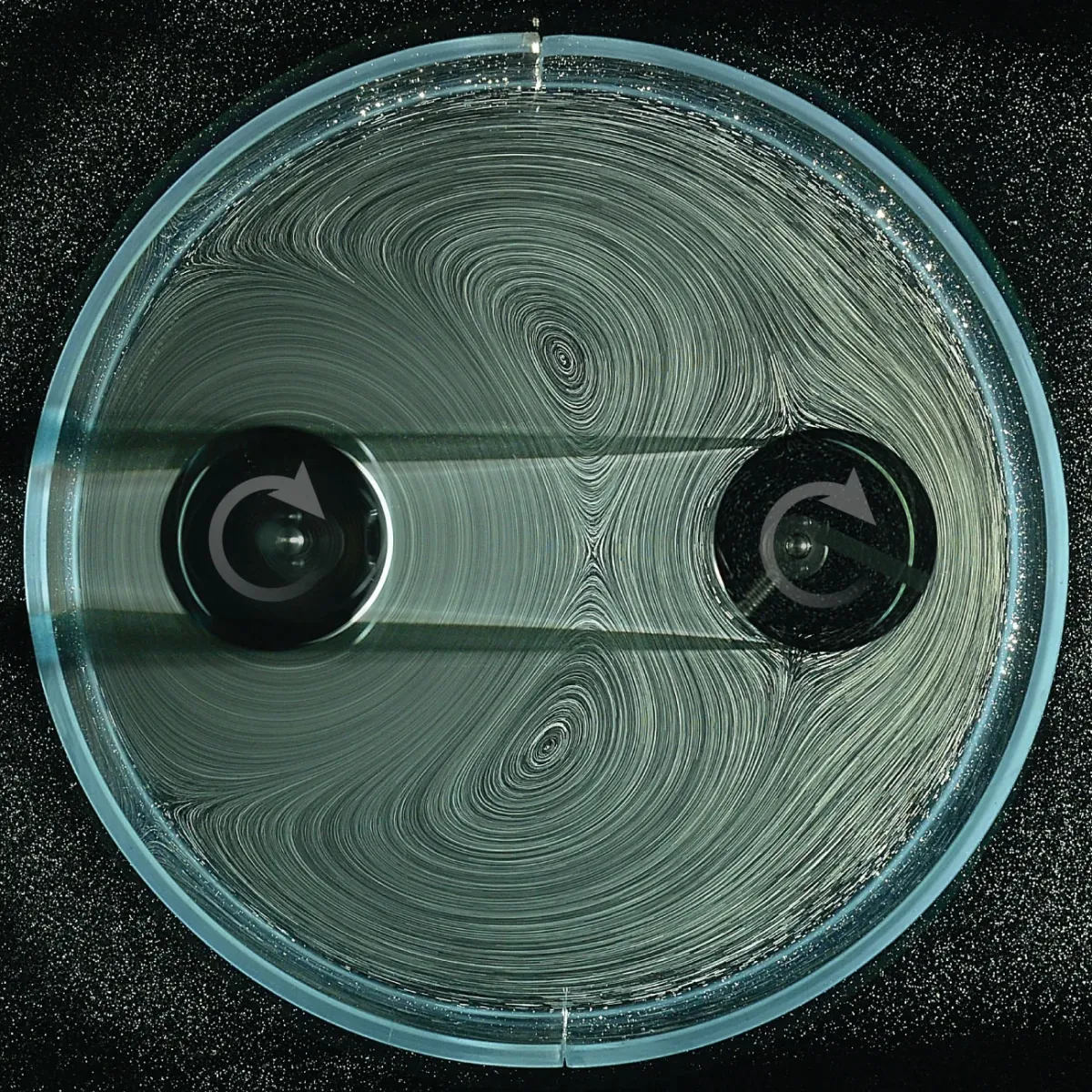
In their setup, one cylinder rotated actively, while a second remained passive. The active cylinder's motion created fluid currents that turned the passive one. They added tiny bubbles to the liquid to see these flows. Experiments tested different distances between cylinders and varying rotation speeds.
The results showed that the interaction between the spinning cylinders and the fluid could mimic different mechanical systems. When the cylinders were close, the fluid acted like gear teeth, making the passive rotor spin in the opposite direction.
When the cylinders were farther apart and the active rotor spun faster, the fluid wrapped around the passive cylinder like a belt and pulley. This made both cylinders rotate in the same direction.
New Control and Design Possibilities
The researchers noted several benefits of this fluid-based approach.
Ristroph explained that regular gears need precise design for their teeth to mesh correctly. Any flaw can cause them to jam. Fluid gears avoid these issues. Their speed and direction can also be changed in ways not possible with mechanical gears.
Deep Dive & References
Hydrodynamic Spin-Coupling of Rotors - Physical Review Letters, 2026
The National Science Foundation supported this research.