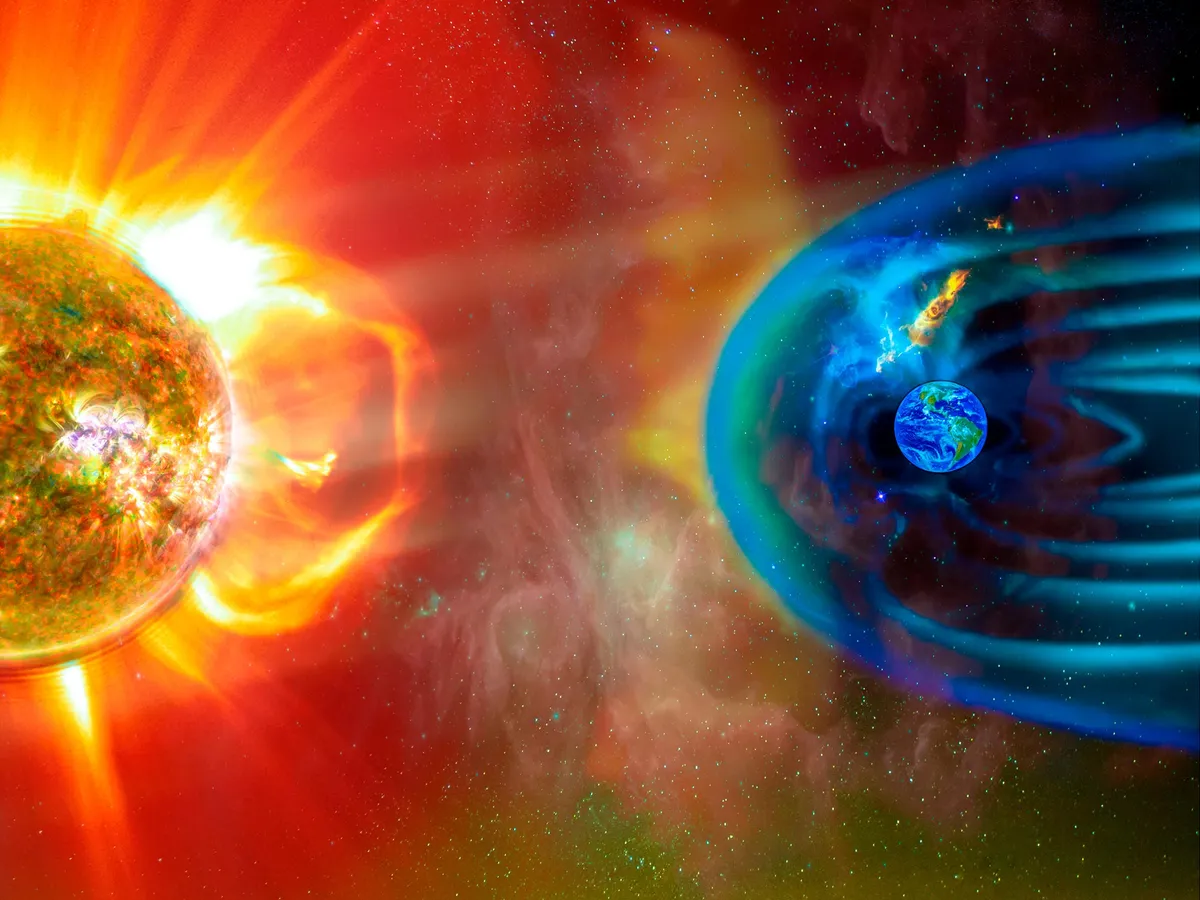
Scientists at Kyoto University have sketched out a plausible physical pathway linking space weather to earthquake initiation — not as a forecasting tool, but as a framework for understanding how the atmosphere and crust might influence each other in rare circumstances.
The idea hinges on a simple observation: when solar flares erupt, they reshape the distribution of charged particles high above Earth in the ionosphere. These changes are measurable through their effects on satellite navigation signals. The new model proposes that this atmospheric charge redistribution doesn't stay confined overhead. Instead, because the ionosphere and crust form an electrical system, shifts in the upper atmosphere could generate intensified electric fields within microscopic voids in fractured rock — spaces measured in nanometers.
Why this matters for fault zones
Pressure inside these tiny cavities influences how cracks grow and merge, especially when a fault is already close to failure. In the Kyoto team's calculations, the electrostatic pressure generated during strong solar events could reach several megapascals — a range comparable to other subtle forces known to nudge fault stability, like tidal and gravitational stresses. The effect only becomes relevant when the ionosphere experiences major disturbances from large solar flares, the kind that raise electron content by several tens of units in standard measurements.
We're a new kind of news feed.
Regular news is designed to drain you. We're a non-profit built to restore you. Every story we publish is scored for impact, progress, and hope.
Start Your News DetoxThis isn't a causal claim. The researchers emphasize that temporal coincidence — solar activity followed by an earthquake — doesn't prove one caused the other. But it's consistent with a scenario where ionospheric disturbances act as a contributing factor when crustal conditions are already critical. They point to recent large Japanese earthquakes, including the 2024 Noto Peninsula event, as examples where intense solar activity preceded seismic events.
What makes this framework interesting is its bidirectionality. While we've long known that earthquakes can affect the ionosphere, this model suggests the ionosphere might exert feedback forces on the crust below. It's a way of thinking about earthquakes not as purely internal Earth processes, but as phenomena that could be influenced by conditions in the upper atmosphere.
The next step involves combining high-resolution GPS-based ionospheric mapping with space weather data to identify the specific conditions under which these electrostatic forces might meaningfully influence earthquake timing. It's early-stage work, but it opens a new angle for understanding seismic hazard.