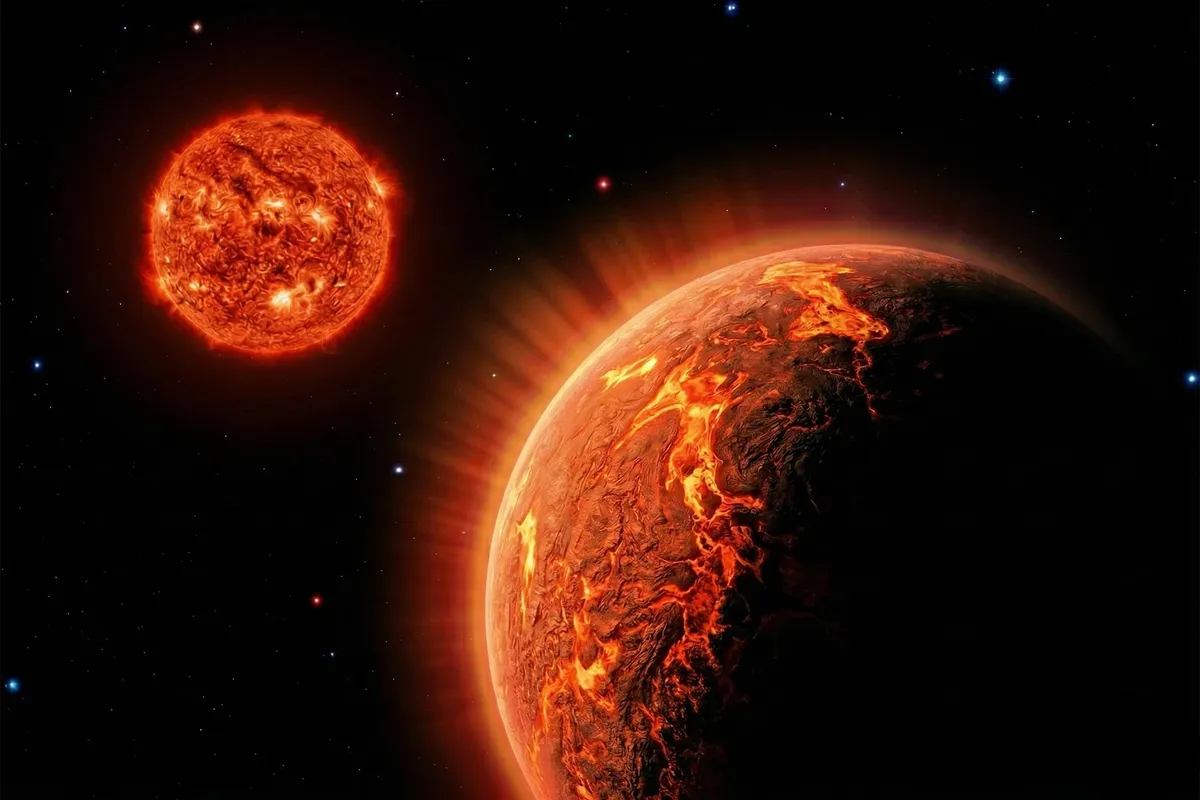
A distant exoplanet, LHS 3844b, is locked in permanent day and night. This might seem too harsh for life. However, new research suggests its interior could create surprisingly stable conditions beneath the surface.
Rethinking Life on Extreme Worlds
LHS 3844b is slightly larger than Earth. It orbits a small red dwarf star, LHS 3884, about 48.5 light-years away. One side of the planet always faces its star, while the other is in constant darkness. This creates extreme temperatures: the day side is very hot, and the night side is near absolute zero.
Daisuke Noto, a researcher at the University of Pennsylvania, is studying if these conditions truly prevent life. He notes that extreme surface temperatures might make these planets seem uninhabitable. However, he believes life might still find a way.
We're a new kind of news feed.
Regular news is designed to drain you. We're a non-profit built to restore you. Every story we publish is scored for impact, progress, and hope.
Start Your News DetoxNoto and his team published their findings in Nature Communications. They suggest that tidal locking can help distribute heat. This could maintain moderate temperatures in certain areas. Noto explains that planets with permanent day and night sides are more common than Earth-like worlds. Many celestial bodies close to their stars are tidally locked. This means their rotation and orbit speeds match, like how we only see one side of our moon.
Simulating Alien Interiors
Noto's research looks at what happens below the surface, especially in the planet's mantle. The mantle is the thick rocky layer between the crust and core. To study this, his team used a rectangular tank filled with viscous glycerol. This liquid changes color with temperature.
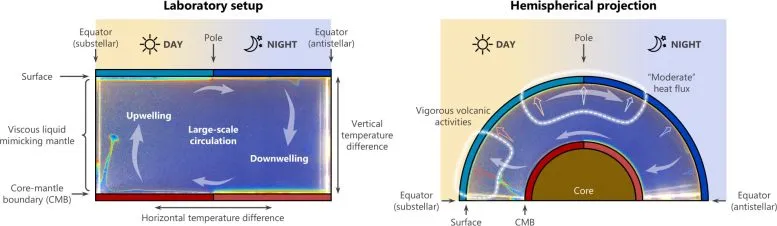
This experiment mimics how heat and structure affect convection in slow-moving systems. Mantle convection is driven by temperature and density differences. The team used thermostats to control heating and cooling. This created temperature gradients similar to those on a planet.
The experiments showed a stable flow pattern. Hot material rises on the day side, moves across, cools, and sinks on the night side. Then it returns along the bottom. This creates a continuous circulation loop, like a steady planetary heartbeat. Noto describes it as "slow and steady. Predictable. Kind of boring but in a good way."
Sometimes, plume-like structures rose from the heated base. Unlike Earth's shifting hotspots, these plumes stayed in one place. The model also showed heat transfer rates similar to Earth's. This suggests that some exoplanets could have localized geothermal environments. These might be in mid-latitude regions where conditions are less extreme.
Future Research
This large-scale mantle circulation could also affect the planet's liquid core. It might generate magnetic fields different from Earth's. Noto notes this is an exciting area for future research.
Noto and his team continue to use similar lab models. They are studying various geophysical systems. Earlier work explored how mass and heat move in confined spaces. This offers insights into fluids in hydrothermal systems. Noto says the possibilities for extending these methods are "quite literally, out of this world."
Deep Dive & References: Convective dynamics in mantle of tidally-locked exoplanets - Nature Communications, 2025