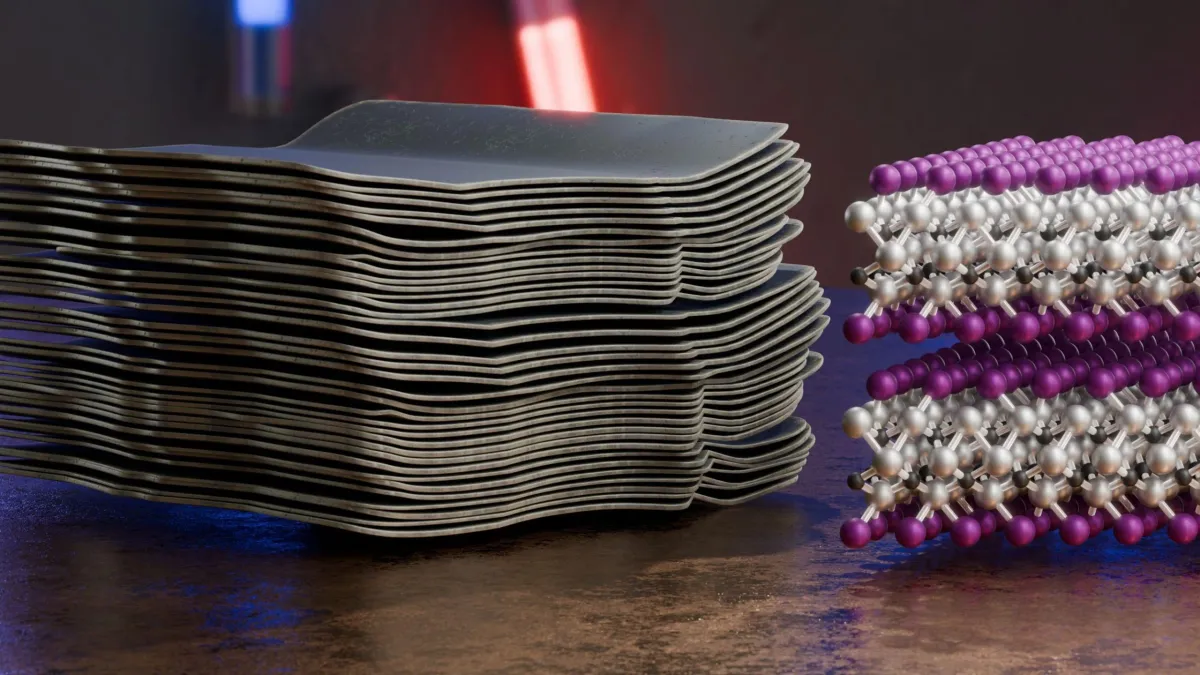
Researchers at RIKEN in Japan have figured out how to extract information from one of quantum computing's most elegant — but stubbornly difficult — systems: electrons suspended just above liquid helium.
The challenge sounds almost absurdly simple until you try it. Electrons hovering a few degrees above absolute zero offer an exceptionally quiet environment for storing quantum information — there's almost nothing nearby to scramble the signal. But reading what's stored inside? That's been the hard part. The electron's magnetic signal is too faint to measure directly, so scientists need another way to peek at what the qubit is doing without collapsing it.
The RIKEN team's solution, published in Physical Review Letters, uses microwaves to detect a subtle shift in electrical capacitance. Instead of trying to measure the electron's spin directly, they observe when the electron jumps to a higher energy state — a Rydberg state — and watch how that change ripples through the electrical properties of the system.
We're a new kind of news feed.
Regular news is designed to drain you. We're a non-profit built to restore you. Every story we publish is scored for impact, progress, and hope.
Start Your News Detox"An electron suspended in vacuum above liquid helium interacts almost exclusively with helium atoms, which are chemically and magnetically inert," explains Asher Jennings of the RIKEN Center for Quantum Computation. "This lack of nearby disturbances means the electron remains exceptionally well shielded from environmental noise."
Making the invisible measurable
To prove the concept works, the researchers used about 10 million electrons suspended above liquid helium, arranged as an effective capacitor. They drove these electrons into the Rydberg state and measured the resulting change in capacitance using microwave frequencies. The signal was clear enough to detect reliably — a crucial validation that the indirect readout strategy actually works.
What makes this significant is the scaling. If you can measure a signal from 10 million electrons, the math suggests you should be able to measure it from a single electron too. That's the next step the team is pursuing: repeating the experiment with just one qubit instead of millions.
This matters because electrons on liquid helium have a real advantage over some competing quantum platforms. Superconducting circuits, silicon qubits, and trapped ions all face noise problems — stray electromagnetic fields, vibrations, thermal fluctuations that gradually corrupt the quantum information. Liquid helium's extreme cold and chemical inertness create an unusually stable environment. If researchers can reliably read and write information to these qubits, this platform could become a serious contender for building practical quantum computers.
The RIKEN team is now working to demonstrate single-electron readout in the lab, which would be the final piece of evidence that this approach can scale from a physics demonstration to an actual computing platform.