Imagine a sheet so thin, it's like an A4 paper that's a million times wider than it is thick. Now imagine trapping light inside it. That's exactly what scientists in Poland just pulled off.
They figured out how to snag infrared light in a layer just 40 nanometers thin. To put that in perspective, a human hair is about 1,000 times thicker. This isn't just a cool trick; it's a huge step for future tech that uses light instead of electricity.
The Clever Trick to Catch Light
Light usually acts like a wave, and it needs space to do its thing. Think of it like a ripple in a pond – it has a certain size. For years, scientists wondered if you could trap light in a space smaller than its own ripple. Turns out, you can.
We're a new kind of news feed.
Regular news is designed to drain you. We're a non-profit built to restore you. Every story we publish is scored for impact, progress, and hope.
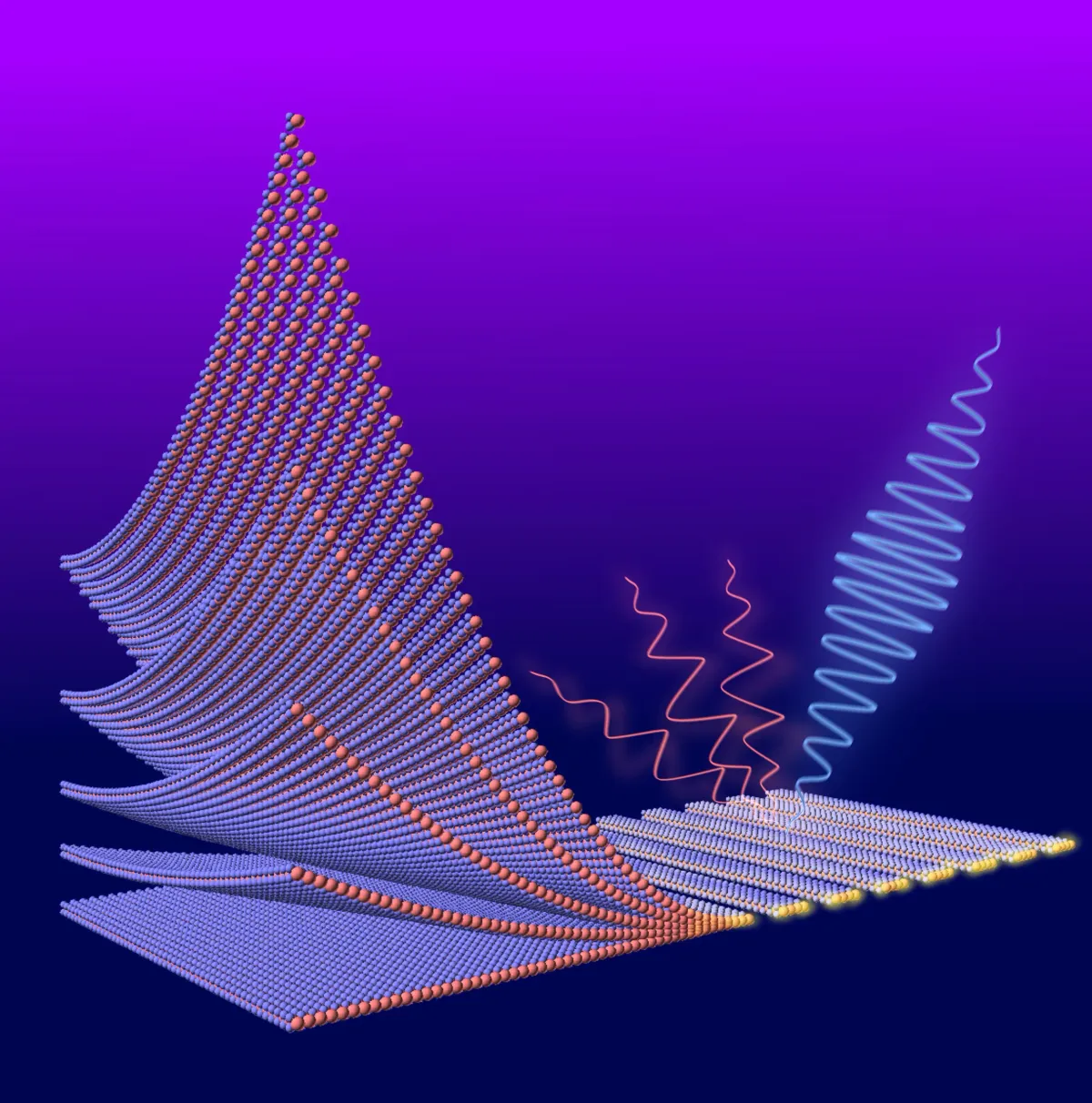
Start Your News DetoxThe team used a special material called molybdenum diselenide (MoSe2) to create a tiny, striped surface, like a miniature Venetian blind. This material has a secret power: it slows light down a lot. While light slows a bit in glass or silicon, it slows 4.5 times more in MoSe2. This allowed them to make their light-trapping structure incredibly thin.
Older methods needed layers hundreds of nanometers thick. But with MoSe2, they could go down to just a few dozen nanometers and still trap light strongly. This is pretty nuts because it means we can start building light-based devices that are way smaller and faster than anything we have now.
Big Effects from Tiny Layers
This super-thin MoSe2 layer does more than just trap light. It also supercharges some wild light tricks. For example, it can take three particles of infrared light and combine them into one particle of blue light. This effect got a boost of over 1,500 times in their setup compared to a flat layer of the same material.
And here's the kicker: they made this material using a standard manufacturing method called molecular beam epitaxy (MBE). Before, making thin MoSe2 layers was like peeling sticky tape – unreliable and only good for tiny pieces. Now, they can create uniform layers covering several square inches. That means this isn't just a lab experiment; it could actually be mass-produced. This could change everything for how we build light-driven devices, making them smaller, faster, and more powerful.