Imagine being able to make a material soft in one spot and stiff in another, just by hitting it with sound. That's exactly what researchers just figured out. They're using sound waves to precisely control tiny internal features in materials that dictate how rigid or flexible they are.
These tiny features are called "mechanical kinks." Think of them like invisible boundaries inside a material. On one side, the atoms are arranged one way; on the other, they're slightly different. This subtle shift is what makes a huge difference in how the material behaves — whether it's bendy or firm.

For ages, scientists have wanted to steer these kinks. Moving them could let us change a material's properties on the fly. But kinks are usually stuck behind invisible energy walls, making them hard to budge reliably.
We're a new kind of news feed.
Regular news is designed to drain you. We're a non-profit built to restore you. Every story we publish is scored for impact, progress, and hope.
Start Your News DetoxNicholas Boechler, a professor at UC San Diego, and his team found a workaround. They designed a special material where moving a kink doesn't take any energy at all. That's pretty wild, and it means they can push and pull these kinks with incredible precision.
In this unique material, wherever the kink is, that area becomes soft. The further away you get from the kink, the stiffer the material becomes. So, if you move the kink to one end, that end softens right up, and the rest gets stiff. Shift it to the middle, and the middle goes soft while both ends firm up.

The Acoustic "Tractor Beam"
Boechler calls their method an acoustic "tractor beam." By sending sound waves from one direction, they can actually pull the kink towards the sound source. A quick sound pulse nudges it a little, and repeated pulses move it step by step. It's like having a remote control for a material's internal state.
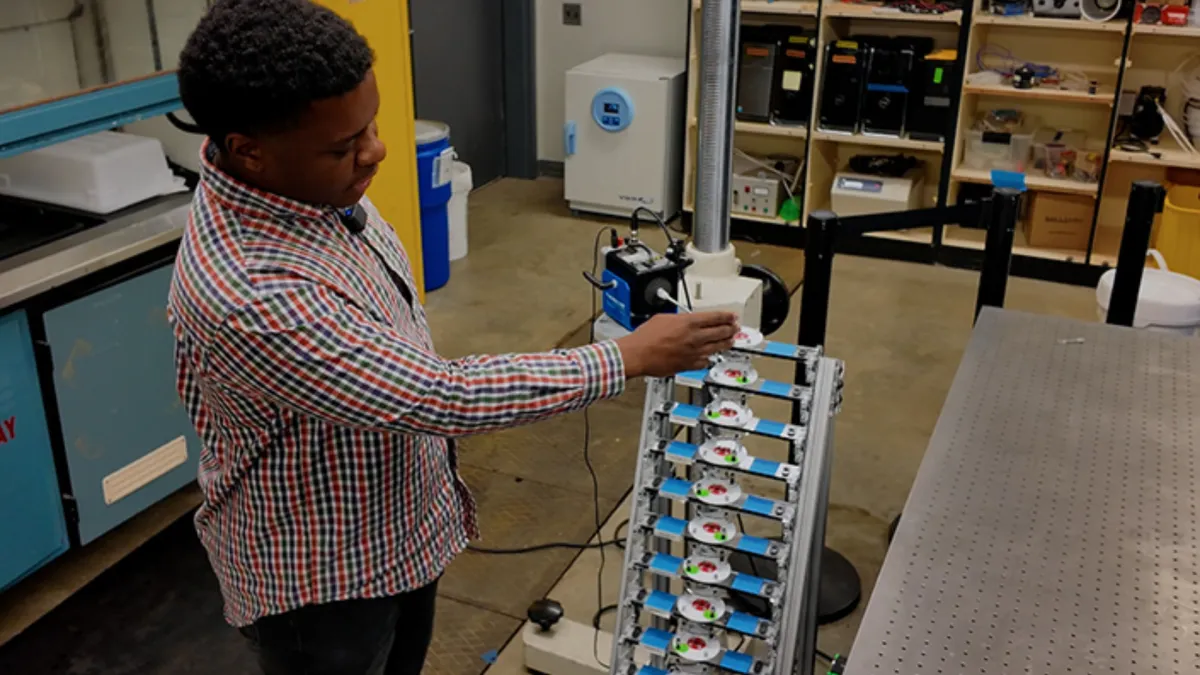
To prove it, they built a bigger model using stacked disks connected by springs, with one disk representing the kink. Short bursts of sound pulled the kink across the chain. Longer vibrations pulled it all the way, completely flipping which side was soft and which was stiff.
This isn't just a lab trick. It means we could one day have devices that can literally adjust their stiffness as needed. Think about a robotic arm that's soft for a gentle touch, then instantly stiffens to lift something heavy. It's a clever way to reshape how materials work, all thanks to sound.