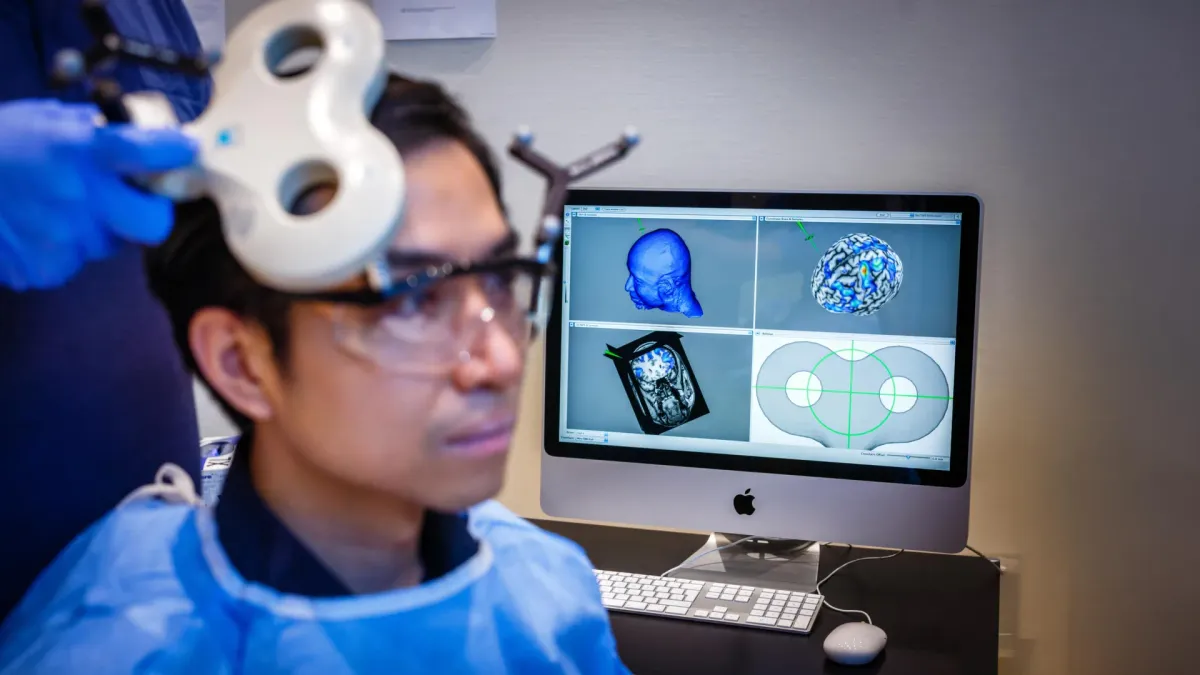
When researchers gently synchronized activity between two regions of the brain, something unexpected happened: people became noticeably more willing to give away money, even when it meant earning less themselves.
The finding suggests that generosity isn't just a moral choice we make consciously. It's also shaped by how different parts of our brain communicate with each other.
In the study, 44 participants played a simple economic game 540 times. Each round, they decided how to split money with another person—keeping as much as they wanted, or sharing more. While they played, researchers used a noninvasive technique called transcranial alternating current stimulation to gently coordinate neuron firing patterns in two brain regions: the frontal and parietal lobes.
We're a new kind of news feed.
Regular news is designed to drain you. We're a non-profit built to restore you. Every story we publish is scored for impact, progress, and hope.
Start Your News DetoxWhen the stimulation specifically strengthened what neuroscientists call "gamma synchrony" between these regions, the effect was clear. Participants shifted their choices. They offered larger shares to their partners, even when doing so reduced their own payoff. The change was modest but consistent across the group.
What Changed in Their Thinking
Using computational models, the researchers traced what had shifted. The stimulation didn't make people suddenly noble. Instead, it changed how they weighted the decision itself. After stimulation, when evaluating each offer, participants gave more mental weight to the other person's outcome. Their brain was balancing self-interest and others' interests differently.
Christian Ruff, one of the lead researchers, frames it this way: "We identified a pattern of communication between brain regions that is tied to altruistic choices. This improves our basic understanding of how the brain supports social decisions."
What matters here is the causality. Previous studies have shown that generous people have different patterns of brain activity than less generous people. But this study went further—it showed that changing that brain activity actually changes behavior. Jie Hu, another coauthor, puts it directly: "When we altered communication in a specific brain network using targeted, non-invasive stimulation, people's sharing decisions changed in a consistent way."
The work opens a door to understanding cooperation at a biological level. In a world where collaboration often determines success—whether in teams, communities, or across nations—understanding the brain mechanisms behind sharing and trust could matter more than we realize. Not as a way to manipulate people into being generous, but as a window into how our brains are actually wired for it.
The researchers are already thinking ahead. Future work could explore whether these findings apply to real-world cooperation, especially in situations where people need to work together to achieve something neither could alone.