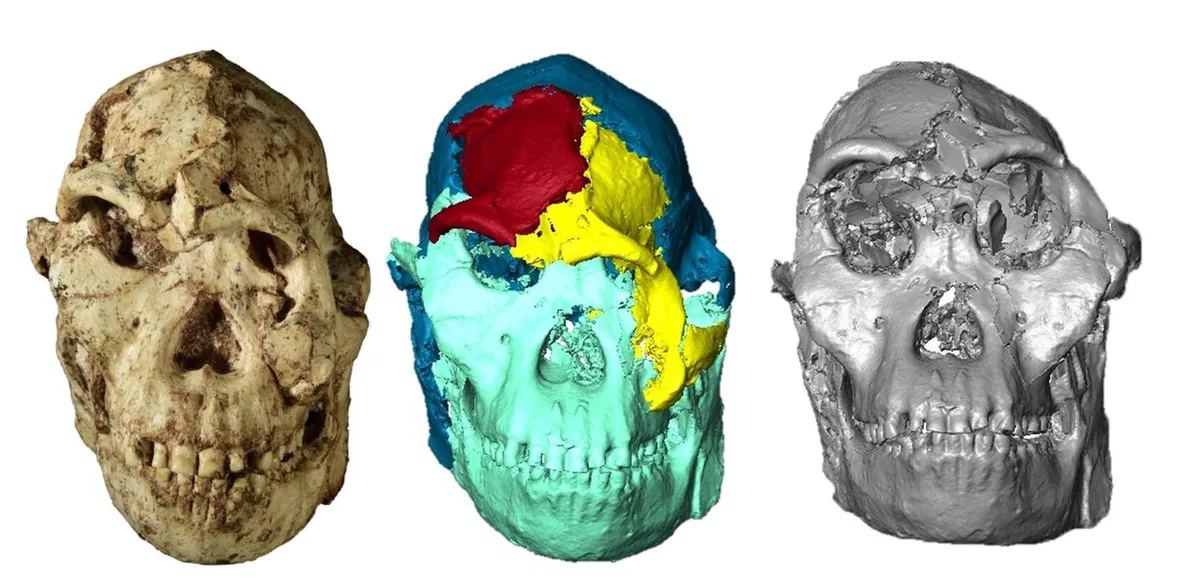
In 1994, researchers in South Africa found a handful of small foot bones tucked inside an old box of fossils. They later discovered the rest of the skeleton in a cave—but the skull and face were crushed and distorted after millions of years underground. The individual, known as "Little Foot," was an Australopithecus, a human ancestor who walked the earth 3.67 million years ago.
Now, for the first time, scientists have digitally reconstructed what Little Foot actually looked like. The work, published in Comptes Rendus Palevol, took years of meticulous digital reassembly of damaged fossil material. And what they found challenges what we thought we knew about our early ancestors.
Why a Face Matters
A face tells a story. It reveals how our ancestors ate, breathed, and saw the world—functions that directly reflect how they adapted to their environment. The face also enables non-verbal communication, a capacity that likely shaped social behavior and survival. By studying how faces changed over millions of years, researchers can trace shifts in diet, social structures, and how early hominins adapted to different ecosystems.
We're a new kind of news feed.
Regular news is designed to drain you. We're a non-profit built to restore you. Every story we publish is scored for impact, progress, and hope.
Start Your News Detox"The story of our ancestors before the first humans appeared remains blurry," paleoanthropologist Amélie Beaudet and geoarchaeologist Dominic Stratford wrote. "It is during this pivotal period that the traits defining our humanity emerged."
The reconstruction began in 2019 when scientists used synchrotron X-ray imaging—essentially a super-detailed digital scanner—to map Little Foot's damaged skull without touching it. Researchers then spent years reassembling the bones on a computer, piece by piece. Once complete, they compared Little Foot's facial proportions with three other Australopithecus skulls (two from Ethiopia, one from South Africa) and modern primates including gorillas, chimpanzees, bonobos, orangutans, and humans.
The comparison revealed something unexpected: Little Foot's face more closely resembled the two Ethiopian fossils than the South African one. This suggests Australopithecus may have had a "more dynamic evolutionary history than previously assumed." The pattern hints that Little Foot may have been part of a group of early hominins who migrated from East Africa to South Africa more than 3.5 million years ago. Once settled in the south, their descendants may have evolved distinct features through local adaptation.
"Rather than viewing early hominin evolution as occurring in isolated regions, the study supports the idea of Africa as a connected evolutionary landscape, with populations adapting to ecological pressures while remaining linked through shared ancestry," Stratford noted.
The reconstruction also revealed striking features—notably large, wide eye sockets. This discovery offers a window into how Little Foot actually lived. The size of those eye sockets suggests vision played a crucial role in daily survival, particularly when foraging for food. Little Foot relied heavily on what they could see.
Researchers emphasize caution here. The sample size remains small, which limits how much we can confidently conclude from these comparisons. But the work opens new questions. Next, the team plans to model Little Foot's teeth and braincase—work that could reveal details about brain size and organization, deepening our understanding of how modern humans came to be.