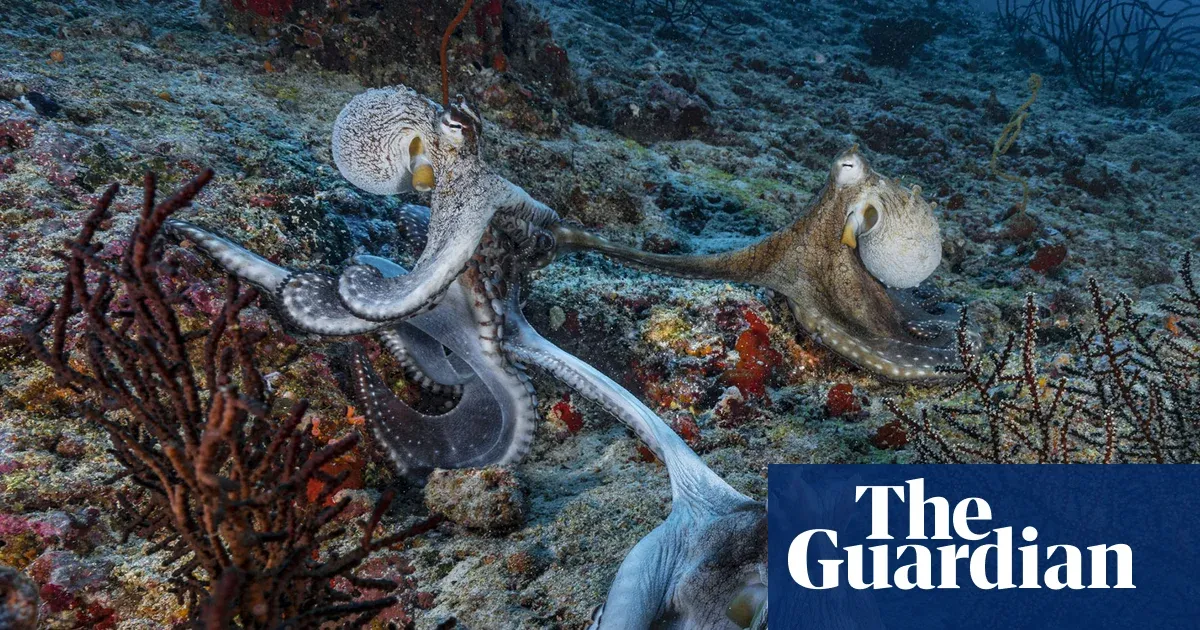
Picture this: you're a male octopus, famously solitary, and you're looking to, well, procreate. But your potential partner is in a separate tank, behind an opaque barrier. What's a guy to do? Apparently, you deploy your specialized, multi-talented mating arm and let it do the sniffing.
Scientists have just confirmed that male octopuses don't need to see their date to get things done. They've got a secret weapon: the hectocotylus. This isn't just any arm; it's the one that delivers the sperm packet. And for a long time, researchers scratched their heads, wondering how this particular limb managed to navigate the complexities of octopus romance.
The Arm That Knows Best
Turns out, this special arm acts a lot like a tongue. It's a sensory powerhouse, capable of detecting the female hormone progesterone. So, while the male octopus might be blissfully unaware of his partner's presence visually, his arm is essentially saying, "Ah, yes, there you are." Because apparently that's where we are now: arms with better dating radar than most humans.
We're a new kind of news feed.
Regular news is designed to drain you. We're a non-profit built to restore you. Every story we publish is scored for impact, progress, and hope.
Start Your News DetoxProfessor Nicholas Bellono from Harvard University, who led this fascinating study, points out that for such solitary creatures, it makes perfect sense. The arm needs to be a jack-of-all-trades: sensor, locator, and delivery system, all rolled into one efficient appendage. No time for awkward introductions when you're an octopus.
Studying octopus mating is usually a nightmare. Put two octopuses in the same tank, and you're more likely to get a fight to the death than a romantic encounter. So, Bellono's team got clever. They separated California two-spot octopuses with a black, opaque barrier, featuring holes just big enough for an arm. The plan was to let them get acquainted, then remove the barrier.
But the octopuses had other ideas. The male, without so much as a visual cue, threaded his special arm through a hole, found the female's mantle, located the egg tubes, and started mating. It happened again, and again, even in pitch-black darkness. This arm was clearly not messing around. (And no, males didn't try to mate with other males. Even an octopus arm has standards.)
The Progesterone Effect
Naturally, the next step was to figure out what chemical signal was guiding this anatomical Casanova. They found progesterone in the females' ovaries and skin. When they tested amputated male arms (for science!), those arms twitched and moved when exposed to progesterone, but not other similar hormones.
To really seal the deal, they repeated the barrier experiment. This time, the female was removed before mating could occur, and the holes were fitted with tubes containing various substances. The males, ever the romantics, readily explored and tried to mate with the progesterone tube. Let that sink in. A tube. Full of hormones. That's how good this arm is.
Further research revealed specific receptors on the arm's tip, evolving at a frankly impressive speed across cephalopods. This suggests different species might be responding to different chemical cues, using these arm-based sniff tests to confirm both sex and species. It's like a very advanced, very squishy ID badge.
Bellono sums it up perfectly: sometimes, the best discoveries come from simply observing animals. They weren't looking for a sensory arm; the octopuses just showed them. Which, if you think about it, is both impressive and slightly terrifying, given what else these creatures might be up to when we're not looking.