Scientists at Trinity College Dublin have discovered something striking: every organism on Earth — from bacteria to blue whales — follows the same basic blueprint for how temperature affects performance. It's a pattern so universal that researchers are calling it a fundamental law of biology.
The finding comes from analyzing over 2,500 thermal performance curves across thousands of species. The pattern is simple but rigid. As temperature rises, an organism's performance improves — faster metabolism, quicker reproduction, sharper thinking — until it hits an optimal point. Beyond that sweet spot, performance collapses rapidly. Push the temperature higher still, and the organism dies.
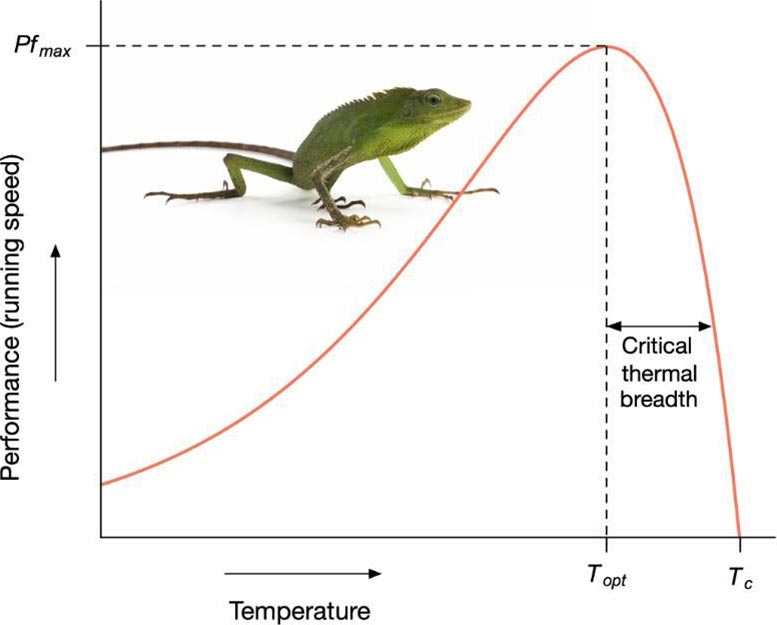
The curve is universal, but the temperatures shift
Here's where it gets interesting: while the shape of this curve is identical across all life, the actual temperatures vary wildly. A bacterium might thrive at 100°C while an arctic fish peaks at 5°C. Yet underneath those differences, the same mathematical relationship holds. It's as if evolution has infinite ways to dress up the same skeleton.
We're a new kind of news feed.
Regular news is designed to drain you. We're a non-profit built to restore you. Every story we publish is scored for impact, progress, and hope.
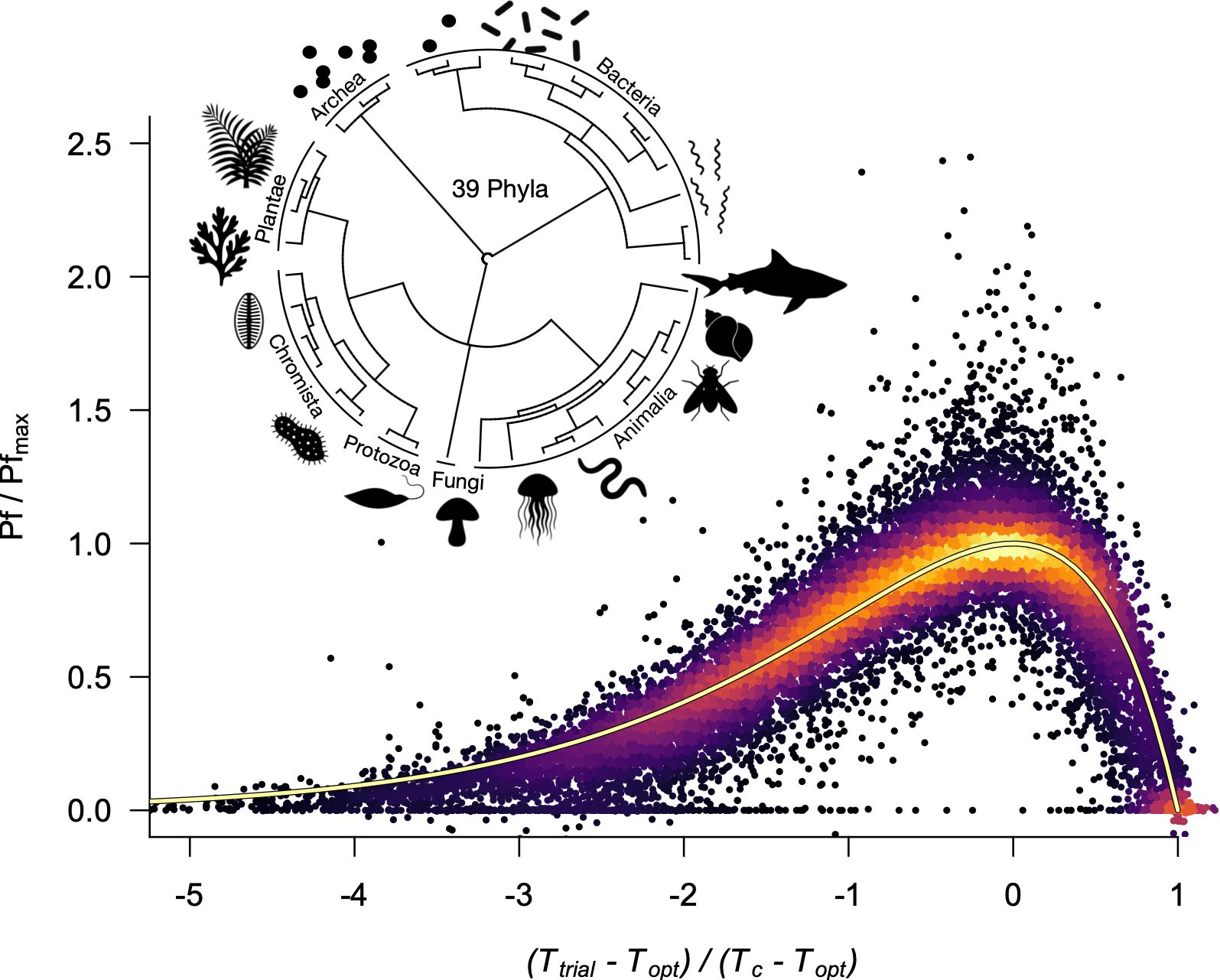
Start Your News DetoxProfessor Andrew Jackson, who led the research, explains it this way: "All the different curves are in fact the same exact curve, just stretched and shifted over different temperatures." More importantly, the team discovered that optimal temperature and the critical maximum temperature — the point of death — are locked together. You can't have one without constraining the other.
"Whatever the species, it simply must have a smaller temperature range at which life is viable once temperatures shift above the optimum," Jackson says. In other words, there's no escape hatch. Evolution can adjust which temperatures a species prefers, but it cannot break the fundamental rule that performance crashes once you exceed that preference.
What this means for a warming world
The implications for climate change are sobering. Species may have less flexibility to adapt to rising temperatures than scientists previously believed. Yes, evolution can shift a population's optimal temperature over generations — but the curve itself cannot be rewritten. As global temperatures climb, organisms don't just lose their preferred conditions; they're forced into a narrower and narrower band where survival is possible.
Dr. Nicholas Payne, part of the research team, notes that the pattern held across "all major groups that have diverged massively as the tree of life has grown throughout billions of years of evolution." From bacteria to insects to plants, the constraint is universal.
The next phase of research will be searching for exceptions — any species or system that subtly breaks the pattern. "If we find any, we will be excited to ask why and how they do it," Payne says. Those exceptions, if they exist, might hold clues to survival strategies in a warming climate.
For now, the study reveals something humbling: for all the diversity of life on Earth, we're all playing by the same thermal rules. The question is how quickly we can adapt when those rules are being rewritten by climate change.
Study: "A universal thermal performance curve arises in biology and ecology" — Proceedings of the National Academy of Sciences