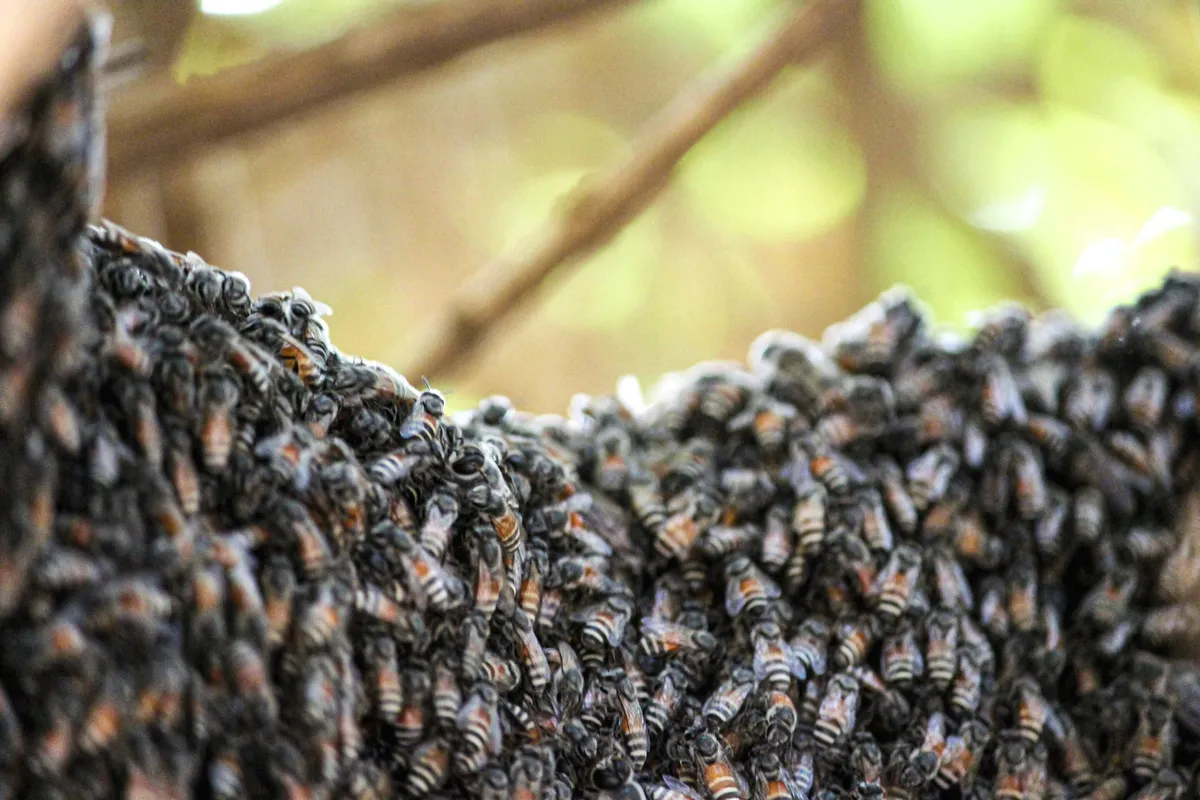
You know that feeling when you're stuck in a sweltering room alone, slowly melting into a puddle of existential dread? Apparently, honey bees get it too. New research out of Michigan State University reveals that a solitary bee exposed to high temperatures experiences a rapid spike in its stress hormones.
But here's the kicker: if that same bee is chilling with its buddies, its hormone levels stay perfectly stable. Because, as it turns out, being social isn't just good for your mental health; it's also a fantastic way to avoid a hormonal meltdown when the mercury rises.
The Hot Bee Experiment
Entomologist Zachary Huang and his colleague Thomas Rachman wanted to see exactly how heat messed with bees. So, they put some bees through a one-hour sauna session at a balmy 40°C (that's 104°F, for those of us not on the Celsius train). They compared solo bees to groups of 25, then measured their juvenile hormone (JH) levels. JH is like the Swiss Army knife of insect hormones — it keeps larvae from growing up too fast and helps adult bees decide if they're going to be a nurse or a forager.
We're a new kind of news feed.
Regular news is designed to drain you. We're a non-profit built to restore you. Every story we publish is scored for impact, progress, and hope.
Start Your News DetoxNow, the researchers also had a hunch that a specific pheromone, ethyl oleate (EO), might be involved. Forager bees naturally produce EO, and it's known to influence when younger bees transition into foraging. But its role in stress? That was a mystery. EO was thought to put the brakes on JH increases in younger bees when adult foragers were buzzing around.
The Power of Friendship (and Pheromones)
The results were pretty clear: the lone bees, stewing in their own heat-induced anxiety, saw their JH levels shoot up. The bees in groups? Cool as cucumbers. Even more fascinating: when the solitary bees were exposed to EO in their little vials, their hormone levels stayed perfectly normal, just like their grouped counterparts.
This suggests that EO acts like a tiny chemical chill pill, helping bees regulate their stress response. And, of course, the simple act of being surrounded by other bees seems to offer a protective shield against the physical effects of heat. As Huang eloquently put it, "Being social can make you cool." Which, if you think about it, is both impressive and slightly terrifying for those of us who prefer our alone time.
This isn't just a quirky bee fact. It’s a crucial insight into how social insects might just cope with our warming planet. If pheromones and social structures can buffer bees from heat stress, colonies might be more resilient than we've given them credit for. And who knows, maybe there's a lesson in there for us too. Next time the AC breaks, grab a friend. Or a pheromone. Whatever works.