Scientists have finally watched a solar flare grow from its first magnetic whisper to a full plasma avalanche — and the process looks nothing like they expected.
On September 30, 2024, the ESA-led Solar Orbiter spacecraft caught an M7.7-class solar flare in unprecedented detail, recording roughly 40 minutes of buildup before the explosion reached its peak. What they saw challenges how we understand these violent events. Rather than a single unified explosion, the flare emerged from a cascade of smaller reconnection events — each one triggering the next, like dominoes falling in slow motion across the Sun's surface.

How a solar flare actually begins
Solar flares happen when twisted magnetic field lines suddenly snap and reconnect, releasing enormous amounts of energy in minutes. For decades, scientists proposed that this happened through an "avalanche" mechanism — but no one had seen it happen in a single large flare. They'd only observed it in the aggregate behavior of hundreds of thousands of smaller flares.
We're a new kind of news feed.
Regular news is designed to drain you. We're a non-profit built to restore you. Every story we publish is scored for impact, progress, and hope.
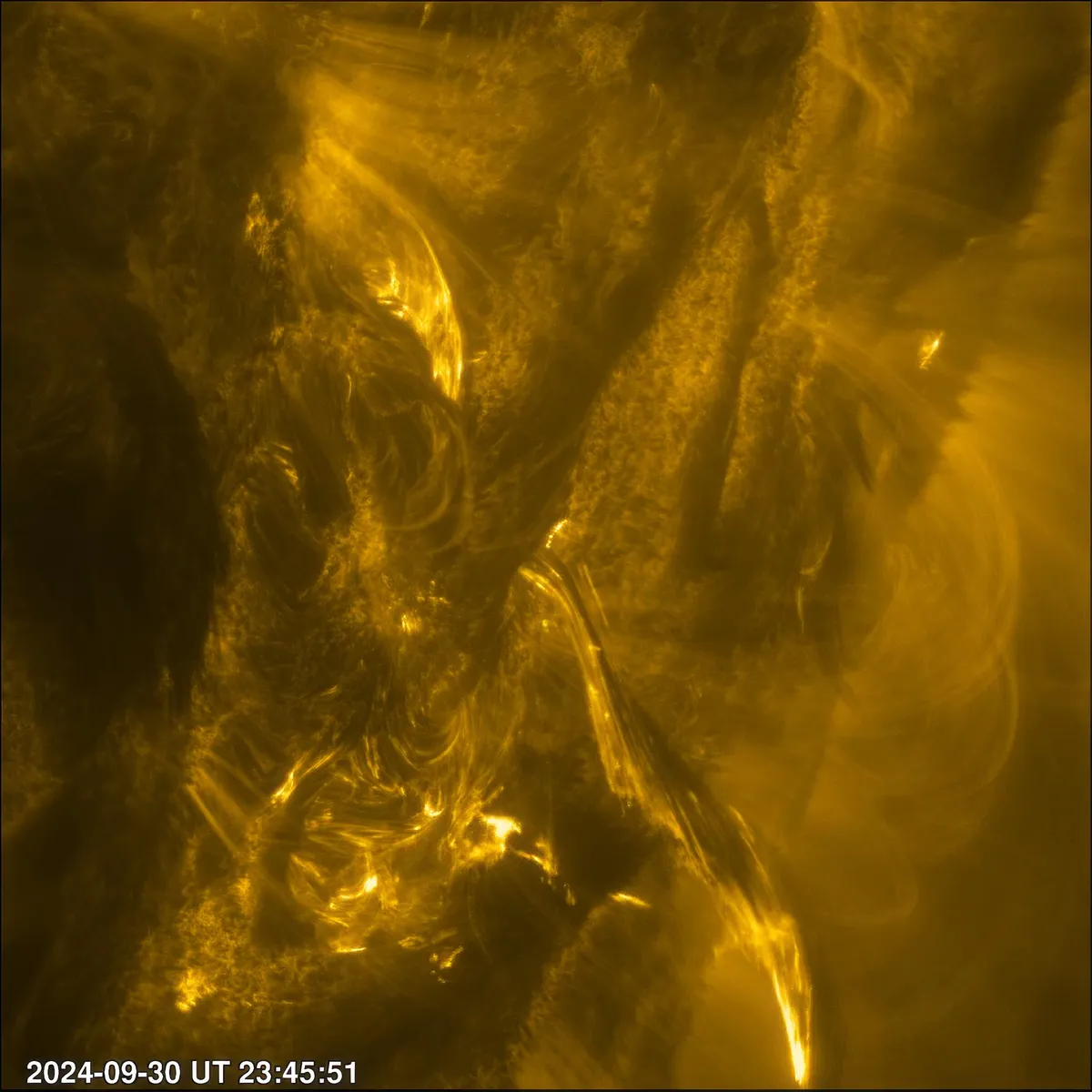
Start Your News DetoxThen Solar Orbiter's Extreme Ultraviolet Imager (EUI) caught it happening in real time. Starting at 23:06 Universal Time, about 40 minutes before the flare peaked, the spacecraft watched a dark arch-like filament of twisted magnetic fields. New magnetic strands appeared in nearly every image frame — every two seconds or less. Each one remained magnetically contained, twisting like coiled rope. As more strands formed, the region became unstable. The twisted structures began breaking and reconnecting, triggering a spreading cascade of further disruptions. Each disruption released more energy. The process lit up in the images as sudden, increasingly intense bursts of brightness.
At 23:29 UT, a particularly strong brightening erupted. Soon after, the dark filament detached and violently unrolled at high speed. The main flare erupted around 23:47 UT.
"These minutes before the flare are extremely important," says Pradeep Chitta of the Max Planck Institute for Solar System Research, who led the study. "We were surprised by how the large flare is driven by a series of smaller reconnection events that spread rapidly in space and time."
The raining plasma that keeps falling
What made this observation truly rare was that four Solar Orbiter instruments worked together simultaneously. The EUI captured high-resolution images of the corona — the Sun's outer atmosphere — focusing on structures just a few hundred kilometers across. Three other instruments, SPICE, STIX, and PHI, examined different depths and temperature ranges, from the corona down to the Sun's visible surface.
Together, they revealed something no one had seen before at this level of detail: ribbon-like streams of plasma "raining" down through the Sun's atmosphere. These weren't just bright flashes. They were signatures of energy being transferred directly from the magnetic field to the surrounding plasma — and they continued even after the main flare began to fade.
During the flare, particles were accelerated to 40 to 50 percent of the speed of light — roughly 431 to 540 million kilometers per hour. The high-energy X-ray emissions revealed where these accelerated particles released their energy. This matters because these particles can escape into space and pose radiation risks to satellites, astronauts, and Earth-based technology.
Solar Orbiter saw that, in the lead-up to a solar flare, twisted magnetic fields break and reconnect, creating an outflow of energy that subsequently rains down through the Sun's atmosphere in ribbon-like streams. Credit: ESA & NASA/Solar Orbiter/EUI Team
What this means for space weather
Understanding how solar flares build and release energy is crucial for space weather forecasting. The strongest flares can trigger geomagnetic storms and radio blackouts on Earth. Now scientists have a much clearer picture of the chain of events that leads to these eruptions.
"Solar Orbiter's observations unveil the central engine of a flare and emphasise the crucial role of an avalanche-like magnetic energy release mechanism," says Miho Janvier, ESA's Solar Orbiter co-Project Scientist. The next question is whether this mechanism happens in all flares, and whether it occurs on other flaring stars.
The research team notes they still have much to explore — particularly in understanding how the avalanche process leads to such high-energy particles. That would require even higher resolution X-ray imagery from future missions. But for now, Solar Orbiter has given us the clearest view yet of the moment a solar flare is born.