Space Coast: What it's like to be in Florida for Artemis launch

Thousands flock to Florida's Space Coast, buzzing with anticipation for the historic Artemis moon mission launch. The energy is electric as crowds gather around Kennedy Space Center.

5 min read
United States
5 views✓ Verified Source
Share

Why it matters: The Artemis launch inspires a new generation, like eight-year-old Isiah, to dream big and pursue scientific exploration, benefiting humanity's future in space.

Hundreds of thousands of people are heading to Florida's Space Coast. They are gathering to watch the Artemis II rocket launch. This mission will send four astronauts around the Moon.

Eight-year-old Isiah thinks "People going up to the Moon is kind of cool." He is one of about 400,000 people expected to watch the launch. They will fill causeways, beaches, and motel balconies.

The 10-day test flight will not land on the Moon. However, the crew might see lunar views never before seen by humans. Amanda Garcia traveled over 1,000 miles from New Mexico to see it. She expects a "great show."

Wait—What is Brightcast?

We're a new kind of news feed.

Regular news is designed to drain you. We're a non-profit built to restore you. Every story we publish is scored for impact, progress, and hope.

Start Your News Detox

A Boost for the Local Economy

The area around the Kennedy Space Centre is buzzing. Bars are selling "moonshots," and hotels warn of traffic delays. Local officials expect a "historic influx" of tourists. This could bring in about $160 million (£121 million). Traffic plans are in place for the busy night.

Brenda Mulberry owns Space Shirts, a shop on Merritt Island. She has sold NASA souvenirs for 40 years. She says this launch is different. "People are beyond excited," she noted. Brenda has stocked up for the biggest customer surge she has ever seen. She even jokes about opening "the first T-shirt shop on the Moon."

Split screen showing a woman holding a small dog, and a young man with the beach behind him.

Inspiring the Next Generation

Future Artemis missions aim to land humans on the Moon again. This would be the first time since 1972. The long-term goal is to build a permanent Moon base. This base could use natural resources and serve as a launchpad for Mars missions.

Artemis II mission commander Reid Wiseman hopes the mission inspires young people. He wants kids to look at the Moon and know "we are there now."
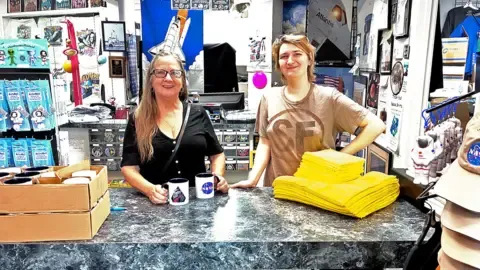
Inside a small, crowded NASA gift shop, two people stand behind a grey marble-effect counter. Shelves and walls around them are packed with space souvenirs, mission posters, and astronaut photos. On the left are boxes of mugs; the woman holds two white mugs decorated with NASA-style logos. Next to her, a younger person in a pale T‑shirt leans on the counter near two neat piles of bright yellow folded T‑shirts. To the right, a rack displays beige and orange NASA baseball caps and small astronaut toys, giving the scene a busy, colourful, fan-filled atmosphere.

The Mission Details

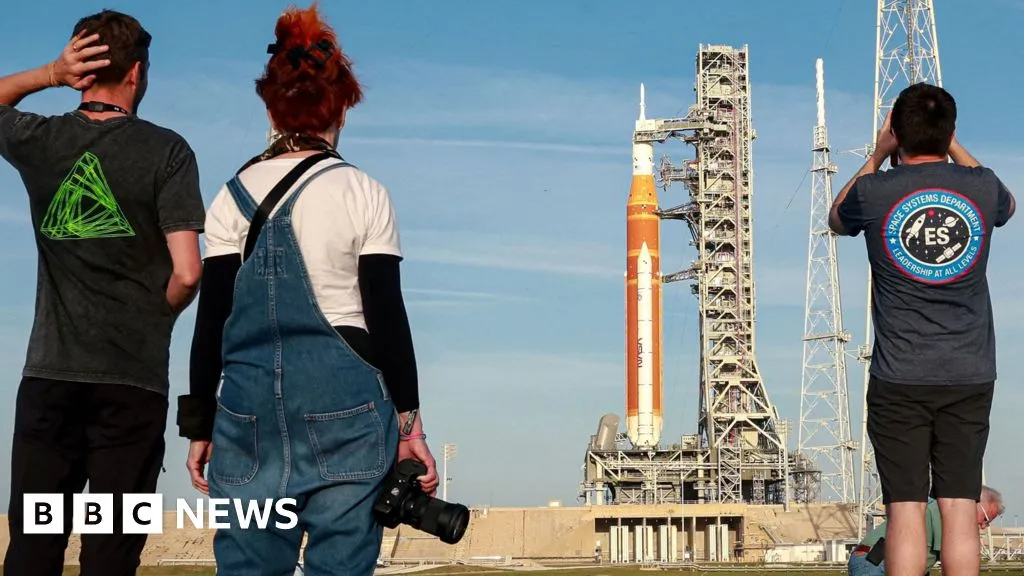
The launch will happen from Launch Pad 39B. This is the same pad used for the Apollo program in 1969. NASA's Space Launch System (SLS) rocket stands 98 meters (321 feet) tall. It is the heaviest rocket NASA has ever launched.

At the top is the Orion capsule, about the size of a small van. Four astronauts will spend 10 days inside it. This is the first time Orion will carry a human crew.

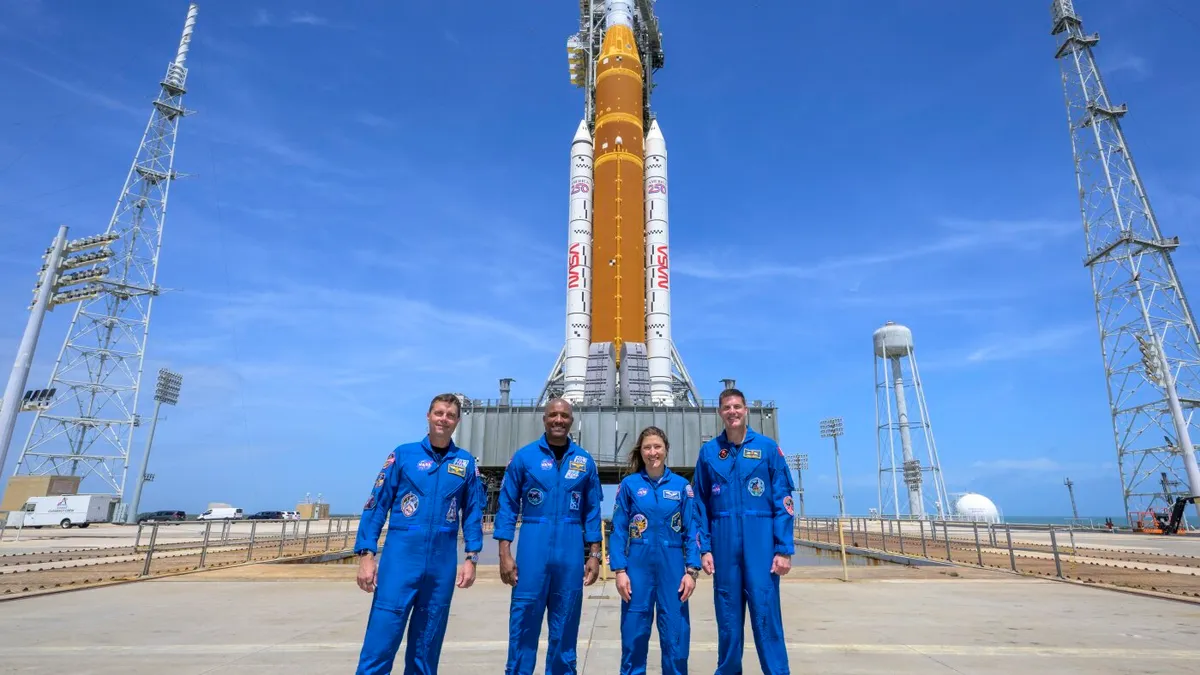
The crew includes Commander Reid Wiseman, Pilot Victor Glover, Christina Koch, and Jeremy Hansen. Hansen, a Canadian fighter pilot, is making his first trip to space.
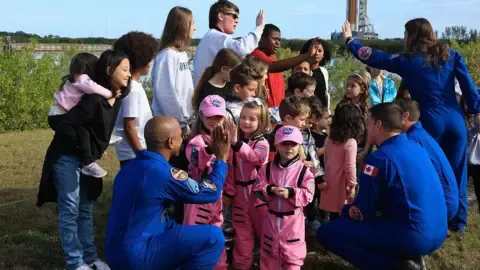
On a grassy patch near water, three Artemis II astronauts in bright blue flight suits crouch down to talk with a group of young children. The children in the centre wear miniature pink spacesuits and caps, facing the astronauts and giving them high‑fives. Other children and parents cluster around them, some holding toddlers, forming a loose semicircle. In the distance, partly blurred, a tall rocket and launch tower rise above the trees. The mood is warm and playful, with astronauts and families smiling and interacting at eye level, turning a serious mission into a friendly, down‑to‑earth moment.

After reaching orbit, Orion will practice manual flying and test life support. On Day 2, a "trans-lunar injection burn" will send the spacecraft towards the Moon. This will put it on a path that naturally loops it around the Moon and back to Earth.

On Day 6, Orion will fly around the far side of the Moon. Radio contact will be lost for about 40 minutes. Orion will travel about 4,000–6,000 miles above the Moon's surface. It might even go further from Earth than Apollo 13's record of about 250,000 miles (400,000 km).

The capsule will then be pulled back to Earth. On the final day, the crew will face re-entry into Earth's atmosphere at about 25,000 mph (40,000 km/h). Orion's heat shield must withstand extreme temperatures.
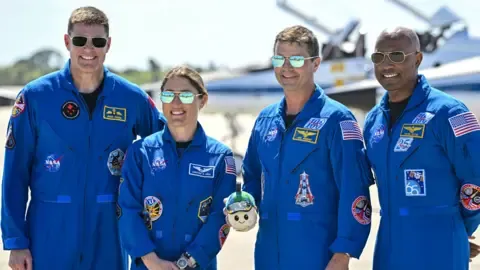
Four Artemis II astronauts stand side by side on a sunny runway, posing for a group portrait. They all wear bright blue NASA flight suits covered in mission patches and name badges, with dark boots. One astronaut in the centre holds a small mascot or model in both hands. Behind them, two sleek white-and-blue T‑38 training jets sit on the concrete, their pointed noses facing left and right, with the NASA “meatball” logo visible on a tail fin. The sky above is clear and pale blue, giving the scene a crisp, formal but upbeat feel.

Heat Shield Improvements

After the uncrewed Artemis I flight, engineers found cracks in the heat shield's coating. This happened during a "skip" re-entry maneuver. For Artemis II, they are keeping the two-step re-entry but changing the angle and timing. This should reduce heating and stress. This will be the first time this revised descent is flown with a crew.

If Artemis II succeeds, the next big crowd on the Space Coast will be for another test flight. This will bring humanity closer to walking on the Moon again, half a century later.

A small, round soft toy sits on a white tabletop, about the size of a large grapefruit. Its fabric face is pale cream with big black embroidered eyes, rosy pink cheeks and a simple smiling mouth, giving it a cute cartoon look. On top, it wears a dark blue cap sprinkled with embroidered yellow stars and tiny white rockets. Above the cap is a padded green‑and‑blue globe, like a miniature Earth, with a short dark loop for hanging. The toy’s overall impression is friendly and playful, like a cheerful mascot for a children’s space adventure.

72
SignificantMajor proven impact

Brightcast Impact Score

This article celebrates a significant milestone in space exploration, the Artemis II mission, which represents a notable new approach to lunar travel. The mission has the potential for global impact and inspires a sense of wonder and progress. The article provides specific details about the mission and the public's engagement.

29

Hope

Strong

23

Reach

Strong

20

Verified

Solid

Wall of Hope

0/50

Be the first to share how this story made you feel

How does this make you feel?

1
2
3
4
5
6
7
8
9
10
11
12
13
14
15
16
17
18
19
20
21
22
23
24
25
26
27
28
29
30
31
32
33
34
35
36
37
38
39
40
41
42
43
44
45
46
47
48
49
50

Connected Progress

Share

Originally reported by BBC Science & Environment · Verified by Brightcast

Get weekly positive news in your inbox

No spam. Unsubscribe anytime. Join thousands who start their week with hope.

More stories that restore faith in humanity