In May 2024, the strongest geomagnetic storm in over two decades hit Earth. The aurora borealis blazed so far south that people in Switzerland saw it. But here's what made this moment different: for the first time, scientists watched the entire event unfold from both sides of the Sun simultaneously.
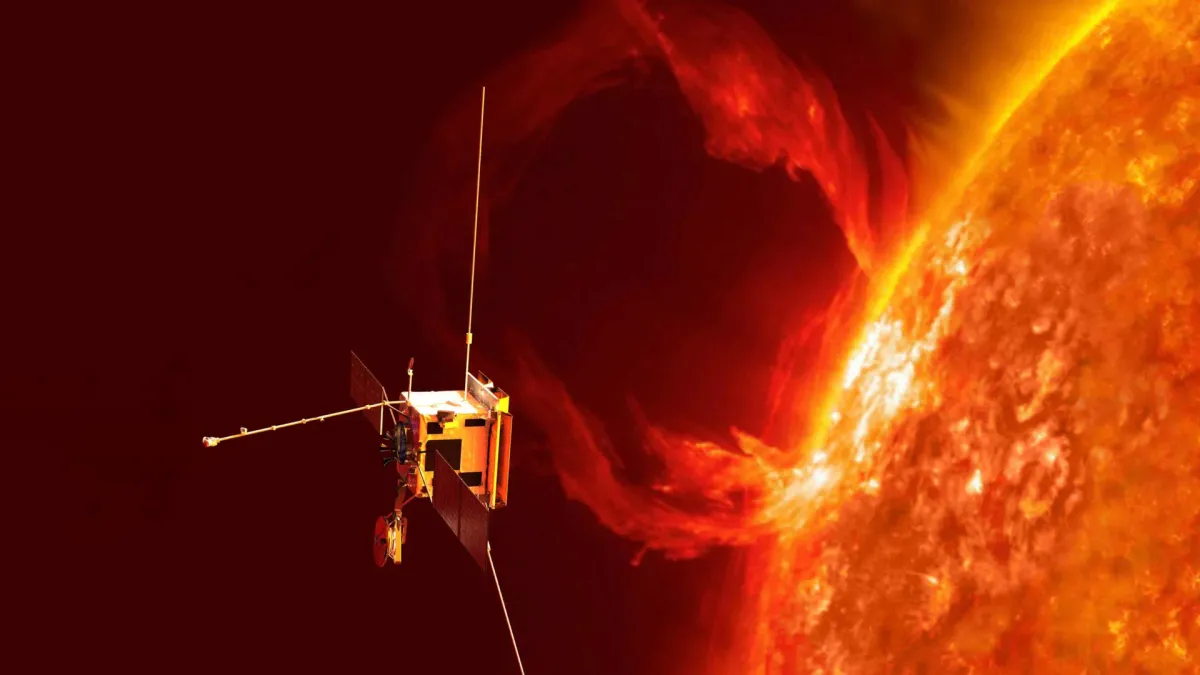
The culprit was a solar region called NOAA 13664 — one of the most intense patches of solar activity in the past twenty years. What made it possible to study so thoroughly was the European Space Agency's Solar Orbiter, launched in 2020, which orbits the Sun every six months and can see the far side that Earth-based telescopes miss. "This broadened our perspective significantly," says Ioannis Kontogiannis, a solar physicist at ETH Zurich.
By combining data from Solar Orbiter with continuous observations from NASA's Solar Dynamics Observatory (which watches the Sun-facing side from Earth's vantage point), researchers created something unprecedented: 94 consecutive days of uninterrupted images of a single active solar region. "It's the longest continuous series of images ever created for a single active region," Kontogiannis says. "It's a milestone in solar physics."
We're a new kind of news feed.
Regular news is designed to drain you. We're a non-profit built to restore you. Every story we publish is scored for impact, progress, and hope.
Start Your News DetoxFor the first time, they followed the same solar region through three complete rotations, watching as its magnetic structure grew increasingly tangled and complex. That buildup peaked on May 20, 2024, with the most powerful solar flare in two decades — erupting on the far side of the Sun where no Earth-based observatory could see it directly.
What This Storm Actually Broke
Auroras are the visible part of the story. The real damage happens to infrastructure we depend on daily. In May 2024, NOAA 13664's storms disrupted satellite signals used in modern agriculture. Farmers lost working days as GPS signals from satellites, drones, and ground sensors went offline. Crop failures followed, with significant economic losses. Railway signaling systems malfunctioned — signals switched from red to green unpredictably. "That's really scary," says Louise Harra, professor at ETH Zurich and director of the Davos Physical Meteorological Observatory.
Satellites themselves are vulnerable too. In February 2022, heightened solar activity destroyed 38 of 49 newly launched Starlink satellites within two days of deployment. Power grids, communication networks, and aircraft crew radiation exposure all face risks during severe space weather events.
Predicting the Unpredictable
Active regions like NOAA 13664 form when magnetized plasma rises from the Sun's interior and breaks through the surface. When these magnetic fields tangle and destabilize, they release energy violently — producing solar flares and hurling massive amounts of plasma across the solar system.
The challenge is prediction. Scientists can now recognize when a region has stored enormous energy in its complex magnetic structure. "When we see a region with an extremely complex magnetic field, we can assume there's a large amount of energy that will be released as solar storms," Harra explains. But they still can't pinpoint exactly when eruptions will happen, or whether a region will produce one catastrophic event or several smaller ones.
That's changing. The ESA is developing a new space probe called Vigil, dedicated exclusively to improving space weather forecasting. It's scheduled to launch in 2031. Better predictions could protect satellites, power systems, and the technologies modern life depends on — from agriculture to air traffic control.
For now, this 94-day observation of NOAA 13664 gives scientists their clearest map yet of how extreme solar regions evolve. "We live with this star," Kontogiannis says. "It's really important we observe it and understand how it works and how it affects our environment."