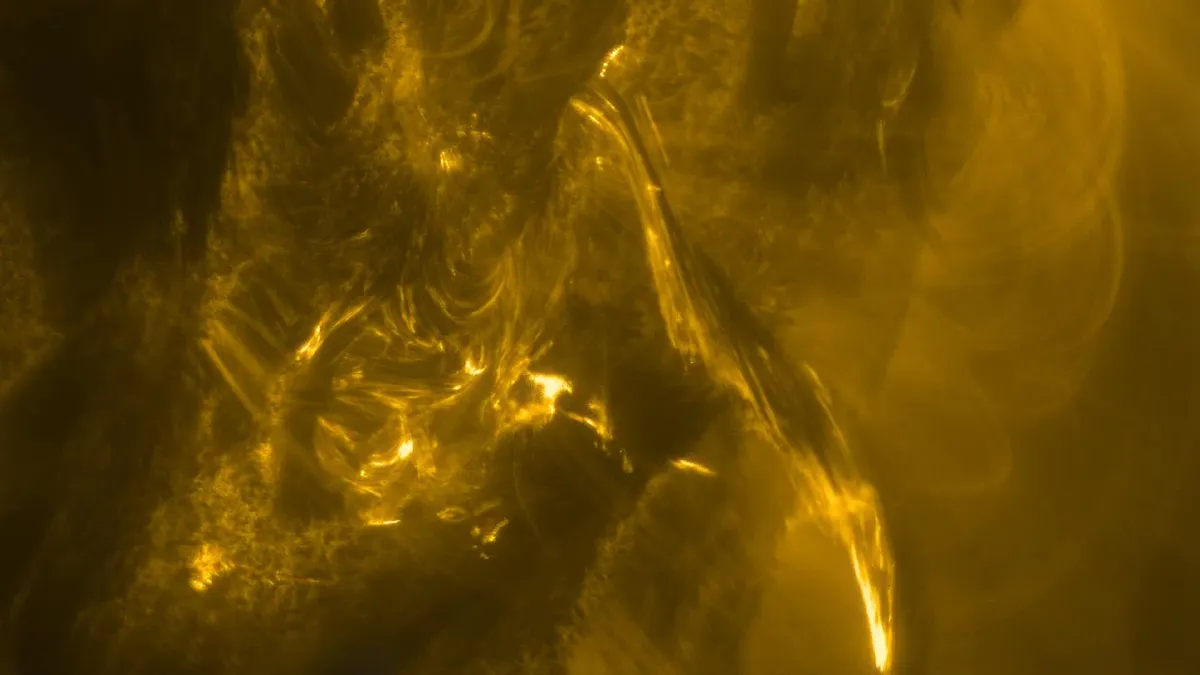
For decades, scientists knew that solar flares—among the most violent explosions in our solar system—happened when twisted magnetic fields suddenly snapped and released. What they didn't see was how it all started. Now, the Solar Orbiter spacecraft has captured the clearest footage yet of a solar flare being born, and it looks less like a single explosion and more like a cascade of dominoes.
The spacecraft watched as small magnetic disturbances began multiplying rapidly across the Sun's outer atmosphere, each one triggering the next in a chain reaction. Miho Janvier, ESA's Solar Orbiter co-Project Scientist, calls it "one of the most exciting results from Solar Orbiter so far." What they were witnessing was what researchers call a "magnetic avalanche"—the central engine of a flare itself.
How the Avalanche Builds
The Sun's corona—its outer atmosphere—is threaded with magnetic field lines. Normally, these lines exist in a kind of balance. But when enough twisted magnetic strands pile up in one region, the whole system becomes unstable. That's when the avalanche begins. Magnetic field lines pointing in opposite directions start breaking apart and reconnecting in new configurations, a process called magnetic reconnection. One reconnection triggers the next, and the next, each one stronger than the last.
We're a new kind of news feed.
Regular news is designed to drain you. We're a non-profit built to restore you. Every story we publish is scored for impact, progress, and hope.
Start Your News DetoxSolar Orbiter's instruments captured this buildup in remarkable detail. The spacecraft resolved features only a few hundred kilometers across and recorded changes every two seconds—precise enough to watch the avalanche gather momentum over roughly 40 minutes before the main flare erupted. Each burst of brightness marked another cascade in the chain reaction.
What makes this observation significant is what it reveals about flare structure. A major solar explosion doesn't have to be one unified event. Instead, it emerges from many smaller reconnection events that interact and build on one another, amplifying in power. It's the difference between a single landslide and a series of smaller slides that trigger one another down a mountainside.
The Aftermath: Plasma Rain
When the flare finally peaked, particles accelerated to 40 to 50 percent of the speed of light. X-ray and ultraviolet emissions surged dramatically. But perhaps most striking was what happened after: streams of glowing plasma blobs continued raining through the Sun's atmosphere long after the flare itself had subsided. These weren't stragglers. They were the visible signature of energy being transferred directly from the magnetic fields into the surrounding plasma—a process that kept feeding the explosion even as the initial cascade was winding down.
This understanding matters because solar flares send radiation and energized particles toward Earth. The more we understand about how they ignite and evolve, the better we can predict and prepare for the ones that might disrupt satellites, power grids, or communications. Solar Orbiter's magnetic avalanche footage is the kind of precise observation that turns "we know this happens" into "we understand how it works."