On July 2, 2025, NASA's Fermi telescope caught something that shouldn't exist: a gamma-ray burst that kept going. Most of these cosmic explosions—the most violent events in the universe short of the Big Bang itself—flash and vanish in seconds. This one, named GRB 250702B, didn't get the memo. It erupted repeatedly for more than seven hours straight, making it the longest gamma-ray burst ever recorded.
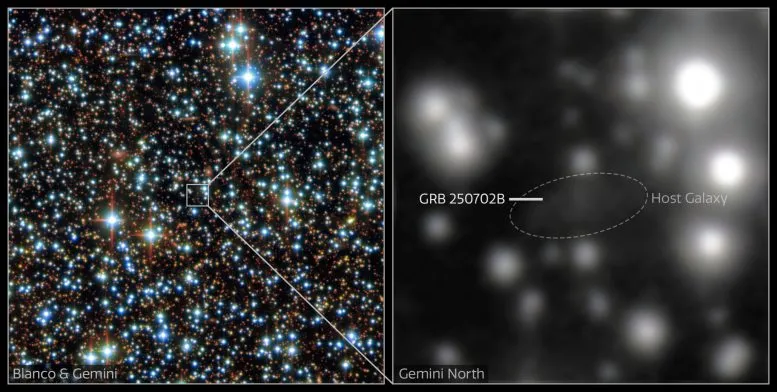 GRB 250702B Collage
When the initial signal lit up instruments around the world, astronomers scrambled. Within hours, researchers across the globe had trained some of Earth's most powerful telescopes on the fading afterglow—the gradually dimming light left behind after the main explosion. Jonathan Carney, a graduate student at the University of North Carolina at Chapel Hill, led a team that monitored the burst using three of the world's best ground-based observatories: the Víctor M. Blanco 4-meter telescope and the twin 8.1-meter Gemini telescopes. They tracked the afterglow from about 15 hours after the initial detection all the way to 18 days later.
What made this burst so strange
The puzzle started with visibility. GRB 250702B was completely hidden from normal telescopes—not just by dust in our own Milky Way, but by thick clouds of dust in its home galaxy, billions of light-years away. The Gemini North telescope needed nearly two hours of continuous observation just to catch a faint glimmer of the host galaxy beneath all that cosmic fog. That level of obscurity told the team something important: this burst happened in an unusually dense, dusty environment.
We're a new kind of news feed.
Regular news is designed to drain you. We're a non-profit built to restore you. Every story we publish is scored for impact, progress, and hope.
Start Your News DetoxThe data revealed that the initial explosion likely came from a relativistic jet—a narrow beam of material traveling at nearly the speed of light, crashing into surrounding gas and dust. But the host galaxy itself was massive compared to typical gamma-ray burst hosts, and the environment around the burst was extraordinarily dense. This combination is rare.
Three possibilities, one mystery
So what actually happened billions of light-years away? The research team has narrowed it down to three scenarios. The first: a black hole colliding with a star stripped down to nearly pure helium. The second: a star or brown dwarf torn apart during a close encounter with a stellar-mass black hole or neutron star—what scientists call a micro-tidal disruption event. The third, and most intriguing: a star being shredded as it falls into an intermediate-mass black hole, with the black hole firing off a relativistic jet in the process. If that last one is correct, this would be the first time humans have directly observed such a jet from an intermediate-mass black hole actively consuming a star.
More observations are coming, and they may eventually pin down the exact cause. For now, GRB 250702B remains a cosmic puzzle that rewrote what we thought possible—proof that the universe still has surprises waiting in the data.
Study Title - The Astrophysical Journal Letters, 2025