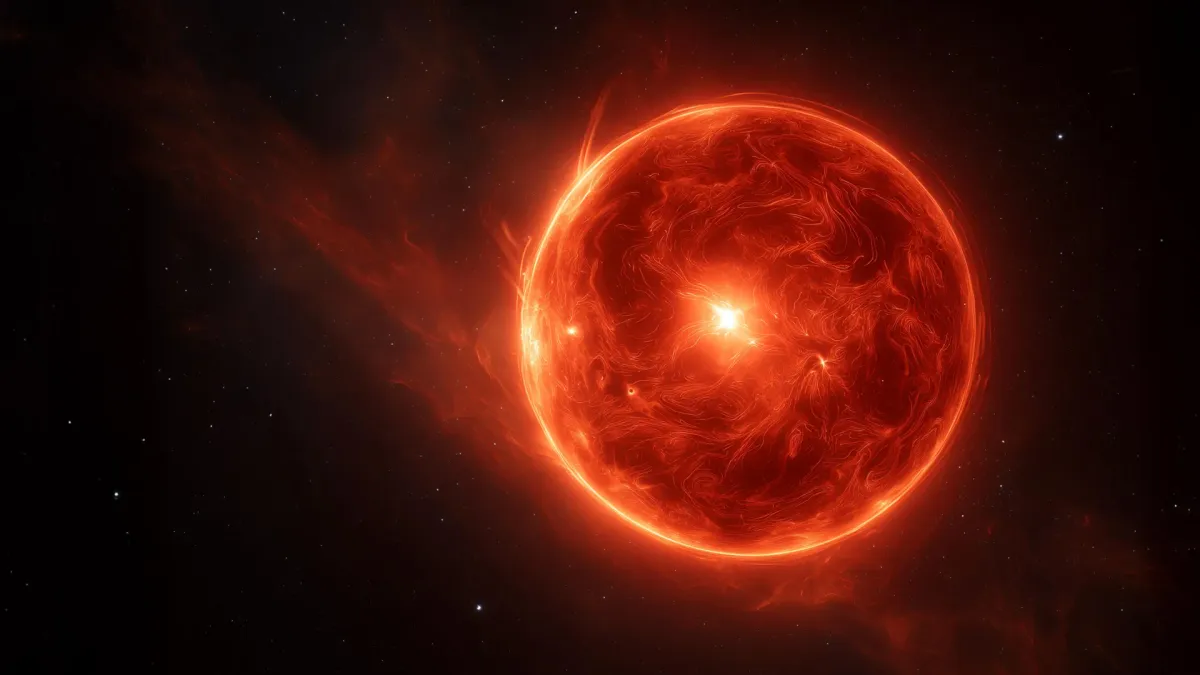
Astronomers have finally solved a decades-old puzzle about red giant stars. They discovered how material from deep inside these stars reaches their surface. Supercomputer simulations showed that stellar rotation plays a big role in mixing elements across a barrier inside the star.
For many years, scientists wondered why the chemical makeup at the surface of red giant stars changes as they evolve. Nuclear reactions in the core change the star's internal composition. However, a stable layer separates this core from the outer part of the star. How material crossed this barrier was a mystery.
Stellar Rotation Drives Element Mixing
The answer lies in how stars spin.
Simon Blouin, a lead researcher at the University of Victoria (UVic), explained that high-resolution 3D simulations helped identify how rotation impacts elements crossing this barrier. He noted that stellar rotation is crucial and explains the chemical changes seen in red giants. This discovery helps us understand how stars evolve.
We're a new kind of news feed.
Regular news is designed to drain you. We're a non-profit built to restore you. Every story we publish is scored for impact, progress, and hope.
Start Your News DetoxStars like our Sun become red giants when they run out of hydrogen in their cores. They can grow up to 100 times their original size. Since the 1970s, astronomers have noticed changes in their surface chemistry, like shifts in carbon-12 to carbon-13 ratios. These changes suggested that material from deep inside the star moved outward, but the exact way this happened was unknown.
Blouin explained that internal waves, created by churning motions, could pass through this barrier. However, earlier simulations showed these waves moved very little material. The new research found that the star's rotation greatly increases how effectively these waves mix material across the barrier. This mixing matches the observed changes in surface composition.
Blouin and his team found that rotation can boost mixing rates by over 100 times compared to non-rotating stars. Faster rotation leads to even stronger mixing. Since our Sun will become a red giant, these findings also offer clues about its future.
Advanced Simulations Reveal Hidden Processes
To uncover this process, the team used hydrodynamical simulations. These models show how material flows inside stars in three dimensions. These simulations are very complex and need powerful computing systems. Recent advances in supercomputing made this discovery possible.
Falk Herwig, the principal investigator and director of UVic's Astronomy Research Centre (ARC), noted that limited computing abilities previously prevented testing the rotation hypothesis. These new simulations allow scientists to find small effects and understand what truly happens.
The researchers used computing resources from the Texas Advanced Computing Centre and the Trillium supercomputing cluster at SciNet in Toronto. Trillium, launched in August 2025, is one of Canada's most powerful systems for large-scale academic simulations. Its enhanced processing power was key to this work.
Herwig stated that a new stellar mixing process was discovered thanks to the immense computing power of the Trillium machine. These are the most intensive stellar convection and internal gravity wave simulations done to date.
Broader Impact and Future Research
The methods used in this study have uses beyond astrophysics. The same computational approaches can help scientists understand fluid motion in other systems, such as ocean currents, atmospheric patterns, and blood flow. Herwig is working with researchers in these fields to create shared tools for large-scale simulations.
Blouin plans to continue studying how stellar rotation affects different types of stars. Future research will look at how varying rotation patterns influence mixing and if similar processes happen in other stages of a star's life.
Deep Dive & References:
Wave-driven mixing enhanced by rotation in red giant branch stars - Nature Astronomy, 2025