For a long time, shrinking photonic technologies has been tough. This is because of a basic physics rule: how tightly light can be squeezed depends on its wavelength. This wavelength is much larger than the electrons used in computer chips. This means photonic chips stay big, and optical imaging can't get super sharp.
Using metals to compress light, a method called plasmonics, seemed like a fix. But metals always lose energy as heat. This problem has slowed down progress for making efficient, small devices.
A New Way to Control Light
In 2024, a team led by Ren-Min Ma at Peking University in China made a big step forward. They created a new theory called the singular dispersion equation. This theory explains how light can be squeezed into tiny spaces using dielectric materials, which don't lose energy as heat. This breakthrough could lead to smaller, more energy-efficient photonic devices.
We're a new kind of news feed.
Regular news is designed to drain you. We're a non-profit built to restore you. Every story we publish is scored for impact, progress, and hope.
Start Your News DetoxLater, the researchers showed that this extreme squeezing of light is linked to something new: "narwhal-shaped wavefunctions." These special light patterns combine a strong, focused light boost with a wider, fading effect. This allows light to concentrate much more than ever before.
Testing the Idea
To prove their theory, the team built a 3D singular dielectric resonator. This device could squeeze light in all directions to a very small size. They used special measurements to see the narwhal-shaped wavefunctions directly. These measurements showed the light growing quickly near a central point and then fading out further away.
The results matched their predictions and computer simulations very closely. They achieved an incredibly small mode volume of 5 × 10⁻⁷ λ³.
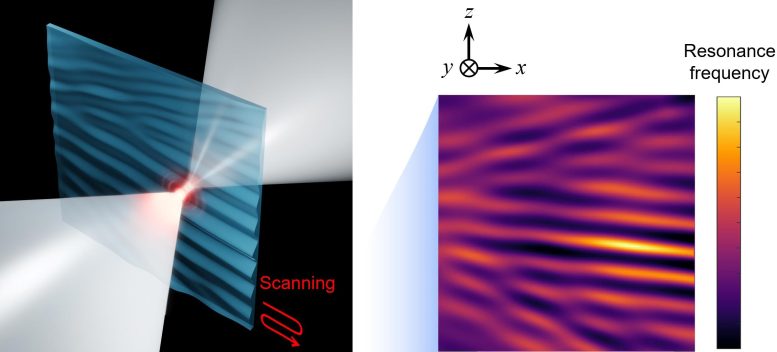
The team also used these focused wavefunctions to create a new imaging tool called the singular optical microscope. This microscope uses the tightly squeezed light fields to detect tiny details. It achieved a record resolution of λ/1000, allowing them to image very small patterns, like the letters "PKU" and "SFM."
This work shows that the singular dispersion equation creates these unique narwhal-shaped wavefunctions. These modes can confine light to extreme scales in materials that don't lose energy.
This research sets the stage for "singulonics," a new field in nanophotonics. It focuses on controlling light at very small scales without energy loss. This could lead to better information processing, new quantum optics technologies, and even sharper imaging.
Deep Dive & References
Singulonics: narwhal-shaped wavefunctions for sub-diffraction-limited nanophotonics and imaging - eLight, 2025